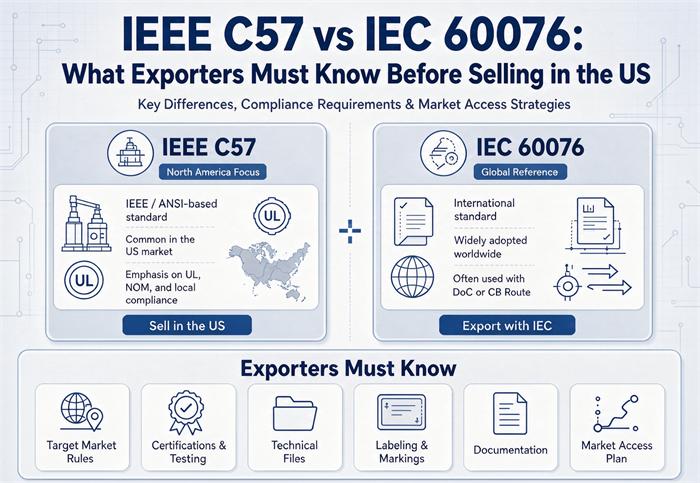
IEEE C57 is the standard family North America expects, and IEC 60076 is what most of the rest of the world runs on. To sell a transformer in the US, you need more than a unit that looks compliant on paper. You need UL or cUL listing from an NRTL, DOE 10 CFR 431 efficiency compliance, a 60 Hz native design, a US style nameplate, and test reports a US inspector will accept. This is the exporter checklist that turns a passed factory test into a cleared customs and commissioning job.
If you only need the standards side of the story, our IEC 60076 vs ANSI/IEEE comparison walks the clause by clause differences. This page is the action list for getting a unit accepted in the US market specifically.
The one line that decides acceptance
Your destination grid picks the standard family. IEC 60076 governs IEC grid markets across Europe, most of Asia, Africa, and the Middle East, and China adopts it as GB/T 1094. IEEE C57 governs the United States and Canada and is harmonized with NEMA. Neither family is “better.” Each is simply the convention the grid on the other end expects.
The trap is thinking that a unit built to one family can drop into the other. It usually cannot without rework, because the two families disagree on ambient basis, temperature rise, cooling letters, loss reference temperature, insulation level notation, and polarity reporting. A factory will build to either one the moment you name it, but you have to name it, and you have to name the edition.
What each standard family actually is
IEC 60076: the global baseline
IEC 60076 is a single series of numbered parts. The parts that matter for most power and distribution contracts are 60076-1 (general), 60076-2 (temperature rise), 60076-3 (insulation and dielectric tests), 60076-5 (short-circuit withstand), with 60076-7 (loading), 60076-10 (sound), 60076-11 (dry-type), and 60076-20 (efficiency and loss evaluation) filling in the rest. It is written around a 50 Hz grid and a yearly average ambient of 20 degrees C.
IEEE C57: the North American rulebook
IEEE C57 is a family of separately numbered standards rather than one tidy series. C57.12.00 sets the general requirements for liquid-immersed distribution, power, and regulating transformers. C57.12.90 holds the standard test code used for factory and type tests. C57.12.01 covers dry-type units. The family is written around a 60 Hz grid and an average ambient of 30 degrees C.
The five differences that bite exporters
These are the places where a perfectly good IEC unit fails a US review. The numbers below are the common values for liquid-immersed units; the exact figure depends on cooling type and the edition you cite, so confirm the edition with your engineer.
| Parameter | IEC 60076 | IEEE C57 |
|---|---|---|
| Yearly average ambient basis | 20 deg C | 30 deg C |
| Top oil temperature rise | 60 K | 65 K |
| Winding temperature rise | 65 K (ON cooling) | 65 K |
| Hotspot rise allowance | 78 K | 80 K |
| Loss reference temperature | 75 deg C | 55 deg C (liquid), 75 deg C (dry) |
| Cooling notation | ONAN, ONAF, OFAF | OA, FA, FOA |
| Insulation level | Rated lightning impulse Up | Basic Impulse Level (BIL) tables |
| Phase relationship | Clock hour notation | Additive or subtractive polarity |
A transformer designed for 50 Hz carries a different core flux density, no load loss, and magnetizing current than the same kVA built for 60 Hz. Do not assume the two are interchangeable. Confirm the nameplate frequency matches the local grid before anything else.
Why compliant on paper is not sellable in the US
The standard difference is only half the job. The US layers a set of market gates on top of IEEE C57, and these are what catch exporters who stop at the standards comparison.
UL or cUL listing from an NRTL
A US buyer expects a listing mark from a Nationally Recognized Testing Laboratory, most often UL (Underwriters Laboratories) or cUL for Canada. This is not the same as a CE mark. CE says the unit meets European directives; it does not let you sell in the US. For dry-type units, expect UL 1561 or UL 1562 depending on voltage. Ask the supplier for the actual UL file number and confirm the model is within the listed scope, because a listing that covers one frame size does not automatically cover another.
DOE 10 CFR 431 efficiency compliance
US distribution and power transformers must meet DOE 10 CFR 431 efficiency levels. The 2016 levels are current today, and the 2024 update takes effect on 2029-04-23. This is a legal floor, not a methodology. A unit that meets IEC 60076-20 loss evaluation does not automatically meet DOE, because the two use different loading assumptions and reference temperatures. Request separate guaranteed loss values and confirm they clear the applicable DOE table for your kVA and BIL.
NEC 450 and the local code edition
The National Electrical Code Article 450 sets installation rules for transformers, and local authorities adopt a specific edition. Overheating, clearances, and enclosure rules vary by edition and by state. Specify the code edition in your documentation so the installing electrician is not guessing.
Utility interconnection specifications
Most US utilities add their own requirements on top of IEEE and NEC. These often cover BIL, impedance tolerance, tap range, and metering. A unit that passes the national standards can still be rejected at the utility if the addenda are missing. Pull the utility’s specification before you freeze the design.
The 60 Hz trap
This is the single most expensive mistake exporters make. A 50 Hz transformer forced onto a 60 Hz grid does not just run warm. Core flux density, no load losses, and magnetizing current all shift with frequency, so the unit may miss its loss guarantees or regulate poorly. Always design the unit native to 60 Hz for a US order. If the same unit must also serve a 50 Hz market, that is a dual frequency project and should be engineered as one, not retrofitted after the fact.
Nameplate content the US inspector wants
IEEE C57.12.00 asks for more granular nameplate content than many IEC units carry. A US nameplate should show the standard and edition, the impedance and its tolerance, the BIL, the cooling designation, the tap settings, the temperature rise, the guaranteed losses at the reference temperature, and the sound level. Our nameplate guide shows where each of those values lives and why they matter at acceptance.
Test reports that clear US acceptance
Routine tests prove the unit was built correctly. Type tests prove the design family survives stress. For a US order, ask for both, and make sure the reports come from a lab a US authority will recognize. A marketing claim of “tested to IEEE” is not the same as stamped routine and type test reports that list the exact C57 part numbers and editions. Our routine testing write-up lists the tests a clean unit should pass before it ships.
Can one transformer serve both grids
At a stated frequency, yes. A dual compliant design starts from one core and geometry and is engineered to pass both test regimes, including the different loss reference temperatures and nameplate content. In documented projects this approach has cut effective lead time by around 30 percent, because one qualification serves multiple grids. The catch is that the test reports must cover every required regional requirement, not just one family. Ask for the actual dual reports rather than a brochure line.
Common exporter mistakes
- Shipping a 50 Hz unit to a 60 Hz grid and calling it close enough.
- Treating a CE mark as a US acceptance ticket when the buyer needs UL or cUL.
- Assuming IEC 60076-20 loss numbers satisfy DOE 10 CFR 431.
- Naming the standard family but not the edition, so the factory tests to the wrong year.
- Skipping the utility addenda and getting rejected at interconnection.
- Presenting test claims instead of stamped routine and type test reports.
Exporter’s pre shipment checklist
| Step | What to confirm |
|---|---|
| Standard and edition | Name the exact C57 part numbers and year |
| Frequency | Native 60 Hz for the US order |
| Listing | UL or cUL file number within model scope |
| Efficiency | DOE 10 CFR 431 guaranteed losses for kVA and BIL |
| Code edition | NEC 450 edition adopted by the authority |
| Utility addenda | BIL, impedance, tap range, metering |
| Nameplate | C57.12.00 granular content in US units |
| Tests | Stamped routine and type reports, NRTL recognized |
If you are weighing dry-type against oil-immersed for a US site, our dry vs oil guide covers the NEC and fire code angle, and the dry-type explainer goes deeper on UL and enclosure rules. Cooling notation differences are spelled out in the cooling classes guide. When you are ready to source, the distribution transformer buyers guide helps you shortlist US ready suppliers.
FAQ
What is the main difference between IEC 60076 and IEEE C57? IEC 60076 is the global standard series used on 50 Hz grids in Europe, Asia, Africa, and the Middle East, while IEEE C57 is the family used in the United States and Canada on 60 Hz grids. Your destination grid picks the family, and the two disagree on ambient basis, temperature rise, cooling letters, loss reference temperature, and insulation notation.
Can a transformer built to IEC 60076 be sold in the US? Not directly. A unit built to IEC 60076 still needs UL or cUL listing from an NRTL, DOE 10 CFR 431 efficiency compliance, a 60 Hz native design, a US style nameplate, and test reports a US inspector accepts. The IEC build is a starting point, not a finished US product.
What DOE compliance date should exporters track? The 2016 DOE 10 CFR 431 levels are current today, and the 2024 update takes effect on 2029-04-23. Exporters should confirm which table applies to their kVA and BIL and request guaranteed losses that clear it, because IEC 60076-20 loss evaluation uses different assumptions.
Does a 50 Hz transformer work on a 60 Hz US grid? No. Core flux density, no load losses, and magnetizing current all change with frequency, so a 50 Hz unit may miss its loss guarantees or regulate poorly on 60 Hz. Design the unit native to 60 Hz for a US order rather than rerating a 50 Hz frame.
What loss reference temperature applies to US DOE efficiency? DOE references 55 degrees C for liquid-filled transformers and 75 degrees C for dry-type units. IEC 60076 references 75 degrees C. Because the reference differs, a loss value that looks good under one standard can look different under the other, so compare at the same basis.
How do the ambient and temperature rise bases differ? IEC 60076 uses a 20 degrees C yearly average ambient and a 60 K top oil rise, while IEEE C57 uses a 30 degrees C average ambient and a 65 K top oil rise. Winding rise is 65 K under both for typical cooling, but the ambient basis alone shifts the design headroom.
How much can dual IEC plus IEEE compliance save on lead time? In documented projects, engineering one dual compliant design instead of two separate qualifications has cut effective lead time by around 30 percent, because a single type test package serves multiple grids. The saving depends on the project, so treat it as a planning estimate and confirm with the supplier.