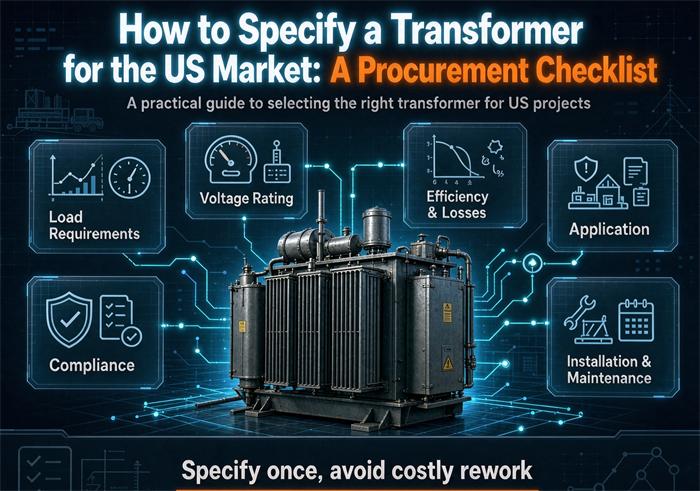
To specify a transformer for the US market, lock four things first: the ANSI/IEEE product standard and its edition, the DOE efficiency rule and its April 23, 2029 compliance date, the required UL or cUL listing, and your serving utility’s own specification. Miss any one and the unit can fail acceptance or get rejected at inspection, even when the price looks right.
This guide is written for electrical engineers, EPCs, procurement leads, and project managers who issue the RFQ and then have to defend the order when something comes back wrong. A transformer that meets a great price but fails the utility’s spec is not a bargain. It is a delay. The goal here is a field-by-field procurement checklist you can paste into a spec sheet, plus a worked example and the four mistakes that get units kicked back.
Why specifying for the US market is its own job
A transformer is not a global commodity with one rulebook. The same 1,000 kVA unit built to IEC 60076 for a project in Europe will not automatically walk through acceptance in the United States. The US market layers several independent requirements, and buyers who treat them as one line item on a quote are the ones who get surprised at the receiving inspection.
Four rulebooks that do not line up automatically
The first habit to build is treating these as four separate checks. Meeting one does not prove the others.
| Rulebook | What it sets | Who owns it |
|---|---|---|
| Product standard | Design, construction, test methods | ANSI/IEEE C57 series |
| Federal efficiency | Minimum energy losses, compliance date | DOE, 10 CFR 431 |
| Listing or certification | Third-party safety acceptance | UL, CSA, ETL (NRTL) |
| Utility and project spec | Local voltage, BIL, drawings, addenda | Serving utility, engineer |
A supplier can show you an IEEE test report and still ship a unit that misses the DOE loss limit or carries no UL listing. Ask for each one by name, for the exact model, with the edition and date attached.
You inherit the 60 Hz North American system
US projects run on 60 Hz, and the common voltages are different from IEC markets. Residential service is 120/240 V split-phase. Commercial and light industrial service is usually 208Y/120 V or 480Y/277 V. Medium voltage runs 4,160 V, 12,470 V, 13,200 V, and 34,500 V in many utility distributions. If your spec sheet was drawn for 50 Hz or for 230/400 V, the unit will need a different electromagnetic design, not a relabel. Confirm 60 Hz native design in writing before you ask for quotes.
The procurement checklist, field by field
Here is the checklist, broken into the eight blocks a complete US specification should cover. Fill every field, or mark it TBC with a reason, before the RFQ goes out.
1. Service and load profile
Start with what the transformer actually feeds. Capture the phase (single or three), the primary and secondary system voltages, the rated power in kVA, and the load power factor. Then describe the load shape: is it steady, motor-heavy, or rich in harmonics from VFDs, UPS systems, and switched-mode power supplies? Harmonic loads need a K-rated or specially designed unit, not a standard transformer that will run hot and fail early. State the K-rating you need, such as K-4, K-13, or K-20, and the referring standard, IEEE C57.110.
2. Transformer type and cooling
Pick the construction that the site and fire code allow. Dry-type units suit indoor commercial and institutional spaces where oil is restricted. Oil-immersed units suit outdoor, utility, and large MVA applications where cooling and first cost favor liquid. If you go dry, decide between ventilated (VPI) and cast-resin (encapsulated) for the environment. If you go oil, pick the cooling mode: ONAN, ONAF, or a combination. The dry versus oil guide walks the fire-code and cost trade-offs, and the cooling class explainer covers what ONAN and ONAF mean for your rating.
3. Product standard and edition
Name the exact IEEE standard and edition. A pad-mounted single-phase liquid unit falls under IEEE C57.12.38. A three-phase pad-mounted distribution unit falls under C57.12.34. Dry-type units reference C57.12.01. Substation power transformers reference C57.12.10. A unit outside the scope of the named standard needs a different technical basis, so write the number, not a vague phrase like “IEEE compliant.” The ANSI/IEEE versus IEC standard piece shows exactly where the two systems diverge so you can read a supplier’s claim correctly.
4. Federal efficiency rule
US federal law sets minimum efficiency for distribution transformers through DOE 10 CFR 431. The current standards took effect in 2016 and replaced the older NEMA TP-1 basis. The amended standards adopted in 2024 carry an April 23, 2029 compliance date. Do not accept “DOE compliant” as a finish line. Ask which rule and which compliance date apply to the model you are buying, and require the guaranteed no-load and load-loss values in writing. A unit that meets 2016 but is being quoted for a 2029 project needs that gap stated, not hidden.
5. Listing and certification
Most US grid-connected and building distribution units need a full UL or cUL listing, or another Nationally Recognized Testing Laboratory mark such as CSA or ETL. The key word is full and model-specific. A component certificate or a logo on a brochure does not prove the exact unit you receive is listed. Request the listing file number and the model scope, then verify it against the NRTL database. State the required mark in the RFQ: UL 1561 for dry-type up to 600 V, UL 1562 for dry-type from 601 V to 35 kV, and the relevant listing for liquid-filled construction.
6. Electrical design data
This is where US acceptance is won or lost. Specify the basic impulse level (BIL), the impedance (Z percent), the tap range and steps, the vector group, and the grounding scheme. Typical distribution taps are plus or minus 2 steps of 2.5 percent on the primary. Common vector groups are Dyn11 for delta-wye with the low side referenced, or YNd for the reverse. The nameplate guide shows where each of these values lives on the plate and why they matter at inspection. Leave none of them blank on a US order.
7. Installation, drawings, and documents
Attach the single-line diagram, the layout, and the utility’s specification to the RFQ. Define the enclosure type, such as NEMA 1 indoor, NEMA 3R outdoor, or NEMA 4X for corrosive sites. Require the routine test report, the type test report where applicable, the nameplate data, the wiring diagram, and the operation and maintenance manual. State the spare parts policy and any special paint, label, or SCADA metering requirement. The routine testing write-up lists the tests a clean unit should pass before it ships, so a low price does not hide a unit that fails acceptance.
8. Commercial terms and RFQ validity
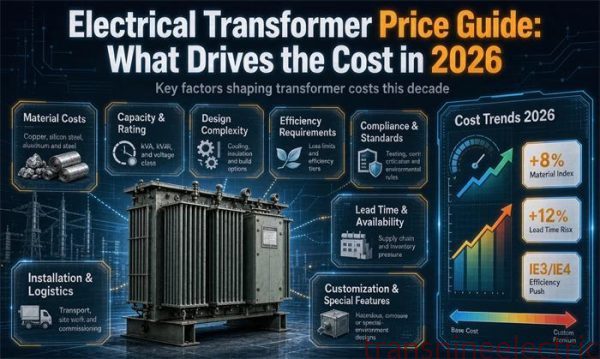
Close the RFQ with the things that protect your budget. State the quantity, the Incoterm and named place, the required delivery date, and the quote validity window. Transformer quotes move with copper and silicon-steel prices, so a 60 or 90 day validity is realistic and a 180 day quote is a risk. Confirm the lead time in writing and tie it to a late-delivery clause. A spec that nails the technical detail but leaves the commercial terms open is still an open check.
A worked example: 1,000 kVA dry-type for a commercial building
A filled spec reads very differently from a blank template. Here is how a real US commercial order should look.
| Field | Value to specify |
|---|---|
| Application | Commercial building service, indoor electrical room |
| Rated power | 1,000 kVA |
| Primary voltage | 480 V, delta |
| Secondary voltage | 208Y/120 V |
| Phase and frequency | Three-phase, 60 Hz |
| Type | Ventilated dry-type (VPI) |
| Enclosure | NEMA 1 |
| Product standard | IEEE C57.12.01 (with edition) |
| Efficiency | DOE 2016 compliant, guaranteed losses stated |
| Listing | UL 1561 listed, file number verified |
| K-rating | K-13 (harmonic-rich commercial load) |
| Impedance | 5.75 percent |
| Taps | Plus or minus 2 steps of 2.5 percent on primary |
| BIL | 10 kV (low-voltage class) |
| Cooling | AN (natural air) |
| Documents | Routine test report, UL certificate, nameplate, O&M manual |
With those fields locked, a supplier returns a comparable quote instead of a number you have to decode. The differences that remain are real: build quality, lead time, warranty, and the loss values that drive your energy cost over the unit’s life.
The four mistakes that get units rejected
These are the errors seen most often in US acceptances. Each one is avoidable with the checklist above.
“DOE compliant” with no rule named
A generic efficiency claim tells you nothing. The 2016 rule and the 2029 amended rule are different, and the guaranteed losses are what you actually pay for in energy. Require the rule, the date, and the loss numbers.
A cert logo that does not cover the model
A UL mark shown for one design does not cover a different kVA, cooling, or enclosure. Verify the exact model against the listing file before you order, not after the container arrives.
Skipping the utility addenda
Utilities often prescribe BIL, loss evaluation, connector type, protection, paint, test reports, and even approved vendors. A unit that meets the national standard can still fail the local one. Attach the utility spec to every RFQ.
Forgetting lead time and quote validity
2026 lead times are long. Distribution units often run 30 to 52 weeks, and large power transformers can run 75 to 110 weeks by capacity. A quote valid for 30 days on a 40 week item is a trap. Lock the lead time, the validity window, and a late-penalty term together.
2026 reality: lead times, content rules, and sourcing
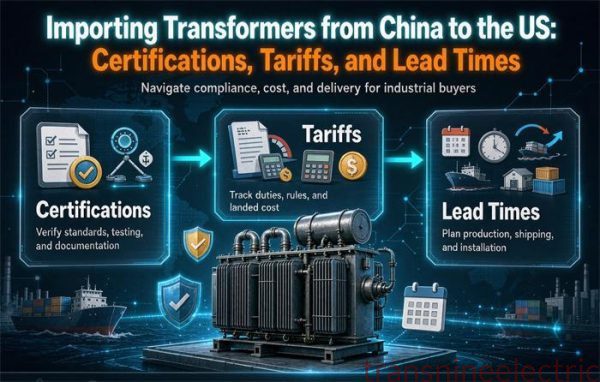
Two non-technical fields now shape US specifications. First, federal, state, and some utility projects carry Buy America or BABA domestic-content requirements under 2 CFR 184 and FAR 52.225-1, which change whether a non-US-built unit is even eligible. Second, imported units from certain origins face tariff stacking that moves total landed cost well past a domestic quote. If your project touches either, state the content requirement and the country of origin up front, and weigh the sourcing options carefully. The US and China manufacturer options guide and the distribution transformer buyers guide cover the trade-offs in more detail.
FAQ
What standard does a transformer for the US market need? US units are built to the ANSI/IEEE C57 series, with the exact number set by type: C57.12.38 for pad-mounted single-phase liquid, C57.12.34 for three-phase pad-mounted, C57.12.01 for dry-type, and C57.12.10 for substation power transformers. Name the standard and edition in the RFQ rather than a vague “IEEE compliant.”
Does meeting an IEEE standard prove DOE compliance? No. The product standard and the federal efficiency rule are separate checks. IEEE C57 sets design and test methods, while DOE 10 CFR 431 sets minimum losses and a compliance date, currently April 23, 2029 for the amended rule. Request the applicable DOE rule and the guaranteed loss values for the exact model.
What listing do I need, UL or ETL? Most US grid-connected and building units need a full UL or cUL listing, or another NRTL mark such as CSA or ETL. The deciding factor is that the exact model is listed, not which mark. Ask for the listing file number and verify it against the NRTL database before ordering.
What kVA, voltage, and impedance should I specify? Specify the rated power from your load study, the primary and secondary system voltages from the service, and the impedance from the utility or engineer, commonly 5.75 percent for many distribution units. State the frequency as 60 Hz and the phase clearly, and confirm tap range, usually plus or minus 2 steps of 2.5 percent.
What is a K-rated transformer and when do I need one? A K-rated transformer is built to withstand extra heating from harmonic currents produced by VFDs, UPS systems, and switched-mode loads, per IEEE C57.110. Specify K-4, K-13, or K-20 when the load is harmonic-rich, or a standard unit will run hot and fail early.
What documents prove a compliant US transformer? Expect a routine test report, type test report where applicable, the UL or NRTL listing certificate with model scope, the nameplate data, wiring diagram, and O&M manual. Clean paperwork clears acceptance in days, while missing certs stall a project for months.
How long is the lead time for a US transformer in 2026? Distribution units often run 30 to 52 weeks, and large power transformers can run 75 to 110 weeks by manufacturer capacity as of 2026. Lock the lead time, the quote validity window, and a late-delivery clause together, because long lead times make a short quote validity a real risk.
Bottom line
Specifying a transformer for the US market is four jobs, not one: name the ANSI/IEEE product standard and edition, pin the DOE efficiency rule and its 2029 date, require a full UL or cUL listing for the exact model, and attach your utility’s spec. Fill the eight checklist blocks before the RFQ goes out, demand the guaranteed loss values and the test reports, and lock the lead time with the quote validity. Buyers who do this compare real offers instead of guesses, and they avoid the rejections that turn a good price into a late project. If you want a spec reviewed against US standards before you issue the order, the team at TransNorth Electric can walk the standard, efficiency, and listing fields with you.