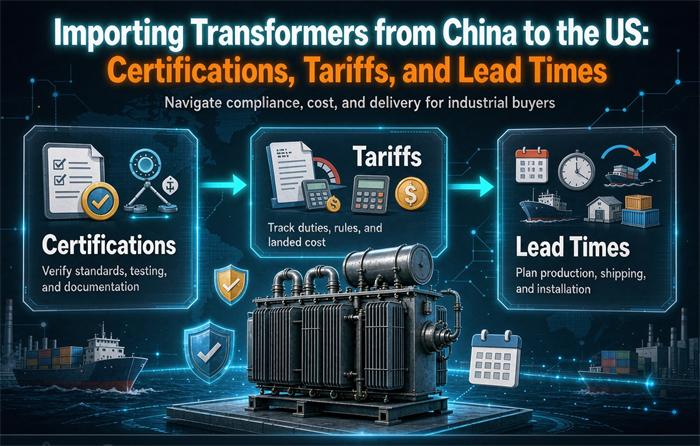
Importing a transformer from China to the US in 2026 comes down to three moving parts: the right certifications (UL or cUL listing plus DOE 2016 efficiency for grid units), the tariffs (a 1.6 percent base duty plus 25 percent Section 301 and metal-content Section 232 duties), and lead times of 8 to 32 plus weeks for production and another 15 to 55 days in transit. Here is how a buyer plans around all three.
Buying a transformer built in China and landing it in a US facility looks simple on a quote sheet. The unit price is attractive. Then the real questions show up. Will it clear US customs and pass local inspection? How much tariff stacks on top? When will it actually arrive? This guide walks through the three things that decide whether the deal works: certifications, tariffs, and lead times. It is written for electrical engineers, procurement leads, and project managers who need a practical plan, not a slogan. For the technical side of sizing and specs, the complete buying guide covers the details.
Certifications you need to clear US entry
A transformer does not enter the US market on its test report alone. US acceptance rests on a short list of marks and standards, and the order matters.
UL or cUL listing is the gate, not a component certificate
For most distribution and power transformers that connect to the grid or a building system, a full UL listing (UL 5085, UL 1561, or UL 1562) or the Canadian-equivalent cUL (CSA C22.2) mark is what customs brokers, AHJs (authorities having jurisdiction), and EPCs actually accept. A component-level certificate, such as an insulated-system recognition, does not substitute for a full unit listing. Several importers have learned this the hard way: a container gets held because the paperwork shows a partial cert, not a listed unit.
The listing process is not fast. Industry reporting in 2026 places a complete UL path at roughly 6 to 12 months, with some sources now citing 10 to 12 months once factory follow-up audits are scheduled. Budget both the calendar and the fee. Chinese manufacturers who already hold active UL file numbers can shave months off your project because the model is pre-listed rather than starting from scratch.
DOE 2016 efficiency, and the 2029 update coming behind it
Any liquid-immersed or dry-type distribution transformer shipped into the US must meet the DOE 2016 efficiency levels under 10 CFR Part 431. These are federal floors tied to kVA and BIL, and they apply regardless of where the unit was built. A unit that misses the table is a non-starter, even with a clean UL mark. If you want the guaranteed loss numbers that prove compliance, the nameplate guide shows where those values live on the plate and why they matter for your energy budget.
Behind DOE 2016 sits a tighter rule with a compliance date of April 23, 2029. Specifying to the 2029 levels now is a smart hedge for assets with a 20 to 30 year life, because a 2027 purchase could face early obsolescence risk on federally funded or efficiency-conscious projects.
IEEE, ANSI, and IEC: what US acceptance really requires
Chinese factories routinely build to IEC 60076, and that standard produces solid units. But IEC alone does not grant US market acceptance for grid-connected equipment. US buyers expect ANSI/IEEE C57 design practice, 60 Hz electromagnetic design (not a relabeled 50 Hz machine), and the insulation system recognized under the US listing. A 50 Hz unit pushed through a 60 Hz system fails on temperature rise and voltage deviation, and the listing will not survive inspection. The standard comparison piece lays out exactly where IEC and ANSI/IEEE diverge so you can read a supplier’s claim correctly.
NRTL marks and field evaluation
UL is the best-known, but any NRTL (Nationally Recognized Testing Laboratory) mark satisfies the same role. If a unit arrives without a listing, a field evaluation by an NRTL can sometimes close the gap, but that is a retrofit cost and a schedule hit you do not want on a critical path. Ask for the listing up front.
Tariffs and duties in 2026
This is where the attractive ex-works price gets tested. Three layers can stack, and a buyer who quotes only the base rate is missing most of the story.
The base MFN duty sits on HTS 8504
Most transformers classify under HTS 8504. The base Most-Favored-Nation duty is modest: around 1.6 percent for liquid units above 10,000 kVA and for dry-type units in the 16 kVA to 500 kVA and above 500 kVA bands, and about 2.4 percent for the 1 kVA to 16 kVA band, based on published 2026 freight and customs guides. That base rate is the easy part.
Section 301 adds 25 percent on Chinese origin
Chinese-origin electrical equipment has carried Section 301 additional duties for years, and 2026 guides still report a 25 percent layer on top of the base. This applies to the entered value, so it is the single largest tariff line for most units. It is also the line your broker will confirm first.
Section 232 metal-content duty is the 2026 change to watch
A newer layer is the Section 232 duty on the metal content of transformers. As reported in 2026 trade coverage, this took effect April 6, 2026 at a 25 percent rate on the steel and copper content, with the largest units (above 10,000 kVA) deferred to December 31, 2027. Because it sits on metal content rather than full value, its dollar impact is smaller than Section 301, but on a copper-and-steel-heavy unit it is still real money. Confirm the exact classification and stacking order with a licensed broker before you sign, because trade policy shifted several times in this window.
Buy America and BABA on federal jobs
If the project touches federal funds, the math changes again. BABA (2 CFR 184) asks for 55 percent domestic content on manufactured goods and 100 percent US-processed steel. The older BAA (FAR 52.225-1) heads toward a 75 percent threshold by 2029. A China-origin unit usually cannot satisfy these on its own, so federal and many state-funded jobs steer toward domestic or qualifying-content builds. Private and commercial projects are where China sourcing stays competitive.
A worked landed-cost example
Numbers make the stacking real. The table below is illustrative, built on a 1,000 kVA dry-type unit quoted at $45,000 ex-works China, using 2026 reported rates. Treat it as a planning model, not a quotation.
| Cost line | Basis | Illustrative amount |
|---|---|---|
| Ex-works unit | Supplier quote | $45,000 |
| Ocean freight and marine insurance (CIF) | 0.3 to 0.8 percent insurance plus freight | $3,500 |
| Base MFN duty | 1.6 percent of CIF (~$48,500) | $776 |
| Section 301 | 25 percent of entered value | $12,125 |
| Section 232 (metal content) | 25 percent of ~40 percent metal value | $4,850 |
| US inland trucking and handling | Port to site | $1,500 |
| Landed total | $67,751 |
A $45,000 unit lands near $68,000, roughly 50 percent over ex-works. The tariff lines, not the freight, drive most of that gap. The routine testing write-up explains which test reports you should see before the unit ships, so a “bargain” does not hide a unit that fails acceptance.
Lead times: production, transit, and clearance
Lead time is the quiet killer of transformer projects. The factory clock and the ocean clock run at different speeds, and the cert clock can run longer than both.
Factory production windows by supplier tier
Production lead time depends on who builds it. 2026 market reporting splits suppliers into tiers:
- Premium Western builders (ABB, Siemens Energy, Hitachi, GE Vernova): 18 to 32 months for power units.
- US-based builders (Prolec GE, Virginia Transformer, WEG): 12 to 24 months.
- Volume Chinese exporters: 8 to 14 months for standard specs, sometimes faster on catalog models.
- IEC-certified exporters serving international jobs: 6 to 12 months.
A standard distribution transformer from an established Chinese line can be 8 to 16 weeks, while a custom power unit runs far longer. The point is simple: the cheap price buys you a wait, and that wait has to fit your project schedule.
Ocean transit: West coast versus East coast
Once built, transit depends on the destination. 2026 shipping guides place door-to-door timing at roughly 15 to 30 days to the US West Coast (Los Angeles, Long Beach, Seattle) and 30 to 55 days to the East Coast (New York, Savannah, Miami), with many East Coast routes routing through the Panama Canal. Port-to-port is faster, but door-to-door is the number that matters for site planning. Air freight exists for spares and small control units, not full-size power transformers.
Customs clearance and the certification clock
Clearance itself is days, not weeks, if the paperwork is clean: commercial invoice, packing list, bill of lading, certificate of origin, factory test reports, and for oil-filled units a dangerous goods declaration and MSDS. The slow part is the certification clock that must finish before shipment, not the clearance after it. An unlisted unit can sit in a US warehouse for months while the listing is pursued.
Build your own import calendar
A realistic buyer calendar stacks like this: cert pursuit (0 to 12 months, ideally done before order), production (8 to 32 plus weeks), ocean transit (15 to 55 days), clearance and inland (1 to 3 weeks). For a custom unit with certs still pending, total door-to-door of 5 to 7 months is normal, and 12 plus months is common at the premium tier. Plan the transformer order before you plan the building, not after.
How to verify a supplier’s claims
Cheap quotes collapse when the claims do not hold up. Four checks separate real offers from come-ons.
Ask for the actual UL file number
A serious Chinese manufacturer will hand you a UL or cUL file number you can verify on the NRTL database. A vague “we are UL certified” with no file number is a red flag. Verify the model you are buying is the one listed, not a cousin.
Request type and routine test reports
Ask for the type test report (short-circuit, temperature rise, impulse) and the routine test report for your exact unit. A general certificate is not evidence. The testing guide lists the routine tests a clean unit should pass before it ships, and those reports are your acceptance evidence at the site.
Confirm 60 Hz design, not a relabeled 50 Hz unit
Require written confirmation the electromagnetic design is 60 Hz native. A 50 Hz machine relabeled for 60 Hz will fail temperature rise and voltage checks under a real listing. This single detail has sunk more imports than any tariff.
Check the HS code and the cert match before you pay
Lock the HTS 8504 sub-code with your broker before the unit leaves China, and confirm the certification matches the destination state’s AHJ expectations. A mismatch here is cheaper to fix on paper than at a US port.
When China sourcing makes sense, and when it does not
Not every project should chase the lowest ex-works price. A short matrix keeps the decision honest.
| Choose China-origin when | Choose US or domestic when |
|---|---|
| Private or commercial project, no federal content rule | Federal, state, or utility job with Buy America or BABA clauses |
| Standard spec, verified UL/cUL and DOE compliance | Urgent lead time under 12 weeks |
| Long project horizon absorbs 8 to 32 plus week lead time | You need fast local service, warranty, or spare parts |
| Tariff math still beats domestic total landed cost | Tariff stacking pushes total cost past a domestic quote |
The tie-breaker is almost always total landed cost plus schedule risk, not the unit price on page one of the quote. If your project is built around a China supply chain, the China manufacturer guide goes deeper on vetting steps.
A practical import checklist
Use this before you issue a purchase order:
- Confirm the project is private or commercial (not federal Buy America).
- Get the supplier’s UL or cUL file number and verify it for your model.
- Confirm 60 Hz native electromagnetic design in writing.
- Require DOE 2016 compliance and ask for the guaranteed loss values.
- Request type and routine test reports for the exact unit.
- Lock the HTS 8504 sub-code with a licensed broker.
- Model landed cost with base duty, Section 301, and Section 232.
- Build an import calendar: cert, production, transit, clearance.
- Plan ocean versus air and West versus East coast transit.
- Keep a contingency for policy shifts confirmed at order time.
FAQ
Do I need a UL listing to import a Chinese transformer into the US? Yes for most grid-connected and building distribution units. US acceptance rests on a full UL or cUL listing (or another NRTL mark), not a component certificate. Partial certs can get a container held at the port, so verify the exact model is listed before you order.
What tariff rate applies to transformers imported from China in 2026? Three layers commonly stack: a base MFN duty of about 1.6 to 2.4 percent on HTS 8504, a 25 percent Section 301 additional duty on Chinese origin, and a 25 percent Section 232 duty on the metal content that took effect April 6, 2026. Confirm the exact rates and stacking with a licensed customs broker.
How long does it take to import a transformer from China to the US? Plan for production of 8 to 32 plus weeks by supplier tier, plus 15 to 55 days of ocean transit, plus 1 to 3 weeks of clearance and inland delivery. A custom unit with certs still pending often runs 5 to 7 months door-to-door, and 12 plus months at the premium tier.
Can I import an IEC-certified transformer into the US? IEC 60076 builds are common from Chinese factories and help customs and insurers trust the unit, but IEC alone does not grant US grid acceptance. US projects expect ANSI/IEEE C57 design, 60 Hz native design, and a UL or NRTL listing. IEC reports support the file; they do not replace the listing.
What documents do I need for US customs clearance? The standard set is a commercial invoice, packing list, bill of lading, certificate of origin, and factory test reports. For oil-filled units, the paperwork also includes a dangerous goods declaration and an MSDS. Clean paperwork clears in days; missing certs stall for months.
Is there a ban on Chinese transformers in the US? No blanket ban existed as of mid-2026. The effect comes through tariffs, including Section 301 and Section 232 duties, plus Buy America preferences on federal work. The result is higher cost and redirected demand, not a prohibition, so the units are still importable with the right certs and landed-cost math.
How do I verify a Chinese supplier’s certification claims? Ask for the actual UL or cUL file number and check it on the NRTL database for your model. Request the type and routine test reports for the exact unit, confirm 60 Hz native design in writing, and lock the HTS code with your broker before shipment. A vague cert claim with no file number is a red flag.
> Cite this article > TransNorth Electric. “Importing Transformers from China to the US: Certifications, Tariffs, and Lead Times.” Resources, TransNorth Electric, last updated October 28, 2026. https://www.transninelectric.com/resources/importing-transformers-china-to-us-2026/
Bottom line
Importing a transformer from China to the US in 2026 is a certification, tariff, and schedule problem more than a price problem. Get the UL or cUL listing and DOE 2016 compliance locked before you order, model the full landed cost with Section 301 and Section 232 on top of the base duty, and plan the calendar around production lead time plus ocean transit rather than hoping it arrives. The buyers who avoid surprises verify the cert file number, read the test reports, and confirm the 60 Hz design up front. If your project needs a verified, listed unit spec’d to US standards, the team at TransNorth Electric can walk the cert and landed-cost math with you before you commit a budget.