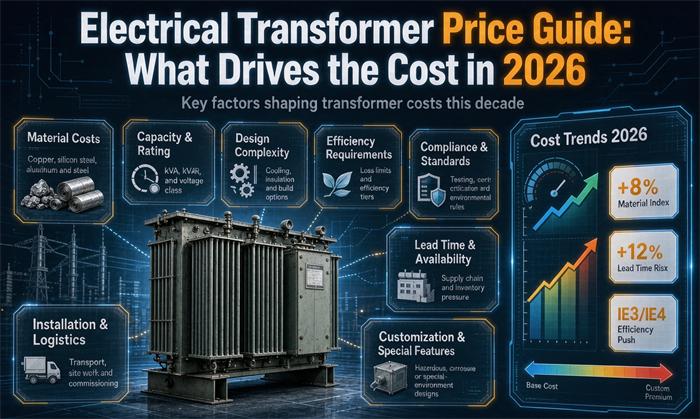
Transformer prices in 2026 are driven by five things: rated capacity (kVA or MVA), voltage class, dry-type versus oil-filled construction, the winding metal, and 2026-specific shocks like copper and silicon-steel volatility, U.S. Section 232 tariffs, and 75 to 110 week lead times on large units. A small single-phase unit starts near $2,000, while a utility-scale power transformer exceeds $5 million.
This guide is written for North American and European buyers, EPCs, and specifiers who need to build a budget, not just collect a number. You will learn what moves the quote, why two suppliers can land 3x to 5x apart on the same kVA, what the 2026 market is doing to prices, and how to write an RFQ that brings back a real number instead of a placeholder.
The Cost Drivers at a Glance
If you remember nothing else, remember these five. They account for most of the spread you see between quotes.
- Capacity (kVA or MVA). The single biggest lever. Double the rating and you roughly double the core, the coil, and the tank.
- Voltage class. Higher system voltage means more insulation, bigger bushings, and wider internal clearances.
- Dry-type versus oil-filled. Oil wins on first cost above 500 kVA. Dry-type wins where fire code and indoor siting rule.
- Winding metal. Copper costs more up front. Aluminum trims first cost but shifts cost into lifetime losses.
- 2026 shocks. Copper and silicon-steel swings, U.S. Section 232 tariffs, and long lead times are the new line items that were not in last year’s budget.
The Five Cost Drivers Every Quote Starts From
Every transformer quote is built from the same skeleton. Learn the skeleton and you can read any price sheet, including the ones that hide the soft costs.
Rated Capacity (kVA and MVA)
Capacity sets the size of the iron and the copper. A 75 kVA unit and a 2,500 kVA unit are different animals in steel, coil weight, tank, and test time. The jump is not linear. Small distribution units are commodity-priced, while each step toward 10 MVA and beyond adds design engineering, heavier lifting, and longer factory queues.
Read the rating off the nameplate before you compare anything. The kVA, the impedance, and the guaranteed losses on that plate are what actually price the unit. Two “1,000 kVA” offers are only comparable once you line up those numbers.
Voltage Class and What It Does to Insulation
A transformer built for 480 V lives in a different cost world from one built for 34.5 kV or 138 kV. Higher voltage needs thicker insulation, larger bushings, longer creepage distances, and more conservative clearances. A 1 MVA unit at 600 V is a compact, factory-standard box. The same 1 MVA at 34.5 kV needs a completely different insulation system and a far costlier bushing set.
This is why a medium-voltage dry-type unit costs more than a low-voltage one of equal kVA, and why stepping a substation up to utility voltage is where budgets quietly inflate.
Dry-Type vs Oil-Filled Construction
This choice splits the market. Oil-filled units use mineral oil for cooling and insulation. Above roughly 500 kVA they are usually the cheaper build and they shrug off overloads better. Dry-type units use air or resin and skip the oil entirely. They cost more per kVA, but they fit hospitals, commercial buildings, data centers, and any site where fire code or indoor placement rules out a flammable liquid.
The trade is real. Pick oil where first cost and cooling headroom lead. Pick dry-type where fire safety and indoor siting lead. Our dry-type versus oil-filled guide walks the decision in detail, and the cooling classes explainer shows how fan and pump options change both price and overload rating.
Copper vs Aluminum Windings
Copper is the conductivity benchmark. Aluminum runs near 61 percent of copper’s conductivity, so an aluminum coil has to grow about 1.6 times larger to carry the same current. The metal itself is far cheaper, and even after the bigger coil and extra wrap, a finished aluminum unit typically lands 15 to 30 percent below copper on first cost.
The catch shows up later. Aluminum gives some of that saving back through higher lifetime loss and fussier terminations. Neither metal is wrong. They spend your money in different places, and the number that matters most is the guaranteed loss on the nameplate, not the metal name.
Efficiency Tier (Today’s Floor vs the 2029 Step)
U.S. federal rules under 10 CFR Part 431 set a minimum efficiency through total losses, and they are material-neutral. A unit built to the current floor is cheaper than one built to a tighter loss guarantee. The next efficiency step carries an April 23, 2029 compliance date, and units designed to clear it use more and better core steel, which adds cost up front.
Buyers outside the U.S. follow IEC 60076 and regional efficiency schemes. Export projects often need both frames reconciled, and our IEEE versus IEC standards note covers what that means for your spec and your paperwork.
Why the Same kVA Can Quote 3x to 5x Apart
This is the part most price lists refuse to explain. You can pull three quotes for a “1,000 kVA dry-type” and see $45,000 next to $110,000 and next to $160,000. The kVA is the same. The units are not.
- Scope. Does the price include the enclosure, the cooling fans, the bushings, the tap changer, the factory acceptance test, the packing, and the documentation? One supplier quotes bare active part. Another quotes a tested, packed, documented unit ready to land.
- Standard and listing. IEEE C57.12.00 with a UL listing costs more than an unlisted unit built to a lighter frame. The certificate is not free.
- Guaranteed losses. Two units at the same kVA can carry very different no-load and load loss guarantees. The tighter the loss, the more core and coil steel, and the higher the price.
- Brand and channel. A direct factory quote and a trader’s markup are different numbers for the same hardware. So are regional labor and steel costs.
- Lead time bought. Some quotes include a slot in a busy production queue. Others assume you will wait.
A clean routine testing package is the fastest way to tell a real offer from a bare-number come-on. If the quote does not state guaranteed losses, the standard, and the test scope, you are not comparing prices. You are comparing guesses.
2026-Specific Pressures That Weren’t in Last Year’s Budget
The five drivers above are permanent. These four are what make 2026 different from 2024, and they are the reason stale price sheets mislead you.
Copper and Silicon-Steel Volatility
A transformer is mostly metal. Copper and grain-oriented electrical steel (the CRGO core) move with global demand, and both have been jumpy. When metal spikes, the factory reprices. Many suppliers now hold a quote open for only 15 to 30 days, where the old norm was 60 to 90.
The practical move is simple. Get the quote, freeze the window in writing, and do not treat a material price as fixed for the project. A budget built on a 90-day-old quote is a budget built on a number that no longer exists.
U.S. Section 232 Tariffs
For buyers landing units in the United States, the Section 232 tariffs on transformers (HTS 8504) took effect April 6, 2026 at a 25 percent rate. Units above 10,000 kVA were deferred to December 31, 2027. That 25 percent is applied to the import value and it sits on top of any product cost, so it can swing a landed budget by a fifth or more.
Tariff classification is fact-specific. Confirm the current HTS code and the applicable rate with a licensed customs broker before you commit a number, because the deferral window and the thresholds change.
Lead Times: 75 to 110 Weeks on Large Units
New 5 to 50 MVA power transformers were quoting 75 to 110 week lead times through 2026. That is more than two years from order to site for the big iron. The cause is a stacked queue: grid upgrades, data-center buildout, and factory capacity that has not kept pace.
Lead time is a cost even when the sticker is flat. A project that needs a unit in 18 months and faces a 110-week queue either pays for acceleration, redesigns around a smaller standard unit, or slips. None of those are free, and none show up on a price sheet that only prints the unit cost.
The 2029 Efficiency Step and Buy America Premiums
Two more 2026 line items. First, units specified to clear the April 23, 2029 federal efficiency step cost more in core steel now. Second, U.S. public and utility buyers often carry Buy America or BABA domestic-content rules, which add cost through required domestic melt and manufacture. Those premiums are real and they are written into the spec, not the tariff line.
Indicative 2026 Price Ranges by Capacity (Planning Only)
The table below is a planning map, not a quote. Ranges are drawn from published manufacturer price guides observed in 2026 and they deliberately span wide, because the same kVA quotes 3x to 5x apart for the reasons above. Use these to size a budget conversation, then confirm with a written RFQ.
| kVA | Typical type | Indicative 2026 USD range (planning) |
|---|---|---|
| 25 to 75 kVA | Single-phase pole or pad | $3,000 to $12,000 |
| 100 to 167 kVA | Single or three-phase pad | $8,000 to $20,000 |
| 300 kVA | Three-phase dry or oil | $15,000 to $35,000 |
| 500 kVA | Three-phase | $25,000 to $60,000 |
| 750 kVA | Three-phase | $35,000 to $80,000 |
| 1,000 kVA | Dry or oil | $45,000 to $110,000 |
| 1,500 kVA | Oil or dry | $70,000 to $160,000 |
| 2,000 kVA | Oil or compact substation | $90,000 to $200,000 |
| 5,000 kVA | Compact substation | $150,000 to $400,000 |
| 30 to 500 MVA | Utility power transformer | $1 million to $5 million plus |
For large power units, options like on-load tap changers and online monitoring can each add six figures. Our power transformer buying guide covers the large-unit spec in full.
Sticker Price Is the Wrong Number: The TCO Trap
The purchase price is the smallest part of what a transformer costs you. The unit runs for 30 years, and every watt it wastes is a watt you pay for month after month.
A 1,000 kVA Example
Take a 1,000 kVA unit with a 1.5 kW no-load loss and a 9 kW load loss, run at a typical 60 percent average load. A standard loss model puts that unit at about 43,000 kWh of losses a year. At a blended $0.12/kWh, that is roughly $5,200 a year in wasted energy.
Stretch that over the unit’s life and discount it at 7 percent, and the present value of those losses is about $64,000. A unit that costs $10,000 more to buy but saves $20,000 of losses in present value is the cheaper machine. The sticker lied.
Where the Savings Hide
The savings live in the loss guarantee, not the metal. A lower no-load loss (better core steel, often amorphous alloy) and a tighter load loss (more copper, better design) compound for decades. Amorphous-core distribution units cut no-load loss hard, which matters most on lightly loaded feeders that sit energized around the clock.
When you buy on total cost of ownership, the winning bid is often the one with the higher price and the lower guaranteed losses. Ask every supplier to state no-load and load loss at rated temperature, then capitalize those losses the same way for every bid.
Landed Cost: What Gets Added After the Factory Gate
The ex-works price is the starting line, not the finish. Buyers who forget the tail end of the cost stack blow the budget after they thought they were done.
- Incoterms. EXW or FOB prices leave freight, insurance, and clearance to you. CIF or DDP prices bundle them in. Always state the Incoterm before you compare.
- Freight. Transformers are heavy and awkward. Ocean and inland haul scale with weight and size, and both have been volatile.
- Duties and tariffs. For U.S. arrival, the Section 232 line can be 25 percent of import value on many units.
- Site works. Crane, pad, oil fill, and commissioning are real money and they are never in the unit price.
A budget that reads only the factory number is a budget with a hole in it. Build the landed cost, not the ex-works cost, and the comparison between suppliers finally means something.
What to Put on Your RFQ So the Quote Is Real
A vague RFQ brings back a vague quote, and vague quotes are where the 3x to 5x gaps come from. Give the supplier enough to price the unit you actually need.
- kVA or MVA, high-voltage and low-voltage ratings, vector group, impedance
- Applicable standard: IEEE C57.12.00 (North America) or IEC 60076 (export), plus any listing such as UL
- Guaranteed no-load and load losses at rated temperature, not just “copper” or “aluminum”
- Enclosure, cooling class, and tap changer type (de-energized or on-load)
- Winding conductor: copper, aluminum, or propose for stated losses and duty
- Site conditions: indoor or outdoor, ambient, altitude, coastal or corrosive
- Incoterm, target delivery date, and quote validity window in days
- Whether the unit parallels an existing transformer, with the nameplate photo attached
If you want the wider spec worked through, the nameplate guide shows where the guaranteed losses live, and our routine testing write-up lists the tests a clean unit should pass before it ships.
FAQ
How much does a 1,000 kVA transformer cost in 2026? A 1,000 kVA unit runs roughly $45,000 to $110,000 in 2026 planning ranges, and the same kVA can quote 3x to 5x apart. The spread comes from scope, standard, guaranteed losses, and lead time, not from the kVA alone. Confirm with a written RFQ that states losses and Incoterm.
Why do transformer prices vary so much between suppliers? Most of the gap is scope and specification, not greed. One quote may exclude the enclosure, cooling, tap changer, factory test, and packing. Another includes all of it. Different efficiency guarantees, standards, listings, and brand channels add more. Always compare like-for-like before judging a price.
Why are transformer lead times so long in 2026? Demand from grid upgrades and data-center buildout has outrun factory capacity. New 5 to 50 MVA power transformers were quoting 75 to 110 week lead times through 2026, which is over two years. Long queues push buyers toward acceleration fees, redesigns, or schedule slips.
How much do U.S. tariffs add to transformer prices? The Section 232 tariff on transformers (HTS 8504) took effect April 6, 2026 at 25 percent, applied to import value, with units above 10,000 kVA deferred to December 31, 2027. That can add roughly a fifth to a landed budget. Confirm the current HTS code and rate with a licensed customs broker.
Is a higher-efficiency transformer worth the extra cost? Often yes over the life of the unit. A 1,000 kVA example with about 43,000 kWh of annual losses is worth roughly $64,000 in present-value energy cost over 30 years at $0.12/kWh. A unit that costs more but loses less can beat a cheaper, thirstier machine on total cost of ownership.
What should I include in an RFQ to get an accurate transformer quote? State kVA or MVA, voltages, vector group, impedance, the applicable standard and listing, guaranteed no-load and load losses, enclosure and cooling, conductor metal, site conditions, Incoterm, target delivery, and a quote validity window. Attach the existing nameplate if the unit will parallel one already in service.
Bottom Line
Transformer cost in 2026 is five permanent drivers plus four new shocks. Capacity, voltage, dry versus oil, and winding metal set the base. Copper and silicon-steel swings, Section 232 tariffs, 75 to 110 week lead times, and the 2029 efficiency step are what make this year’s number different from last year’s.
Buy on landed cost and on guaranteed losses, not on the ex-works sticker. Write an RFQ that states scope and Incoterm in plain terms, freeze the quote window in writing, and compare offers that actually match. Do that and the 3x to 5x gaps stop being a mystery and start being a negotiation.