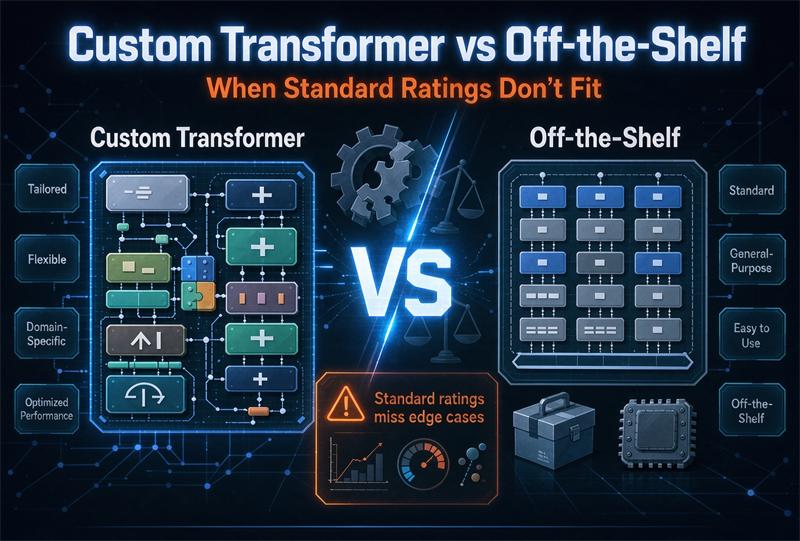
Standard ratings don’t fit when your voltage, frequency, kVA, site, or code requirement falls outside the catalog’s fixed steps. That means a non-standard grid like 11 kV or 690 V, a load that lands between two standard sizes, altitude above 1,000 m, or a certification the stock unit can’t carry. In those cases a custom build is the only unit that truly meets spec.
Most transformer orders start with a catalog page, and that is usually the right place to start. Standard units ship fast, cost less, and come with drawings and certification files already in hand. But a real share of the projects that reach a factory began as a standard model that almost worked. The voltage was close, the footprint was tight, or the ambient temperature pushed the design past its limit. The buyers who saved money on paper ended up paying for field workarounds. This guide is about the moment the standard ratings stop fitting, and how to decide whether a custom build is worth the wait.
What “off-the-shelf” actually covers
An off-the-shelf transformer is a unit built to a manufacturer’s standard catalog. The parameters follow combinations defined in IEEE C57.12.00 for North America and IEC 60076 for most export markets, so a stock unit from one supplier is roughly interchangeable with the same rating from another. That interchangeability is exactly why distributors keep them on the shelf.
The catalog has hard edges, though. Here is what a standard rating normally fixes:
| Parameter | Standard catalog | What a custom build can open up |
|---|---|---|
| Capacity (kVA) | Preferred steps: 15, 30, 45, 75, 112.5, 150, 225, 300, 500, 750, 1000, 1500, 2000, 2500 | Any rating matched to your real load |
| Voltage | Common LV (600, 480, 240, 208, 120 V) and MV (4.16, 13.8, 25, 34.5 kV) | 11, 22, 33 kV grids; 380, 575, 690 V; dual-ratio windings |
| Frequency | 60 Hz in North America, 50 Hz in much of the world | Dual-frequency or single 50/60 designs |
| Temperature rise | Dry-type 80, 115, 150°C; liquid-immersed ~65°C | 55°C rise for hot climates, higher margin for overload |
| Impedance | 3.5% to 5.75% typical | 2% to 10%+ per system study |
| Enclosure | Ventilated indoor, NEMA 3R outdoor | Custom footprint, seismic bracing, busway flange |
Those fixed steps are a feature, not a limitation, for the 80 percent of jobs that fit them. The problem starts when your job does not.
The round-up penalty: when your load falls between two sizes
Here is the part most buyers miss. Standard kVA ratings are discrete steps, and when your load lands between two of them you must round up to the next step. That rounding is rarely free.
Say your calculated load is 380 kVA. The standard ladder jumps from 300 kVA straight to 500 kVA, so you buy a 500 kVA unit. About 120 kVA of that unit, roughly a quarter of what you paid for, sits idle under normal load. A custom 400 kVA unit would cover the same 380 kVA load with about 5 percent headroom and no oversizing.
The same penalty shows up on the voltage side. If your equipment is built for 690 V and the local grid is 480 V, a standard 480/240 step-down simply will not connect. You either live with a derate you did not budget for or you pay for a field workaround. A custom 690/480 winding is not an upgrade in that case. It is the only option.
This is why the choice between stock and custom is rarely a price decision. It is a fit decision, and fit is where the real money lives.
Five situations where standard ratings don’t fit
1. Voltage or frequency doesn’t match the grid
Non-standard grid voltages and frequencies are the number one reason projects end up at a custom shop. Southeast Asia and the Middle East run 11 kV, 22 kV, and 33 kV distribution in many regions, and a 13.8 kV North American winding will not connect. European and Asian machinery often arrives built for 380 V, 575 V, or 690 V, or for 50 Hz, while the site is 60 Hz. Dual-voltage windings for a plant that may relocate, or an odd autotransformer ratio, are not catalog items either. When the mismatch is electrical, standard stops being standard and becomes a compromise.
2. The footprint won’t fit the room
Retrofit jobs are the second signal. An existing electrical room may allow only a compact footprint, a wall mount, or a specific bushing and terminal arrangement. A standard unit that will not fit through the door, or will not clear the existing busway, is not a solution. Custom enclosures, vertical or horizontal configurations, and special lifting provisions exist for exactly this. If the catalog footprint does not fit the room, the room is not going to move.
3. The environment beats the catalog limits
Altitude above 1,000 m derates insulation and cooling. Coastal sites demand salt-spray protection. Mines bring dust and vibration. Tropical sites bring 40°C ambients and high humidity. Each one changes the design: creepage distances, enclosure rating (NEMA 4X instead of 3R), cooling class, and sometimes the insulation system itself. A standard unit may survive these conditions for a while. A purpose-built one is engineered for them from day one.
4. The application needs more than a catalog part
A data center may need a dry-type unit with a 45 dBA sound rating and a specific impedance to limit fault current. A solar farm on a 35 kV collection network needs a transformer built around inverter output rather than a utility-grade winding. A mining site needs dust-tight, corrosion-protected construction. Medical and marine loads bring their own isolation and leakage limits. None of these is exotic in a manufacturing sense, but the application-specific parameters usually do not match a standard SKU.
5. The certification or grid code isn’t on the stock label
A stock import may carry a general mark, but your project might require UL 1561 or UL 1562 for dry-type units, CSA C22.2 No. 47 for Canada, or a local utility interconnection rule a standard import cannot satisfy. Since the U.S. Department of Energy updated distribution transformer efficiency levels under 10 CFR Part 431 (the final rule appeared in 89 FR 29834, with a compliance date of April 23, 2029), a growing number of older standard designs quietly fall out of compliance. A custom build is often the clean path to a unit that is both site-matched and fully documented.
Three tiers: stock, modified-standard, fully custom
Not every non-standard requirement needs a fully custom build. There is a useful middle ground, and sorting your job into one of three tiers keeps both cost and lead time honest.
| Tier | Fits when | Typical lead time | Relative cost |
|---|---|---|---|
| Stock / off-the-shelf | All parameters match the catalog | 2 to 6 weeks from US stock, 4 to 8 otherwise | Baseline |
| Modified standard | One or two small deviations (non-standard taps, different enclosure, one added certification) | 6 to 12 weeks | About 10 to 20 percent above stock |
| Fully custom | Three or more deviations, or a parameter the catalog cannot express at all | 10 to 20 weeks | About 20 to 40 percent above stock, amortizing on volume |
The practical rule we use with buyers: count your deviations from the catalog. One or two minor ones usually justify a modified-standard unit, because the base design and most components stay standard. Three or more, or any single parameter the catalog simply cannot express (an 11 kV primary, a 690 V secondary, a 45 dBA limit), pushes past modification into fully custom territory.
The cost spread above is a planning range suppliers quote, not a fixed price. The real number is driven by active material (core steel, copper or aluminum, insulation class), which is 60 to 70 percent of any transformer’s cost, plus the test scope you ask for.
Why “custom costs more” is the wrong comparison
It is true that a custom transformer typically carries a premium. Ryan Transformers cites a 15 to 30 percent premium for a typical custom build, and Rex Power Magnetics puts highly specialized units at 30 to 100 percent. Treat both as planning figures rather than quotes, because the comparison changes once you add the cost of making a standard unit fit.
A standard unit that needs busbar rework, added compensation, a protection restudy, or a derate routinely costs more than its price tag suggests. Ryan tells the story of a Texas utility engineer who saved roughly $4,000 by picking an off-the-shelf 500 kVA pad-mounted unit instead of a custom build. The rework that followed, replacing bushings, re-terminating the secondary, and re-issuing the protection study, cost more than $18,000 and pushed energization back nine weeks. The transformer was never the problem. The specification was.
Then there is the round-up penalty from earlier. A 500 kVA unit bought to serve a 380 kVA load is a 500 kVA purchase with a 380 kVA job. On projects where downtime is expensive, the difference between a unit that goes in once and a unit that needs field surgery decides the payback.
The 2029 efficiency factor
If you sell into the United States, efficiency is now part of the specification, not a footnote. The DOE’s distribution transformer standards under 10 CFR Part 431 (Subpart K) were updated, the final rule sits in 89 FR 29834, and the compliance date is April 23, 2029. Older standard designs that met the previous levels may not meet the new ones, and a stock unit that cannot be ordered compliant is no bargain. A custom build lets you design to the new levels from the start. If you sell into the European Union, the Ecodesign framework sets its own efficiency floors, so confirm both regimes before you specify. You can read how the two standard families differ in our guide on IEC 60076 versus ANSI/IEEE for export transformers.
What a custom quote should include (your RFQ checklist)
A useful custom quote starts with a useful brief. Here is what any serious manufacturer should ask for, and what you should have ready before you send the inquiry:
- Electrical parameters: kVA (and your actual load, not just a rounded guess), high-voltage and low-voltage ratings, phase, frequency (50, 60, or dual), impedance percent, and tap range.
- Site conditions: altitude in meters, maximum ambient temperature, humidity, and pollution or salt or dust level.
- Application: data center, solar, mining, utility, industrial, marine, or medical.
- Certification targets: UL 1561 or 1562, CSA C22.2 No. 47, IEC 60076, local grid code, and DOE or Ecodesign compliance.
- Installation format: indoor or outdoor, pad mount, busway connection, wall mount, or skid.
- Test scope: routine tests only, or special tests such as partial discharge and lightning impulse.
If a supplier quotes without asking for this information, treat the quote as a guess. Those inputs determine the active material, which is most of the cost. Our distribution transformer buyers guide walks through the rest of the purchasing decision.
How a custom order moves through the factory
After you send a spec, a real custom job follows a fixed path rather than a catalog lookup:
- Technical review: engineers confirm load profile, ambient, altitude, the governing standard (IEEE, IEC, or local), and the certification target.
- Design: electromagnetic and loss calculations plus CAD drawings for the core, windings, and enclosure.
- Drawing approval gate: you sign off on dimensions, terminations, and accessories before any steel is cut.
- Build: cast resin or VPI for dry-type units, core-and-coil plus tank for oil-filled. (See dry-type versus oil-immersed for which cooling path fits your site.)
- Testing: routine tests (turns ratio, polarity, no-load and load loss, applied and induced voltage, temperature rise), plus special tests like partial discharge when the spec asks for them. Our routine testing guide lists what every unit should pass.
A signed drawing package before cutting steel is the single control that prevents most expensive late changes. If a shop skips it, ask why.
Frequently Asked Questions
When do standard transformer ratings actually not fit?
Standard ratings stop fitting when your voltage, frequency, kVA, site, or code requirement falls outside the catalog’s fixed steps. Common triggers are a non-standard grid such as 11 kV or 690 V, a 50 Hz machine on a 60 Hz site, a load that lands between two standard kVA sizes, altitude above 1,000 m, or a certification like UL 1561 that a stock import cannot show. In those cases a custom build is the only unit that meets spec.
Is a custom transformer always more expensive than a stock unit?
Not in total cost. A custom unit typically carries a 15 to 30 percent premium over a comparable stock unit, and highly specialized builds can run higher, but a stock unit that needs busbar rework, a protection restudy, a derate, or nine weeks of delay often costs more than the premium. The fair comparison is total installed cost, not the first price tag.
How much longer does a custom transformer take to deliver?
Stock units ship in roughly 2 to 8 weeks. Modified-standard builds run about 6 to 12 weeks. Fully custom units start near 10 weeks and routinely reach 16 to 20 weeks for complex designs, with longer times if specialty steel or insulation is tight. Plan the lead time into the equipment specification, not after it.
What is a modified-standard transformer?
A modified-standard unit starts from a catalog design and changes one or two parameters, such as non-standard taps, a different enclosure, or one added certification. Most components stay standard, so cost and lead time stay closer to stock than to fully custom. It fits jobs with one or two minor deviations from the catalog.
Can I run a 50 Hz transformer on a 60 Hz system, or the reverse?
Only with care, and often not at full rating. A 60 Hz transformer run on 50 Hz sees higher flux and can overheat; a 50 Hz unit on 60 Hz may be fine for voltage but changes the nameplate’s rated behavior. If your equipment or grid crosses the 50/60 Hz line, specify a dual-frequency or single-frequency design built for it rather than forcing a standard unit.
Does a custom transformer help with the 2029 DOE efficiency rules?
Yes. The U.S. DOE’s distribution transformer standards under 10 CFR Part 431 were updated (final rule in 89 FR 29834, compliance April 23, 2029), and some older standard designs fall out of compliance. A custom build lets you design to the new levels from the start and document them, instead of discovering a stock model can no longer be ordered compliant.
What information should I send for a custom transformer quote?
Send your electrical parameters (kVA and actual load, HV and LV voltage, phase, frequency, impedance, taps), site conditions (altitude, ambient, humidity, pollution), application type, certification targets (UL, CSA, IEC, local code, DOE or Ecodesign), installation format, and test scope. A supplier that quotes without this list is guessing at the active material that drives most of the cost.
Will a custom transformer be accepted by my inspector or authority having jurisdiction?
It will, provided it carries the right listing and documentation for your market. In the U.S. that means UL 1561 or UL 1562 for dry-type units, in Canada CSA C22.2 No. 47, and the test reports to back the nameplate. Build the certification target into the design file from day one, and the field inspection is a label check rather than a fight.
Bottom line
Buy the stock unit whenever your job fits the catalog: standard voltage, standard kVA, standard site, standard duty. Most jobs do, and stock keeps the budget and the schedule. But once you count the site conditions, most projects stop fitting a standard rating cleanly. A custom transformer in those cases is not a premium you pay for status. It is the cheapest way to get the specification right the first time, and to arrive with drawings, tests, and certifications the inspector will actually accept.
If your project has a non-standard voltage, site, or certification requirement, send us your one-line diagram and let our engineers take a look. We build special and custom transformers to IEEE and IEC standards with full test reports. Get a free technical quote from our engineering team.