An autotransformer steps AC voltage through one shared winding and gives you no electrical isolation, while an isolation transformer uses two separate windings to fully separate the supply from the load. The right pick comes down to one question: can your setup tolerate a direct conductive link between input and output, or does safety require that link to be broken?
If you’re staring at a quote sheet wondering which one to buy, you’re in the right place. This isn’t a spec-sheet lecture. It’s the straight answer you’d get from an engineer who’s wired both into real panels, made the mistake once, and doesn’t want you to.
The 10-second answer
Here’s the whole thing in one breath: an autotransformer is cheaper, smaller, and more efficient because its input and output share part of the same coil. An isolation transformer costs more and takes more space because it builds a physical wall between input and output. That wall is what keeps a fault, a surge, or a ground loop from reaching your people and your gear.
So the short version is this. If you only need to change voltage and the wiring rules let the two sides stay connected, an autotransformer is usually the smart, economical call. If anyone can touch the output, if sensitive electronics are involved, or if a code says “separate the circuits,” you need an isolation transformer. Full stop.
Quick pick:
- Voltage trim only, no isolation needed → autotransformer
- Medical, lab, or anything a person can contact → isolation transformer
- Sensitive electronics, noisy supply, ground loops → isolation transformer
- Tight cabinet, tight budget, close voltages → autotransformer
How each transformer actually works
What an autotransformer does
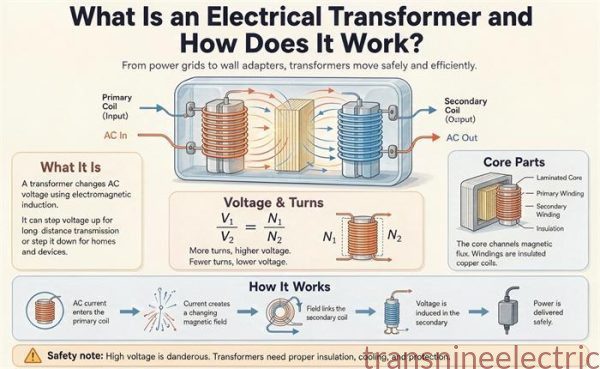
Picture one continuous coil. You tap into it at two points: one point is your input, another point is your output. Part of that coil does double duty, carrying current for both sides. Because the two sides literally share conductors, there is no electrical separation. None. It’s the same circuit, just at two different voltages.
That shared coil is exactly why autotransformers are so attractive. They use less copper, a smaller core, and lose less energy. For a small step, say 480 V down to 415 V, efficiency often lands at 98–99 percent, and the unit can weigh roughly half of an equivalent two-winding design.
What an isolation transformer does
Now picture two completely separate coils wound on the same core. Power crosses from one to the other only through the magnetic field, never through a wire. Cut the input and the output still can’t find a conductive path back to the supply. That gap is galvanic isolation, and it’s the whole reason these exist. A proper isolation build also matters for where it gets installed, which is why our dry-type transformer selection guide walks through enclosures and cooling.
A good isolation transformer can also carry an electrostatic shield between the windings. That shield is what knocks down high-frequency noise traveling from the supply into your load.
The one thing that separates them
If you remember nothing else, remember this: isolation is not about voltage, it’s about connection. Both types step voltage up or down just fine. Only the isolation transformer breaks the conductive link between source and load. That single fact decides every “which one” question below.
Autotransformer vs isolation transformer: side-by-side
| Topic | Autotransformer | Isolation transformer |
|---|---|---|
| Winding | One shared winding with taps | Two separate primary and secondary windings |
| Galvanic isolation | No | Yes |
| Efficiency (close ratio) | 98–99% | 95–97% |
| Size and weight | Smaller, lighter (up to ~50% less weight) | Larger, heavier |
| Cost (same kVA, close ratio) | Lower, often 20–40% less upfront | Higher |
| Ground loops | Remain (no break) | Broken |
| Common-mode noise | Passes through | Cut, often 40 dB+ with a shield |
| Best ratio range | Close ratios, roughly up to 3:1 | Any ratio; wins beyond ~3:1 |
| Safety role | Voltage conversion only | Personnel and equipment protection |
| Typical use | Motor starting, voltage trim, grid interconnect | Medical, labs, IT, sensitive controls |
When an autotransformer is the smart pick
Small voltage steps (close ratios)
The closer your input and output voltages, the more an autotransformer shines. Classic jobs are 480 V to 415 V, 600 V to 575 V, or 230 V to 208 V. Once the ratio stretches past about 3:1, you lose the material savings and a two-winding unit often makes more sense.
Tight on space or budget
In a crowded control cabinet or a weight-limited rooftop, that ~50 percent weight cut matters. For a fixed kVA at a close ratio, you’ll typically pay 20–40 percent less up front. If isolation isn’t required by the job or the code, that’s real money left on the table by overspecifying.
Motor starting and line compensation
Autotransformers are the workhorse for reduced-voltage motor starting and for boosting voltage at the end of a long feeder where it has drooped. They’re also common in high-voltage grid interconnection where ratios are close and the power is huge, because even a fraction of a percent in losses is a lot of megawatts.
Single-phase or three-phase? Both transformer types come in either build, and phase follows your load, not the isolation question. If you’re matching imported equipment to local power, our single-phase transformer range covers the common control and small-power cases.
When you really need an isolation transformer
Anything that touches people
If the output can reach a person, isolation stops being optional. Hospitals lean on isolation transformers in patient-care areas because a ground fault must not find a path through a patient. Standards such as NEC Article 517 in the US and IEC 60601-1 for medical electrical equipment build this requirement into law, not advice.
Sensitive electronics and ground loops
A shared winding does nothing for a ground loop. An isolation transformer breaks it. In labs, data centers, and audio or measurement setups, that break is what keeps a stray loop from frying a board or adding noise to a reading. In one bench test on a 5 kW drive, a shielded isolation transformer cut common-mode noise by more than 40 dB, while the autotransformer passed roughly 92 percent of the switching transients straight back toward the supply.
A separate neutral or grounding scheme
Sometimes you don’t want the load’s ground tied to the building’s ground. An isolation transformer lets you define a new, independent secondary reference. An autotransformer can’t, because its output is the same circuit as its input.
Why safety is the part you can’t talk away from
The failure-mode reality
Here’s what most catalogs skip. In an autotransformer, the input and output share a winding. If that winding’s insulation fails, the full input voltage shows up on the output. A 480 V supply can land on what you thought was a 120 V side. An isolation transformer fails differently: a fault on one winding doesn’t automatically energize the other at line potential, because the coils are physically separate. When the stakes are a person or a six-figure machine, that difference is not academic.
“Floating” doesn’t mean “safe to touch”
Don’t get burned by this one. A floating secondary is not a free pass to grab the terminals. Touch both output conductors at once and you’ve still got the full output voltage across your hands. Capacitance between windings and connected equipment can also build return paths you didn’t plan for. Keep the protective-earth connections on the enclosure intact. Stripping them off to chase “perfect isolation” is how people get hurt during a fault.
Ground loops and noise, in real numbers
If your supply is dirty, your load pays for it. An isolation transformer with a proper shield is the clean fix; an autotransformer just passes the mess along. The 40 dB-plus attenuation figure above isn’t a sales number, it’s what a Faraday shield between windings does to common-mode noise. For EMI and EMC compliance testing, that clean baseline is often the reason the isolation unit is specified in the first place.
What the codes actually require (US + EU)
Buyers on both sides of the Atlantic ask the same thing: will this pass?
- United States: NEC Article 517 drives isolation in health-care patient areas; UL listing and proper grounding apply broadly; OSHA expects hazard control on accessible circuits.
- European Union: IEC 60601-1 covers medical electrical equipment; IEC 61558 covers safety of power transformers; the Low Voltage Directive (2014/35/EU) sets the compliance frame for equipment in its voltage range.
If your project sits in a regulated space, the code usually decides the transformer for you. Start there, not with the price. For the full picture on what each market expects, our ANSI/IEEE vs IEC standards guide lays out the export mapping.
The 3-question selector
Walk this in order. The first answer that points to isolation wins.
- Can the supply and load stay electrically connected? If no, you need an isolation transformer.
- Does anyone or any sensitive device touch the output, or does a code require separated circuits? If yes, you need an isolation transformer.
- Are the voltages close (within about 3:1) and is space or budget tight, with no isolation requirement? If yes, an autotransformer is the economical pick.
That’s it. Safety questions beat price questions every time.
Mistakes buyers keep making
Swapping in an autotransformer where isolation is mandated
The cheapest unit on the quote is the wrong unit if the spec says “isolation.” Specs say that for a reason. Don’t let a lower number override a requirement.
Thinking “isolated” means “safe to grab”
As covered above, a floating output still bites. Treat isolation as system protection, not as permission to drop safe-work habits.
Buying on price alone
An autotransformer can look like a steal next to an isolation unit. But when downtime, a shock incident, or a failed compliance audit is the alternative, the “expensive” unit was the cheap one all along. Weigh the failure cost, not just the sticker.
Quick FAQ
What is the main difference between an autotransformer and an isolation transformer?
An autotransformer uses one shared winding, so input and output are electrically connected. An isolation transformer uses two separate windings, which physically separates the supply from the load. Only the isolation type provides galvanic isolation.
Can an autotransformer provide electrical isolation?
No. Because the two sides share part of the same winding, there is a direct conductive path between input and output. It cannot provide protective separation.
Is an autotransformer safe?
Yes, when it’s correctly specified, protected, installed, and used only where the wiring rules allow the circuits to stay connected. Its lack of isolation sets where it can be used; it isn’t inherently unsafe.
When should I use an isolation transformer instead of an autotransformer?
Use it when people or sensitive equipment can contact the output, when you must break a ground loop or cut noise, when you need a separate neutral or grounding scheme, or when a code such as NEC 517 or IEC 60601-1 requires separated circuits.
Why are autotransformers cheaper and smaller?
Part of the power flows conductively through the shared winding, so only the voltage-difference portion is transformed magnetically. That cuts copper, core material, weight, and cost, especially at close ratios.
What happens if an autotransformer winding fails?
If the insulation between taps breaks down, the full input voltage can appear at the output. That’s the key failure-mode risk an isolation transformer avoids by keeping the windings physically separate.
Does an autotransformer create a separately derived system?
No. Its output remains electrically tied to the input. A two-winding isolation transformer can establish a separately derived secondary.
What should I send a supplier when I ask for a quote?
Your input and output voltages, kVA or VA, single-phase or three-phase, required isolation (yes or no), the standard you need (NEC, IEC 60601, IEC 61558, UL), and the environment (indoor, outdoor, hazardous). Clear specs get you a correct quote instead of a guess.
Bottom line
Both transformers change AC voltage. Only one of them builds a wall between your supply and your load. Pick the autotransformer when voltage trim is all you need and the rules let the circuits stay joined. Pick the isolation transformer the moment a person, a sensitive device, a ground loop, or a code says the circuits must come apart.