A practical 2026 buyer’s guide for US and EU specifiers — written for the person who has to defend the choice to a fire marshal, a CFO, and a maintenance manager at the same time.
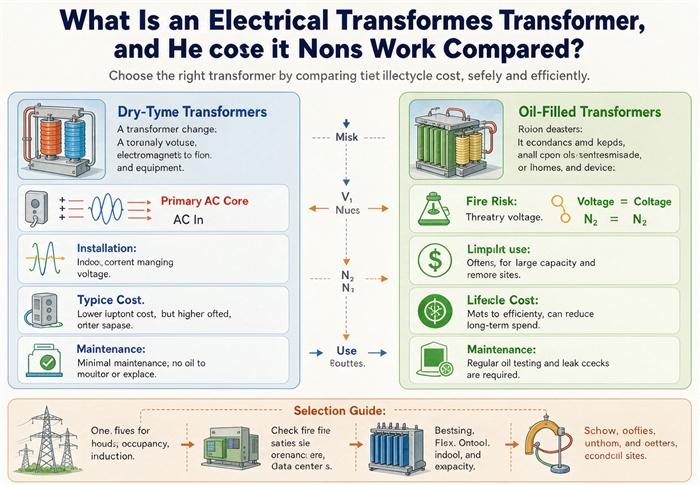
Dry-type transformers insulate and cool with air plus solid epoxy or cast resin, so they’re non-flammable and can sit inside a building with no vault. Oil-filled units use mineral or ester oil to cool and insulate, cost less per kVA, reach higher voltages, but need fire-rated containment and routine oil testing.
Here’s the thing nobody tells you on page one of a spec sheet: there is no “better” transformer. There’s the one that fits your room, passes your fire code, survives your maintenance budget, and doesn’t bankrupt you over 20 years. This guide walks through the three levers that actually decide it — fire code, cost, and maintenance — and then gives you a decision matrix you can hand to your engineer.
The 30-Second Answer
If you remember nothing else, remember this:
- Pick dry-type when the unit goes indoors, sits near people, must meet strict fire codes, or your team has no oil-testing program. Hospitals, data centers, high-rises, schools, and basements are dry-type territory.
- Pick oil-filled when it’s outdoors, above roughly 10 MVA, needs the highest voltage, or the lowest first cost wins. Substations, solar and wind farms, heavy industry, and rural distribution run on oil.
Everything below is just detail wrapped around those two sentences.
How They Actually Work
Dry-Type — Air and Resin, No Liquid
A dry-type transformer does its cooling with the air already in the room. The windings are sealed in solid epoxy (cast-resin, or CRT) or soaked and cured under vacuum (VPI — vacuum pressure impregnated). No tank, no oil, no sump. That single fact is why it’s allowed where oil isn’t: there is literally nothing to burn or leak.
The trade-off is that air is a poor coolant compared with oil, so dry-type units need bigger clearances, bigger surface area, and sometimes fans (that’s the “AF” rating you’ll see on a nameplate). The epoxy also makes recycling at end-of-life messier, but we’ll get to lifecycle cost later.
Oil-Filled — Oil Does Two Jobs at Once
In an oil-filled (liquid-immersed) unit, the oil is both the insulator and the coolant. It wraps the windings, blocks electrical breakdown, and carries heat to the tank walls or radiators. Because oil moves heat about six times better than air, the same kVA rating comes in a smaller, cheaper box, and the thermal mass lets it shrug off short overloads that would stress a dry-type unit.
The catch is the oil itself. Mineral oil is flammable. Esters (natural or synthetic) raise the flash point past 300°C and are biodegradable, but code still treats them as a liquid that needs containment. So an oil unit buys you size and efficiency and then asks you to build a safe home for the liquid.
Fire Code & Safety: Where Most Guides Stop Short
This is the section your fire marshal cares about most — and the one almost every comparison article glosses over with a vague “fire codes restrict oil indoors.” Let’s be specific.
What US Codes Actually Require
For US buyers, the rulebook is a short stack:
- NEC Article 450 governs transformer installation. Dry-type units get a relatively easy path (450.21 for less than 600 V, 450.23 for over 600 V). Oil-filled units indoors fall under the vault rules.
- NFPA 850 / NFPA 851 add fire-protection requirements for power plants and generating facilities — relevant if you’re specifying near generation or large rotating equipment.
- The International Building Code (IBC) sets the vault construction standard: typically 3-hour fire-resistive walls, a 1-hour fire-resistive roof, drainage, and ventilation.
- UL 1561 / UL 1562 are the product-safety listings for dry-type transformers (under and over 600 V respectively). UL 1563 covers certain pool and spa units; ask your supplier which listing your unit actually carries.
The Vault Problem (and What It Costs)
Put an oil-filled transformer indoors and codes usually demand a fire-rated transformer vault: 3-hour walls, drainage to hold a leak, forced ventilation, and often suppression. In the real world that’s not a line item — it’s a small building inside your building. Plan on roughly $40,000 to $150,000+ in civil work depending on size and jurisdiction. Most commercial and institutional projects decide that’s enough reason on its own to go dry-type.
Less-Flammable Fluids — The Middle Option
If you genuinely need oil performance indoors, ask about less-flammable (high-fire-point) fluids such as natural ester (FR3-type). Under NEC 450.23 these can relax some vault requirements because the flash point sits above 300°C. They’re not a free pass — you still need containment and ventilation — but they close the gap between “oil” and “allowed indoors.”
EU Buyers: IEC 60076, EN 50541, and CE
Across the EU the reference is IEC 60076 (with IEC 60076-11 covering dry-type units and their environmental classes E0/E1/E2 and climate classes C1/C2). Efficiency bands come from EN 50541 / the EU Ecodesign rules, and the product needs CE marking against the low-voltage and machinery directives. The fire logic is the same as the US — no flammable liquid near occupied space — but the paperwork and the standard numbers are different, so don’t assume a UL-listed unit drops straight into an EU project.
Cost — Upfront Price Is the Wrong Number
Every buyer asks “which is cheaper?” and every catalog answers “oil, by 20 to 50 percent.” That answer is true and useless, because it ignores where the money actually goes.
What You Pay on Day One
For the same rating, a cast-resin dry-type unit typically runs 30 to 50 percent more than an oil-filled equivalent. You’re paying for solid insulation, a larger air-cooled frame, and a more involved build. Oil wins the sticker price, full stop.
The Hidden Civil Cost of Oil Indoors
Move that oil unit inside and the vault, drainage, and suppression can erase the purchase saving many times over. Even outdoors, oil needs an oil-containment sump (often sized to 110 percent of fluid volume) and a spill plan. Dry-type needs none of that.
A Worked TCO Example (1,000 kVA, 20 Years)
One published 2025 manufacturer comparison put a 1,000 kVA unit at 60 percent load over 20 years like this:
| Cost line | Dry-Type | Oil-Filled |
|---|---|---|
| Equipment + install | $37,000 | $30,000 |
| 20-yr energy + maintenance | $126,000 | $124,000 |
| 20-yr TCO | $163,000 | $154,000 |
Read that carefully: at 60 percent load, oil beats dry by only about 5 percent over two decades. Now add an indoor vault at $40,000 to $150,000 and oil flips from “cheaper” to “expensive.” The upfront discount is real; the lifetime advantage usually isn’t.
When the Dry Premium Pays Itself Back
For indoor commercial jobs, the dry-type premium typically pays back in 8 to 12 years through avoided vault work and oil maintenance. Below about 30 percent utilization, dry-type can win outright on lifecycle cost because you’re not carrying an oil-testing program you barely use. Above 50 percent utilization outdoors, oil usually wins. The crossover is real and movable — that’s why you model it instead of guessing.
Maintenance — What Your Team Will Actually Do
This is where the two types diverge hardest in day-to-day life.
Dry-Type: Mostly Cleaning
A dry-type unit is close to maintenance-free. The yearly routine is a visual inspection for dust, corrosion, and physical damage, plus cleaning the windings and ventilation paths so airflow isn’t choked. No sampling, no filtration, no top-ups. Budget roughly $800 to $1,500 per year, mostly labor.
Oil-Filled: Testing, Sampling, and Watching
Oil units need a real program. Plan for:
- Dissolved Gas Analysis (DGA) and oil dielectric (breakdown voltage) testing every 1 to 2 years — this is your early-warning system for arcing or hot spots.
- Annual checks of gaskets and seals for leaks.
- Periodic filtration or replacement of the oil as it ages.
- Radiator, pump, and fan service on forced-cooled (ONAF/OFAF) units.
Budget about $1,500 to $3,000 per year, and add the cost of a trained technician and a lab relationship. Done well, it extends life to 30-plus years; skipped, it ends in a failure nobody saw coming.
Annual Maintenance Cost, Side by Side
| Task | Dry-Type | Oil-Filled |
|---|---|---|
| Routine inspections | Visual, yearly | Visual, yearly |
| Fluid testing | None | DGA + dielectric, 1–2 yr |
| Filter / replace medium | None | Periodic |
| Typical annual cost | $800–$1,500 | $1,500–$3,000 |
Side-by-Side Comparison Table
| Parameter | Dry-Type | Oil-Filled | Edge |
|---|---|---|---|
| Cooling medium | Air (natural or forced) | Mineral or ester oil | Oil |
| Max voltage | Up to 35 kV | Up to 765 kV+ | Oil |
| Typical range | 25 kVA – 30 MVA | 50 kVA – 1,500 MVA | Oil |
| Fire risk | Very low, self-extinguishing | Flammable (esters lower) | Dry |
| Indoor use | Yes, no vault | Vault usually required | Dry |
| Upfront cost | 30–50% higher | Lower | Oil |
| Maintenance | Minimal, cleaning only | Oil testing + sampling | Dry |
| Lifespan | 20–35 years | 25–40 years | Oil |
| Overload capacity | ~120% for 2 hr | Up to 150% for 2 hr | Oil |
| Noise | 45–65 dB | 35–50 dB | Oil |
| Environmental risk | None (no liquid) | Spill / soil risk | Dry |
The Decision Matrix — Pick by What You Control
Stop reading lists of “use X when.” Answer these in order:
| If your project is… | …then the safer pick is |
|---|---|
| Indoors, near people, strict fire code | Dry-type |
| Outdoors, no occupancy nearby | Oil-filled |
| Above ~10 MVA | Oil-filled (dry gets impractical) |
| Above 35 kV | Oil-filled (dry tops out ~35 kV) |
| No oil-testing staff on site | Dry-type |
| Lowest first cost is the mandate | Oil-filled (outdoors) |
| Basement, rooftop, or data-center white space | Dry-type |
When the answers split — say, a 5 MVA indoor unit — dry-type usually wins because the vault cost and the fire risk outweigh the purchase saving. When they align — a 20 MVA outdoor substation — oil wins on every axis.
Before You Ask for a Quote: 7 Things to Check
Most inquiries we get are missing half of these, and that’s how specs get rejected. Tick them off:
- Listing: UL/cETL for the US, CE for the EU — and the specific UL number (1561 vs 1562) for dry-type.
- Standard: IEEE C57.12.00 (liquid) or C57.12.01 (dry) for the US; IEC 60076 for everywhere else.
- kVA rating: use a standard preferred value (15, 30, 45, 75, 112.5, 150, 225, 300, 500, 750, 1000…), not a round made-up number.
- Enclosure: indoor NEMA 1/2 or outdoor NEMA 3R; IP rating for the EU.
- Warranty: typical is 12–24 months; ask what it covers (windings? labor?).
- Lead time: standard dry-type runs weeks; large oil units can run 16–20 weeks. Confirm before you promise a commissioning date.
- Compliance flag: US public or federally funded jobs may need BABA / Buy America content documentation — ask early, it changes the build.
Frequently Asked Questions
1. What is the main difference between dry-type and oil-filled transformers?
Dry-type units use air and solid epoxy or cast-resin insulation, so they’re non-flammable and install indoors without a vault. Oil-filled units use mineral or ester oil for cooling and insulation, cost less per kVA, reach higher voltages, but need fire-rated containment and routine oil testing.
2. Can you put an oil-filled transformer indoors?
Technically yes, but US codes (NEC Article 450 and NFPA 850) usually require a fire-rated transformer vault with 3-hour walls, drainage, ventilation, and suppression. That adds roughly $40,000 to $150,000+ in civil work, which is why most indoor projects choose dry-type instead.
3. Which is cheaper, dry-type or oil-filled?
Oil-filled is cheaper to buy, typically 20 to 50 percent less per kVA. Dry-type costs more upfront but avoids oil testing, spill containment, and (indoors) a vault. At 60 percent load over 20 years, published comparisons put the lifetime cost gap at only about 5 percent before any vault cost.
4. How long do dry-type and oil-filled transformers last?
Well-maintained oil-filled units run 25 to 40 years. Dry-type units typically last 20 to 35 years. Oil’s superior cooling slows insulation aging, while dry-type insulation is more exposed to heat and humidity cycling.
5. What maintenance does an oil-filled transformer need?
Plan for dissolved gas analysis (DGA) and oil dielectric testing every 1 to 2 years, annual visual checks of gaskets and seals, periodic oil filtration or replacement, and radiator or pump service on forced-cooled units. Budget about $1,500 to $3,000 per year.
6. Do dry-type transformers need ventilation?
Yes. They shed heat into the room, so the space needs enough airflow, and forced-air (AF) units add fans. Confined rooms usually need exhaust fans or air conditioning to keep coil temperature in spec.
7. Which transformer is better for a data center?
Dry-type, almost always. White-space and indoor distribution rooms need non-flammable equipment close to the load, and cast-resin units meet strict fire classes without a vault. Oil-filled is reserved for outdoor substation or medium-voltage tie-ins.
8. Are cast-resin and VPI dry-type transformers the same?
No. Cast-resin (CRT) encapsulates the windings in solid epoxy, resists moisture and humidity, and suits harsh or indoor sites. VPI (vacuum pressure impregnated) windings are resin-sealed but not solid-cast, cost less, and suit cleaner, drier environments.
9. What fire code applies to transformers in the United States?
The main references are NEC Article 450 (installation of transformers), NFPA 850 and NFPA 851 (power plant and generator fire protection), the International Building Code (vault construction), and UL 1561 or UL 1562 for dry-type product safety. Less-flammable fluids are addressed under NEC 450.23.
10. How do I choose between dry-type and oil-filled for my project?
Answer three questions: Is it indoors or outdoors? What is the kVA and voltage? And what does the local fire code require? Indoors, under about 35 kV, or fire-sensitive means dry-type. Outdoors, above roughly 10 MVA, or budget-led means oil-filled.
Bottom Line
Dry-type and oil-filled transformers aren’t rivals so much as different tools for different rooms. Fire code decides whether oil is even allowed indoors. Cost flips once you count the vault and the testing program, not just the sticker. Maintenance decides who’s on the hook for the next 30 years. Answer those three, and the “which one” question answers itself.
If you’re weighing a specific rating or site, send us the kVA, the voltage, and where it sits — indoors or out — and we’ll size both options against your code and your budget, then hand you a side-by-side you can take to the fire marshal. We build both types, so we’re not nudging you toward the one we happen to stock.