If you’re staring at a spec sheet wondering which type your building actually needs, you’re in good company. This is one of the most common — and most expensive to get wrong — decisions in any electrical upgrade. The short version: the choice isn’t about which is “better.” It’s about what your utility feeds you, what you’re powering, and how big the load is. Get those three right and the answer usually picks itself.
Below is the same decision path we use when sizing units for plants, data centers, and commercial buildings — minus the sales pitch.
The 30-second answer (at a glance)
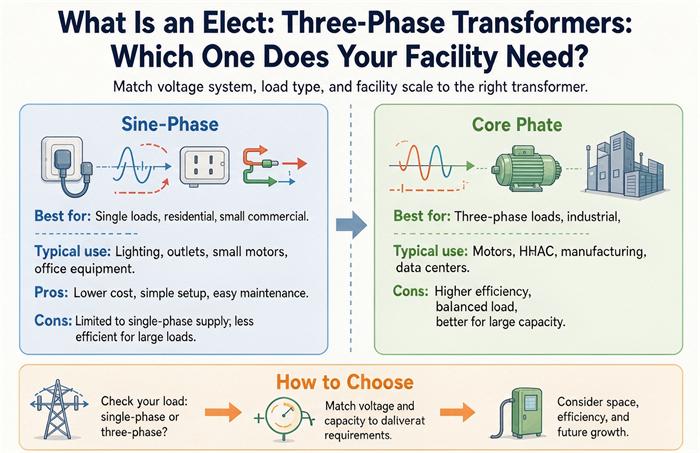
| Single-Phase | Three-Phase | |
|---|---|---|
| Best for | Homes, small shops, rural sites | Plants, commercial buildings, data centers |
| Typical loads | Lighting, outlets, small HVAC | Motors, pumps, compressors, CNC |
| Common size | 5–167 kVA | 15 kVA up to MVA |
| Upfront cost (small) | Lower | Higher |
| Cost per kVA (large) | Higher | Lower |
| Runs a 3-phase motor? | No | Yes |
| Install complexity | Simpler | More involved |
One rule settles most arguments: a single-phase transformer cannot run a three-phase motor. If you have even one real three-phase load, you’re in three-phase territory.
What the two actually are (and why they’re not interchangeable)
Single-phase, in plain English
A single-phase transformer works on one alternating current. You get power between two conductors — line and neutral. It’s the format behind almost every home in the U.S. (120/240 V) and most small rural services. Simple, cheap to install, easy to replace.
Three-phase, in plain English
A three-phase transformer handles three currents, each 120° apart. You get three active conductors plus (usually) a neutral, which lets you deliver both line-to-line and line-to-neutral voltages at once — think 480Y/277 V or 208Y/120 V. That’s why it’s the backbone of anything with motors or heavy, continuous load.
The detail most people miss: kVA isn’t kVA
Here’s a trap that burns buyers. A “10 kVA” three-phase unit is a total rating — roughly 3.3 kVA per phase. A “10 kVA” single-phase unit delivers all 10 kVA on one phase. So two transformers with the same number on the nameplate are not the same machine. When a vendor quotes you kVA, always ask: total, or per phase?
Step 1: Start with your utility service
The single biggest deciding factor is what the utility already runs to your site. You can’t easily argue with the service you’re given.
- Overhead single-phase lines (one hot, one neutral) → you need a single-phase transformer.
- Overhead three-phase lines (three hot conductors) → you can use a three-phase unit, or bank three single-phase units.
- Underground three-phase service (standard for commercial/industrial) → you need a three-phase pad-mount transformer.
Not sure what you have? Check the utility’s service letter, or just count the conductors coming into the existing transformer. Two wires = single-phase. Three or four = three-phase.
Step 2: Then look at your load
Single-phase loads
- Residential lighting and outlets
- Small HVAC, water heaters, ovens, dryers
- Control circuits
- Single-phase motors under about 5 HP
Three-phase loads
- Industrial motors (above ~5 HP — they simply run better on three-phase)
- Pumps, compressors, chillers
- Commercial elevators
- Data-center UPS/PDUs
- Production machinery
A useful rule of thumb: if more than about 20% of your load is three-phase, go three-phase. Trying to run three-phase motors off single-phase with a phase converter wastes energy and shortens motor life. Don’t do it.
Step 3: The kVA thresholds that actually matter
- Under 167 kVA — both types are widely available; your load and service type break the tie.
- 167–225 kVA — the gray zone; single-phase units above 167 kVA are uncommon and usually a special build.
- 225 kVA and above — three-phase is almost always the right call. Integrating one unit beats banking three singles on cost, footprint, and losses.
(These reflect common U.S. distribution practice; your utility’s accepted standards may differ, so confirm against their spec.)
What you actually pay (not just the sticker price)
Up front, a small single-phase unit is cheaper — no debate. But “cheaper to buy” and “cheaper to own” are different animals.
Three-phase wins on total cost of ownership once you’re past small sizes: less copper and core material per kVA, lower losses at high capacity (lower electric bill, every year), and one tank, one pad, fewer bushings and cables versus a bank of three. See our oil-immersed vs dry-type guide for the install-style trade-offs.
Illustrative example: a 500 kVA need. One integrated three-phase pad-mount typically beats three 167 kVA single-phase units once you add the extra tanks, pads, conduits, switchgear, and the higher combined losses. The purchase gap often narrows — or flips — over a 10–20 year horizon. The exact number depends on your energy rate and duty cycle, but the direction is consistent.
Bottom line: size for today and for the 20–30% growth most U.S. commercial/industrial sites see. Buying too small is the expensive mistake, not buying three-phase.
Worked examples by facility type
A rural workshop (single-phase)
A 30 kVA mix of lighting, outlets, and one 5 HP single-phase compressor. Utility feed is overhead single-phase. → Single-phase pad-mount, ~75 kVA for headroom. Simple, cheap, done.
A light industrial plant (three-phase)
250 kW of motors plus 100 kW of misc load. Three-phase service, growing. Size at 125% for continuous load: 350 kW × 1.25 ≈ 437 kVA → round up to the next standard 500 kVA three-phase unit. This is where single-phase simply isn’t an option.
A commercial building (three-phase)
A 400 A panel at 208Y/120 V. kVA = √3 × 208 × 400 ÷ 1,000 ≈ 144 kVA. → Three-phase 225 kVA (next standard step above 167 kVA). Gives you motor loads, EV chargers, and expansion room. See commercial infrastructure solutions.
What if you picked wrong? Can you convert?
Short answer: sometimes, but it hurts.
- Three-phase supply, single-phase equipment? You can tap one phase, but you lose roughly two-thirds of the available capacity and create imbalance. Fine for a few small loads; terrible for a whole facility.
- Single-phase supply, need three-phase? You’d need a phase converter or rotary unit — extra cost, extra losses, lower reliability. Far better to get the right service (and transformer) from the start.
This is exactly why we size from service + load + kVA before you order. For pad-mount sizing specifics, see our pad-mounted transformer buying guide.
NEC and code notes for U.S. buyers
This is where most guides go quiet — and where buyers get burned.
- NEC Article 450 governs transformer installations, including primary overcurrent protection (450.3) and secondary protection. Three-phase units, especially larger ones, usually need coordinated protection and sometimes differential/relaying that a small single-phase pad-mount doesn’t.
- Common secondaries: 208Y/120 V for commercial buildings; 480Y/277 V for industrial. Match the transformer secondary to your panel, not the other way around.
- Standard ratings matter: protection devices land on NEC 240.6(A) standard values (800, 1000, 1200 A…), so your transformer’s FLA should size cleanly against those.
- AHJ sign-off: always confirm with your Authority Having Jurisdiction and utility before finalizing. The “cheapest unit” that fails inspection is the most expensive unit.
If you’re outside the U.S., the equivalents are IEC 60076 (design) and your local wiring code — but the decision logic is identical. For liquid-filled options, browse our oil-immersed transformers.
Frequently Asked Questions
What is the difference between a single-phase and a three-phase transformer?
A single-phase transformer uses one AC waveform and delivers power between two conductors (line-neutral), ideal for homes and small loads. A three-phase transformer uses three waveforms 120° apart, delivering three conductors plus usually a neutral — built for motors, continuous heavy load, and efficient power at scale.
Can a single-phase transformer power a three-phase motor?
No. A single-phase transformer cannot supply a true three-phase motor. You would need a phase converter, which adds cost, loss, and reliability risk. If you have real three-phase loads, specify a three-phase transformer.
Is a three-phase transformer always more expensive than a single-phase one?
Up front, yes for small sizes. But per kVA and over the equipment’s life, three-phase is usually cheaper past roughly 167 kVA due to lower material, losses, and installation hardware. Judge by total cost of ownership, not sticker price.
How do I know whether my facility has single-phase or three-phase service?
Count the conductors at the existing transformer or check the utility service letter. Two wires (one hot plus neutral) means single-phase; three or four conductors means three-phase. Underground commercial feeds are almost always three-phase.
What size transformer does my facility need?
Start from total load in kVA or kW, add about 25% for continuous-duty headroom and 20–30% for growth, then match the next standard rating. Under 167 kVA either type works; above 225 kVA, three-phase is standard.
Can I convert a three-phase supply to single-phase?
You can tap one phase, but you sacrifice about two-thirds of capacity and create imbalance. Acceptable for a few small loads, not a whole site. For a full single-phase facility, order the correct transformer and service.
Conclusion
So — single-phase or three-phase? Start with what your utility feeds you, then look at your load, then size by kVA. Single-phase wins for small, mostly-lighting sites under ~100 kVA. Three-phase wins the moment you have motors, a large or growing load, or anything above ~167 kVA.
The expensive mistakes aren’t about picking the “wrong type” on paper — they’re about ignoring your service, undersizing for growth, or chasing the lowest sticker price. Get the three inputs right and the transformer chooses itself.