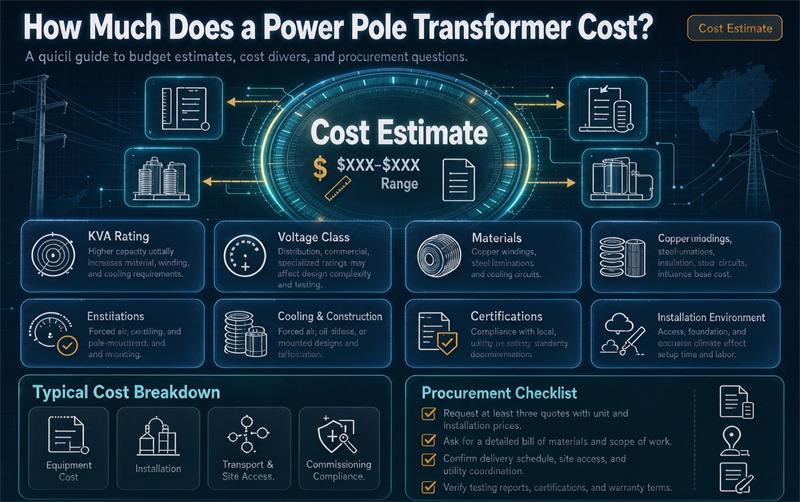
A power pole transformer (the overhead distribution transformer you see bolted to a utility pole) typically costs $500 to $8,000 for the bare equipment and $3,000 to $15,000 fully installed on a prepared pole, with the spread driven mostly by capacity, phase, winding material, and whether your quote includes the cutout, arresters, labor, and utility fees.
That range is wide on purpose. A 10 kVA single-phase unit for a cabin is a different animal from a 333 kVA three-phase transformer feeding a subdivision. Below is the plain-language version we wish every buyer had before they compared two quotes that looked nothing alike.
We at TransNine Electric build distribution transformers for export every week, so this is written for the person actually placing the order, not for an IEEE textbook.
Quick answer: Bare overhead distribution transformers run about $500 (10 kVA) to $22,000 (333 kVA three-phase) in 2026 reference pricing. Installed on a prepared pole, plan $3,000 to $15,000+. The biggest price swings come from copper vs aluminum (+15 to 40%), CSP vs conventional (+15 to 25%), efficiency class (+5 to 15%), and whether the quote is Chinese FOB or Western-branded and certified.
What You Are Actually Paying For
Most cost confusion starts here: people compare a bare-equipment price against an installed price and think one supplier is gouging. They are usually not. They are comparing two different things.
Bare Equipment Cost
This is the transformer itself, free-issue at the factory (EXW/FOB). For a standard oil-immersed overhead unit in 2026, reference equipment ranges run roughly:
- 10 to 25 kVA single-phase: about $500 to $2,500
- 50 to 100 kVA single-phase: about $2,500 to $7,000
- 167 kVA single-phase: about $7,000 to $12,000
- 75 to 500 kVA three-phase: about $3,000 to $22,000
These are planning numbers pulled from multiple supplier price lists. Treat them as a starting band, not a quote.
Installed Cost and Who Pays
Installed cost adds the fused cutout, surge arresters, mounting hardware, the pole (if not already there), crew labor, permits, and utility coordination. In practice that often pushes the total to roughly double the bare unit for small residential jobs, and 1.3 to 1.8 times for larger three-phase work where the transformer itself is the bigger ticket.
Who pays depends on ownership. On a regulated utility line, the utility usually owns the pole transformer and replaces it at no charge when it fails from age or storm. On a private pole line, a farm, a remote residence, an industrial site, or a development with its own distribution, the property owner pays. Always confirm ownership before you budget.
Power Pole Transformer Cost by kVA (Equipment Reference)
This is the table most buyers came for. It is bare-equipment, 2026 industry reference ranges, single-phase unless noted. Three-phase pole units overlap the top of this range and run higher per kVA at the low end because of the extra bushings and balancing.
| kVA | Phase | Equipment range (USD) | Typical use |
|---|---|---|---|
| 10 | 1-ph | $500 – $1,500 | Cabin, small rural service, gate |
| 25 | 1-ph | $1,200 – $2,500 | Basic home, small farm |
| 50 | 1-ph | $2,500 – $4,000 | Average home, EV-ready service |
| 75 | 1-ph | $3,500 – $5,500 | Large residence, light commercial |
| 100 | 1-ph | $4,500 – $7,000 | Heavy residential, small commercial |
| 167 | 1-ph | $7,000 – $12,000 | Subdivision, school |
| 250 | 3-ph | $10,000 – $16,000 | Industrial facility |
| 333 | 3-ph | $14,000 – $22,000 | Manufacturing plant |
Two honest notes. First, Chinese FOB pricing for the same kVA can sit well below the lower edge of these bands, while Western-branded and fully certified units sit at or above the upper edge. That 2 to 5 times spread is real and explained in the next section. Second, these exclude shipping, duties, and installation, which can add 20 to 60 percent to your landed cost depending on destination and Incoterms.
What Makes the Price Swing
This is the part no competitor consolidates. If your quote came in double a competitor’s, one of these is why.
| Factor | Typical price impact | What it buys you |
|---|---|---|
| Copper vs aluminum windings | +15% to +40% | Lower losses, longer life, better resale |
| CSP (self-protected) vs conventional | +15% to +25% | Built-in breaker, fuse, arrester; remote-friendly |
| Efficiency / low-loss class | +5% to +15% | DOE 2016 or EU Tier compliance; pays back in losses |
| Amorphous core | +15% to +25% | 60% to 80% lower no-load loss |
| Higher primary voltage class | +5% to +15% per step | More insulation, bigger bushings |
| Custom accessories | +5% to +20% | Tap changer, special bushings, enhanced surge |
Winding Material: Copper or Aluminum
Copper conducts better and runs cooler, so a copper unit costs more up front but saves losses for 20 to 30 years. Aluminum is the budget default for moderate duty. Ask the supplier to state the winding material in writing; some “standard” quotes are aluminum by default.
Single-Phase vs Three-Phase
Single-phase covers most homes and small farms. Three-phase starts around 75 kVA and is the norm for commercial and industrial loads. Three-phase pole units cost more per kVA at the low end because of the extra high-voltage bushings and phase balancing, but they unlock motor and balanced-load applications single-phase cannot.
CSP vs Conventional
A Completely Self-Protected unit bundles the protective devices into the tank. It costs more but removes the separate fuse and arrester coordination, which is why utilities like it for remote taps. Conventional units are cheaper and let you spec protection separately.
Efficiency Class
A DOE 2016-compliant (U.S.) or EU efficiency-class unit costs a bit more but the no-load and load losses it avoids are paid for every hour it is energized. For always-on rural feeders, the premium often pays back inside the first few years.
North America vs Europe
The standard your market demands changes both the number and what is inside the tank.
In North America, overhead distribution transformers follow IEEE C57.12.20 and U.S. efficiency rules (10 CFR Part 431, the 2016 distribution-transformer rule), with UL-listed construction expected by most utilities. In Europe and most of the IEC world, the units follow IEC 60076 with the European distribution standard EN 50464, carry CE marking, and are often specified to an EU energy-efficiency tier. A transformer built to 12.47 kV / 60 Hz will not drop onto a 20 kV / 50 Hz European network without re-rating, and rewinding or re-tanking after the fact costs more than getting it right the first time. Our IEC vs ANSI/IEEE standard map lays out exactly where the two systems diverge so your spec sheet does not assume the wrong baseline.
How Many Homes Can One Unit Serve
Quick math that utilities actually use. Average U.S. home peaks around 15 to 20 kVA, but with a diversity factor of 0.5 to 0.6 the effective demand drops to about 8 to 12 kVA per home. So a 50 kVA transformer realistically serves 5 to 8 homes, and utilities plan for 50 to 60 percent loading to leave headroom for peaks and growth. A 100 kVA unit typically covers 10 to 15 homes in suburban America. Oversize by a step if you expect EVs or HVAC additions.
Lead Time and Landed Cost
Standard units often ship in 4 to 12 weeks. Custom spec, special loss class, or Western-branded lead times stretch to 12 to 20-plus weeks. Lead time is a cost item: a delayed unit can idle a whole construction schedule. Build the wait into your budget the same way you build in freight and duty.
A Practical RFQ Checklist
Use this so the quotes you collect are actually comparable. If a supplier cannot answer these, that is your answer.
- Exact kVA, primary and secondary voltage, frequency, phase.
- Winding material (copper or aluminum) stated in writing.
- Guaranteed no-load and load losses, and the tolerance.
- Impedance voltage and vector group.
- Efficiency class and which standard it meets (IEEE C57.12.20, IEC 60076, EN 50464, DOE 2016).
- Cooling method and whether it is CSP or conventional.
- Routine test reports and sample nameplate.
- Incoterms, lead time, warranty, and spare-parts availability.
- Destination packing and corrosion protection for the site climate.
Our distribution transformer buyer’s guide walks through each of these line items in more depth, and our technical resource library covers nameplate reading, routine testing, and the IEC vs ANSI standard split if you want the deeper version.
Frequently Asked Questions
How much is a 50 kVA pole transformer?
Bare equipment runs about $2,500 to $4,000 in 2026 reference pricing; installed on a prepared pole it typically lands near $4,800 to $8,000 once you add hardware and labor.
How much is a 100 kVA pole transformer?
Equipment is roughly $4,500 to $7,000; installed totals usually fall between $8,000 and $12,000 or more when rigging and upgrades are involved.
Why do two quotes for the same kVA differ so much?
Usually it is copper vs aluminum (+15 to 40 percent), CSP vs conventional (+15 to 25 percent), efficiency class (+5 to 15 percent), and whether the price is Chinese FOB or Western-branded and certified. Always compare like for like using the RFQ checklist above.
Who pays to replace a pole transformer?
On a regulated utility line the utility usually pays for age- or storm-related failure. On private pole lines, farms, remote homes, and industrial sites, the property owner pays.
Is a pole transformer cheaper than a pad-mounted one?
For the same kVA, the pole unit is usually cheaper and faster to install where the line is aerial. Pad-mounted units cost more because of the enclosed tank, security, and underground-service hardware, and they are required where underground service or public safety demands it.
How long does a pole transformer last?
Routine-design units run about 25 to 40 years with normal maintenance; most failures trace back to lightning, overloading, or animal contact rather than the core itself.
Can I use a 60 Hz transformer on a 50 Hz network?
Not without re-rating. Frequency changes the flux and the cooling margin, so a 60 Hz unit on a 50 Hz grid needs the manufacturer’s written approval and usually a de-rating. Specify frequency up front.
The Bottom Line
A power pole transformer is a $500 to $22,000 equipment purchase depending on capacity and phase, and a $3,000 to $15,000 installed job once hardware and labor are in. The number that matters is the one on a comparable quote built from the checklist above, not the headline price. If your next build needs a unit that actually fits the standard and the schedule, our full transformer catalog covers the oil-immersed and single-phase ranges, and our single-phase cylindrical winding units are built exactly for overhead pole duty. You can also see how these specs play out in the field across our project case studies, including utility EPC substation programs where documented testing and the right standard were the deciding factors.