Choosing a reliable transformer manufacturer in China comes down to verifying you are dealing with a real factory, matching certifications to your destination market, demanding full type-test reports, and running a witnessed factory acceptance test before you commit to volume.
At TransNine Electric we build transformers for export every week, and the same questions land in our inbox from buyers in Ohio, Munich, and Lagos. This guide is written for the person who actually signs the purchase order, not for a procurement textbook. It tells you what to check, what to ignore, and what should end the conversation on the spot.
The short version:
- Reliability is a verification problem, not a brand problem. A famous name on the wall means little if the certificate scope does not cover transformer manufacturing at that address.
- The single most useful step is a witnessed factory acceptance test (FAT) on a pilot unit before you scale up.
- North America and Europe do not accept the same paperwork. Match the certificate to the market, not to the sales deck.
- Gate price is the least useful number in the whole negotiation.
Why “reliable” is the real question
Most first-time buyers from the US or EU open with price. That is understandable, but it is also where projects go wrong. A transformer is a 20 to 40 year asset, and the cost of a failed unit is never the unit. It is the downtime, the crane, the engineer flown in, and the energization date you missed.
The Chinese transformer industry is genuinely capable. It also contains traders posing as factories, and factories whose certificates belong to their suppliers. Neither is hard to spot if you know where to look. The rest of this article is that checklist.
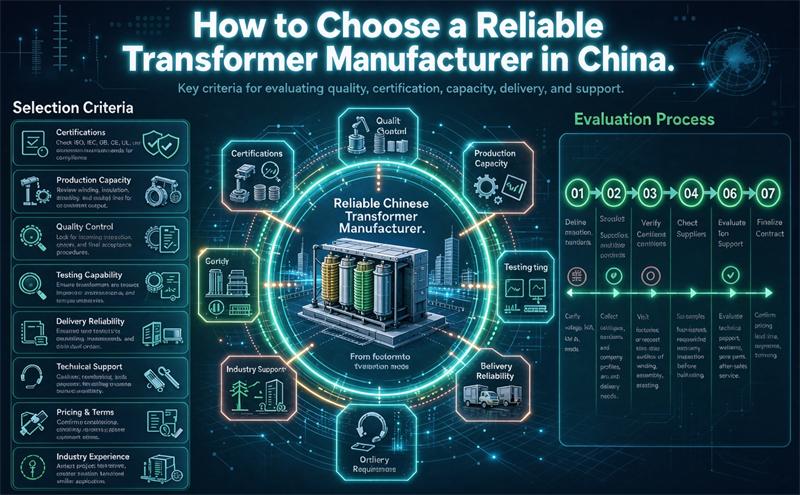
The 7-point evaluation framework
Run every candidate through the same seven points. Apply it to us too. A supplier that answers all seven clearly is worth a second conversation; one that dodges any of them is not.
| # | What to check | What “good” looks like |
|---|---|---|
| 1 | Engineering capability | In-house design with licensed electrical engineers; references at your voltage class and capacity |
| 2 | Quality system | ISO 9001 whose scope covers transformer manufacturing at the factory address, not “sales of electrical equipment” |
| 3 | Test credentials | IEC 60076 or IEEE C57 type-test reports from recognized labs (KEMA, CESI, ASTA) |
| 4 | Capacity and delivery record | Winding machines, vacuum drying, oil processing, and a test bay sized for your rating; on-time data from the last two years |
| 5 | Export and documentation | Destination-market compliance (UL/CSA, CE, SASO, etc.), English docs, experience with LC and Incoterms |
| 6 | After-sales and commissioning | Named contact for installation supervision and warranty; regional references you can actually call |
| 7 | Willingness to be audited | Welcomes third-party inspection, shares calibration records, answers technical questions without deflection |
Point 7 carries more weight than the other six combined. A manufacturer that resists a video tour or a witnessed test is telling you something. One that welcomes it is telling you more.
Browse our full transformer catalog to see the hardware ranges these checks apply to, from dry-type to oil-immersed to compact substations.
A 5-step verification process before you pay
Evaluation criteria tell you what to look for. This is how you confirm it. Budget two to four weeks for the first three steps.
Cross-check the certificates yourself
Take the ISO 9001 certificate number and verify it through IAF CertSearch, the global database for ISO credentials. Confirm three things: the certificate is valid, the issuing body is accredited (SGS, TÜV, BV, or a CNAS-recognized body), and the scope covers manufacturing at the factory address. One EPC buyer we know ran this check and found the scope limited to “sales of electrical equipment.” The wall certificates belonged to the supplier, not the company. It was a trading company.
Demand the full type-test report
A complete IEC 60076 or IEEE C57 type-test report commonly runs 50 to 120 pages. It includes test circuit diagrams, measured values, instrument calibrations, and laboratory signatures. A supplier that sends a cover page with a pass stamp is hiding something, even if only disorganization. Cross-check the report number with the issuing laboratory. KEMA, CESI, and ASTA all verify reports on request.
Verify the business, not just the brochure
Request the business license and check the registered scope and address. A real manufacturer registers with “production” or “manufacturing” in its scope at a factory address. Export records, customs data, and satellite imagery of that address all corroborate. Our routine test checklist walks through the specific tests every unit should pass before it ships, which is the fastest way to judge whether a factory actually tests or just signs.
Audit the factory, or send someone who can
For orders above roughly $100,000, commission a third-party factory audit from SGS, TÜV, or BV in China. The auditor should check raw-material traceability, instrument calibration logs, winding records, and the test bay. If you visit yourself, watch a winding in progress and ask to see the calibration stickers on the test instruments.
Run a pilot unit before volume
Order one unit with a full witnessed FAT before committing to the batch. This single step prevents most expensive mistakes. A project engineer we worked with ordered one 1,000 kVA pilot before a 24-unit order. The witnessed test caught a bushing specification mismatch that would have affected the entire batch. The correction cost the factory two weeks. A full-order failure would have cost the project its energization date and roughly $140,000 in penalties.
North America vs Europe: the certification split that actually matters
This is where a lot of otherwise good sourcing decisions fall apart. The standards are different, and so is the proof.
If your units land in the US or Canada
Plan for UL 1561 (liquid-immersed) or UL 1562 (dry-type) listings, IEEE C57 / ANSI C57.12 design and test basis, and DOE efficiency compliance for distribution and medium-power units. UL or cUL listings must cover the exact model you are buying, not the manufacturer’s general capability. Confirm the listing in UL’s own online database rather than trusting a PDF.
If your units land in the EU or UK
Plan for CE marking against EN 60076 (the European adoption of IEC 60076), UKCA for Great Britain, and, for connected or smart units, the relevant IEC 62443 cyber-security expectations. One honest caveat worth knowing: CE marking for transformers is largely self-declared, so it carries less verification weight than a witnessed test report or an independent type test. Our IEC vs ANSI/IEEE standard map lays out exactly where the two systems diverge so your spec sheet does not assume the wrong baseline.
Red flags that should stop the conversation
| Red flag | Why it matters |
|---|---|
| Business license scope shows trading, not manufacturing | You may never know which factory built your unit |
| Refusal of live video tours or FAT witnessing | Transparency is the cheapest signal a good factory gives |
| Certificates that fail verification with the issuing body | The paper is the whole point; a fake one is a liability |
| UL or CE claims without model-specific listings | Generic claims do not clear customs or the AHJ |
| Price below material logic | Copper, core steel, and oil set a floor; below it, something is substituted |
Stop comparing gate price. Compare total cost.
The factory-gate number is the smallest line on the real invoice. Build your comparison on total cost of ownership:
- Shipping and marine insurance to your port
- Import duties and local taxes for your destination
- Installation, commissioning, and any local inspection
- Guaranteed losses (no-load and load), because a unit running 30 years at 0.5 percent extra loss costs more than the price gap
- Warranty enforcement and the cost of a local service partner if you need one
A supplier that answers these questions clearly makes it easier to evaluate both technical suitability and commercial risk. That is the goal: identify the supplier who can meet the specification, deliver the agreed product, and stand behind it.
Your procurement RFQ checklist
Send the same spec sheet to three to five candidates and compare like for like. Include:
- Required type, voltage ratio, capacity, and vector group
- Applicable standard (IEC 60076 or IEEE C57) and destination-market marks
- Winding material and declared conductor purity if copper is specified
- Guaranteed no-load and load losses, and impedance
- Cooling class (ONAN, ONAF, AN, AF) and enclosure / IP rating
- Routine and type-test scope, with a witnessed FAT clause
- Third-party inspection allowance (SGS, TÜV, BV)
- Payment terms, Incoterms, lead time, and delivery penalties
- Warranty period and who performs local commissioning
A clear specification forces suppliers to quote against the same baseline. Vague RFQs attract vague responses.
Frequently asked questions
1. How do I know if a Chinese transformer supplier is a real factory?
Check that the business-license scope says manufacturing at a factory address, ask for a live video tour of the winding and test areas, and request dated production photos. A third-party audit from SGS or Bureau Veritas settles it definitively.
2. What certifications should a reliable manufacturer hold?
At minimum ISO 9001 with manufacturing scope, plus IEC 60076 or IEEE C57 type-test reports. Then match the market: UL 1561 or UL 1562 and DOE efficiency for North America, CE / EN 60076 and UKCA for Europe. SASO, EAC, BIS, and SONCAP apply for other regions.
3. Can I witness the factory acceptance test without flying to China?
Yes. Most established factories accept a live video FAT, and many buyers appoint an independent inspector to witness on site. Both are common for first orders and cost far less than a failed shipment.
4. How long does a transformer take to manufacture in China?
Commonly cited 2026 ranges: standard dry-type about 20 to 32 weeks, oil-immersed distribution about 30 to 45 weeks, and large or custom power units about 10 to 12 months, with emergency slots sometimes under eight months. Western factories often quote 18 to 24 months for comparable units. Treat these as ranges to confirm against current backlog, not fixed dates.
5. Should I worry about copper versus aluminium windings?
Yes, if your spec requires copper. Aluminium windings are legitimate for some ratings but they are larger, less conductive, and must be declared. If copper is specified, ask for a conductor purity report; copper should exceed 99.9 percent purity.
6. Is buying from China risky?
It can be risky if you choose an unverified supplier, accept an incomplete specification, or decide on price alone. It is not risky by default. The same due diligence applies to a European or North American supplier. Reliability is a verification result, not a country result.
7. What is the single highest-value step in supplier selection?
The pilot unit with a full witnessed FAT. One compliant unit with witnessed testing costs a fraction of a failed batch and confirms everything the paperwork promised before you scale up.
Summary
Choosing a reliable transformer manufacturer in China is less about finding the cheapest quote and more about confirming four things: you are talking to a real factory, the certifications match your market, the test reports are complete and verifiable, and a witnessed FAT on a pilot unit clears before volume. Run the seven-point framework, watch for the red flags in the table, and compare total cost rather than gate price.
You can see how these checks play out in real export work across our project case studies, including an overseas utility EPC substation programme where documentation and witnessed testing were the deciding factors. And our technical resource library covers nameplate reading, routine testing, and the IEC vs ANSI standard split if you want the deeper version. If your 2026 build needs a manufacturer you can actually verify, reach out and we will spec it with you.