A renewable energy transformer is a transformer built to connect solar, wind, battery, and hydro generation to the grid; it steps the low generator voltage (400–690 V AC from inverters, or 690 V from wind turbines) up to the 11–35 kV collection level and beyond, and it has to handle the variable output, inverter harmonics, and two-way power flow that ordinary grid transformers were never designed for.
If you are specifying hardware for a solar farm, a wind project, or a battery site, this is the page you actually want. We at TransNine Electric build units across all of those applications, so this is not a brochure. It is a straight answer to what these transformers are, which type goes where, and how to pick the right one without overpaying or waiting two years for the wrong box.
Here is the short version
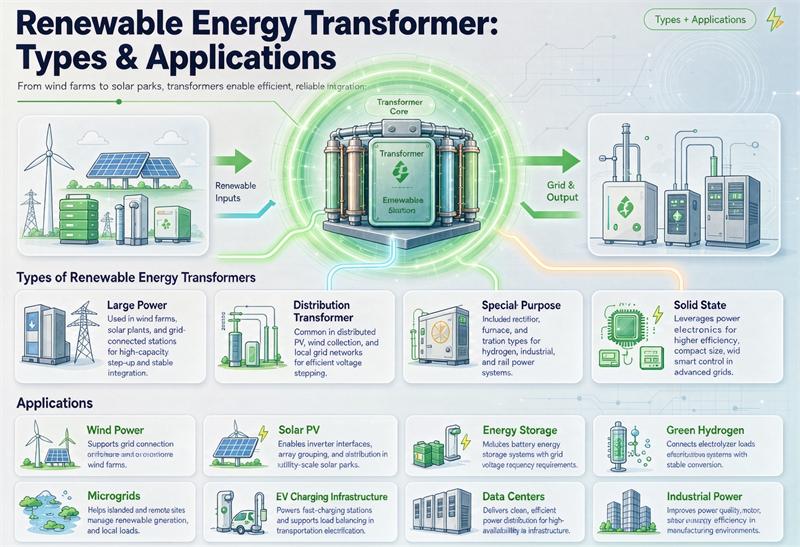
Most renewable transformers do one job: raise low generator voltage to the level the grid wants, while surviving conditions a substation transformer never sees. The four you will meet most often:
- Solar PV inverter transformer: sits by the inverter, 400–690 V AC up to 11 or 33 kV, usually 1–2 MVA per skid.
- Wind turbine transformer: at the tower base or in the nacelle, 690 V up to 11 or 33 kV.
- Collector / grid step-up transformer: the substation unit, 35 kV up to 132–400 kV, often 10–300 MVA.
- BESS transformer: like the others but built for power flowing both ways, 400–800 V DC side up to 11 or 33 kV.
Browse our full transformer catalog to see the hardware that covers each of those spots.
Why renewable projects need a different kind of transformer
A conventional distribution transformer expects a steady, one-direction flow from the grid to a load. Renewable generation does the opposite, and it is messier.
The four stresses ordinary units hate
- Variable output. Solar ramps with clouds; wind gusts and lulls. The transformer sees constant load cycling, not a flat line.
- Harmonics from inverters. Power electronics dump distortion back into the winding. Left alone, that heats the core and shortens life.
- Two-way power flow. Battery sites charge and discharge. The unit has to behave on export and import.
- Harsh outdoor duty. Desert heat, coastal salt, mountain cold, and dust are the normal job site, not the exception.
What that means for the hardware
Those stresses push designers toward low-loss cores, reinforced clamping for vibration (wind), K-factor or harmonic-tolerant windings, sealed or corrosion-resistant enclosures, and sensors plus SCADA for remote monitoring. None of that is optional on a utility-scale build.
The main types of renewable energy transformers
This is the table buyers keep coming back to, so here it is in one place.
| Type | Where it lives | Cooling | Typical voltage | Typical size | Best for |
|---|---|---|---|---|---|
| Solar PV inverter transformer | By the inverter / skid | Dry or oil | 400–690 V → 11 / 33 kV | 1–2 MVA | Utility-scale PV |
| Wind turbine transformer | Tower base or nacelle | Oil or dry | 690 V → 11 / 33 kV | 1–5 MVA | Onshore & offshore turbines |
| Wind / collector step-up | Farm substation | Oil | 35–220 kV | 10–200 MVA | Aggregating feeders |
| Pad-mounted transformer | Outdoor distribution | Oil | 11–35 kV | 1–10 MVA | Safe public-site step-down |
| Dry-type transformer | Indoor / fire-risk zones | Air | 400 V – 35 kV | 0.5–5 MVA | BESS rooms, desert PV |
| BESS transformer | Storage containers | Dry or oil | 400–800 V DC → 11 / 33 kV | 1–10 MVA | Charge / discharge |
| Grid step-up power transformer | Export substation | Oil | 66–400+ kV | 30–300 MVA | Transmission tie-in |
| Microgrid / distributed | Commercial & hybrid | Dry or oil | 400 V – 35 kV | 0.1–5 MVA | Campuses, islands |
Our renewable energy transformer solutions package the solar, wind, and BESS units as one coordinated design instead of three separate purchases.
Where each type actually goes
Solar PV farms
A panel puts out 600–1500 V DC. The inverter turns that into 400–690 V AC. A pad- or skid-mounted transformer then steps it to 11 or 33 kV for the collection network, and a substation transformer pushes it to 132 kV or higher for the grid. Each inverter skid typically carries its own 1–2 MVA dry-type unit. You can see how this played out in a real 50 MW solar PV case study we shipped.
Wind, onshore and offshore
Turbines generate at 690 V AC. A transformer at the base (or inside the nacelle) lifts that to 11 or 33 kV. Collector lines gather many turbines, then a substation unit steps up to 132–220 kV. Offshore, the same idea runs through sealed, compact, subsea-ready hardware.
Battery energy storage (BESS)
Storage inverts between DC and AC, so the transformer sees power going both directions. The DC side is usually 400–800 V, stepped to 11 or 33 kV on the AC side. Bidirectional rating and isolation matter more here than raw capacity.
Hydro and hybrid microgrids
Small hydro steps up from 400 V – 11 kV to 33 kV or 66 kV. Microgrids mix solar, storage, and sometimes gensets at 400 V – 35 kV, and the transformer has to ride through islanded operation.
Dry-type vs oil-immersed for renewables
Both show up, and the choice is mostly about fire risk and size.
- Dry-type (air-cooled, often cast-resin). Lower fire risk, no oil pit, happy indoors or in desert PV and BESS rooms. Sizes top out around 5 MVA in practice.
- Oil-immersed (mineral or ester fluid). Better cooling and the only real option above roughly 5 MVA, and mandatory for substation and export units. Esters (natural or synthetic) cut fire risk and are common near coasts.
Our cast-resin dry-type units are built exactly for the solar and BESS jobs where fire safety and no-oil maintenance win the day.
North America vs Europe: what actually changes
Most guides skip this, and it is the part that bites buyers. The physics is the same; the paperwork and voltage classes are not.
- Frequency. North America runs 60 Hz; most of Europe runs 50 Hz. The transformer is tuned to one, not both.
- Standards. The U.S. leans on IEEE C57.12 and ANSI; Europe leans on IEC 60076. A unit built to one family is not automatically accepted under the other without review.
- Voltage classes. Common North American collection levels are 13.8 kV and 34.5 kV; across much of Europe you will see 10 kV, 20 kV, and 33 kV instead.
- Pad-mounted practice. Underground-residential and pad-mounted distribution is routine in North American utilities; European builds more often use compact substations.
Always confirm the exact edition your jurisdiction’s authority cites before you order. Our technical resource library walks through the IEC vs ANSI split in detail.
Efficiency, standards, and what to ask for
The codes that actually govern these units:
- IEC 60076: the global dry-type and liquid-immersed family, referenced across Europe, Asia, and export projects.
- IEEE C57.12: the North American counterpart for pad-mounted and substation units.
- DOE 2016 (U.S.) and EU EcoDesign: efficiency floors for distribution transformers; verify the edition your market enforces.
When you talk to a supplier, ask for the loss evaluation (no-load and load losses), the K-factor or harmonic rating, the Basic Insulation Level (BIL), and whether the unit carries on-load tap changing for voltage swings. Those four numbers separate a real renewable-grade unit from a repurposed general-purpose one.
How to choose the right one for your project
Skip the type list and start from your site. Five steps:
- Pin the voltages. What does the generator or inverter output, and what does the grid require at the interconnection point?
- Decide indoor vs outdoor and fire risk. That alone often settles dry-type vs oil.
- Size it. Inverter skids run about 1–2 MVA; collector substations run 10–200 MVA; export units 30–300 MVA. Match the stage, not the headline number.
- Pick the cooling. Air for smaller, fire-sensitive sites; oil or ester for anything large or remote.
- Lock the standards and monitoring. IEC or IEEE, 50 or 60 Hz, and the SCADA/DGA sensors your operator expects.
Your RFQ checklist
Before you send a quote request, have these nine items ready:
- Source type (solar / wind / BESS / hybrid) and stage
- Generator or inverter voltage and grid voltage
- Required kVA or MVA and overload margin
- 50 Hz or 60 Hz
- Dry-type or oil / ester, and why
- K-factor or harmonic specification
- Target efficiency and loss evaluation
- IEC 60076 or IEEE C57 edition
- Monitoring (sensors, SCADA, DGA) and test requirements
Get those on paper and you will cut the back-and-forth with any factory to almost nothing.
Frequently asked questions
What is a renewable energy transformer?
It is a transformer designed to connect solar, wind, battery, or hydro generation to the grid. It steps low generator voltage (400–690 V AC, or 690 V from turbines) up to the 11–35 kV collection level and handles variable output, harmonics, and two-way flow.
What types of renewable energy transformers are there?
The main ones are solar PV inverter transformers, wind turbine transformers, collector and grid step-up transformers, pad-mounted units, dry-type units, BESS transformers, and microgrid transformers. Each fits a different point in the generation-to-grid chain.
What voltage do solar farms use?
Panels output 600–1500 V DC. Inverters convert that to 400–690 V AC. A transformer steps it to 11 or 33 kV for collection, then a substation unit pushes it to 132 kV or higher for the grid.
What size transformer does a solar farm need?
Inverter skids typically carry 1–2 MVA dry-type units. Collector substations run 10–200 MVA, and the export transformer can reach 30–300 MVA depending on the grid tie.
Dry-type or oil-immersed for renewables?
Dry-type wins for indoor or fire-sensitive sites up to about 5 MVA. Oil or ester units are needed above that and for any substation or export application where cooling and capacity dominate.
Do wind turbines have their own transformer?
Yes. Each turbine generates at 690 V AC and uses a transformer at the tower base or inside the nacelle to step up to 11 or 33 kV before the collector network.
What standards apply to renewable energy transformers?
IEC 60076 covers most global and European builds; IEEE C57.12 covers North America. Efficiency is governed by rules such as DOE 2016 in the U.S. and EU EcoDesign in Europe. Confirm the exact edition your market enforces.
The bottom line
Renewable energy transformers are not mystery hardware. They are standard transformers asked to do a harder job: climb from 400–690 V to 11–35 kV and beyond, while the sun, wind, and batteries keep changing their mind. Pick by stage and site, not by the longest marketing list, and the spec almost writes itself.
You can see how these units run in the field across our project case studies, from a 50 MW solar plant to hospitals and metro traction. If your 2026 build needs hardware that actually fits the schedule and the standard, reach out and we will spec it with you.