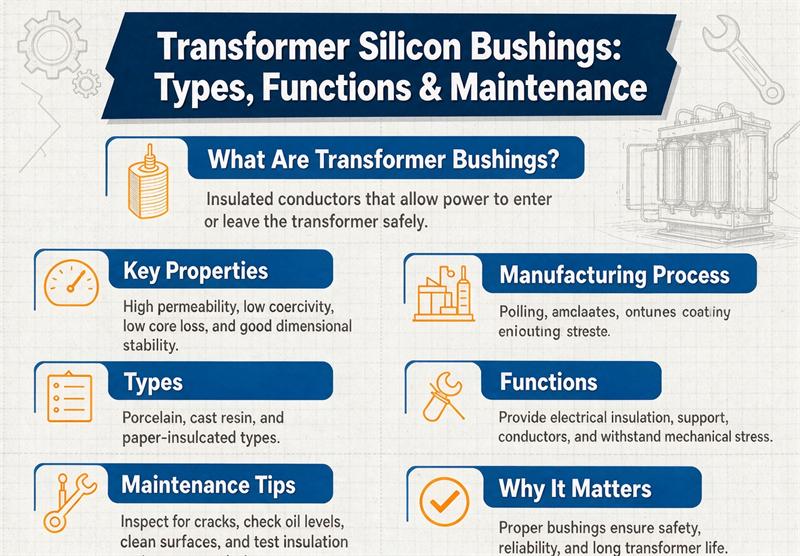
A transformer bushing is the sealed, insulated passage that carries a live conductor safely through the grounded tank wall, so current can enter and leave the windings without arcing or flashover. The bushing type you specify, porcelain, composite, resin, or oil-filled capacitor, sets the insulation, the creepage distance, and most of the maintenance burden.
At TransNine Electric we build dry-type and oil-immersed units, so the bushing choices below are the ones we specify and test every week rather than something we read about secondhand.
| Type | Core insulation | Best fit | Watch out for |
|---|---|---|---|
| Porcelain (solid) | ceramic, air on the outside | LV and simple HV, lowest cost | brittle, needs long creepage in dirt |
| Composite | FRP core with silicone or EPDM sheds | polluted, coastal, easier handling | higher unit cost |
| Resin (dry-type) | solid epoxy | indoor and dry-type units, no oil | limited at the very high voltages |
| Oil-paper capacitor | layered paper and foil soaked in oil | 72.5 kV and above | oil leak risk, test tap must stay grounded |
What a bushing actually does
A bushing has one job that sounds simple and is not. It lets a high-voltage conductor pass through a metal wall that is at earth potential without letting the voltage jump to the wall. Three things have to hold at the same time.
First, electrical isolation. The insulation keeps the live conductor away from the tank by a safe margin under every condition, including lightning and switching surges. Second, mechanical support. The bushing clamps the heavy conductor and holds it steady through short-circuit forces and wind. Third, a controlled leakage path. The outside shape, the sheds and creepage length, decides how much surface current can form when the air is wet or dirty.
Skip any one of those and you get the failures buyers actually fear: a flashover down the side, a cracked insulator, or a slow insulation breakdown that nobody noticed.
The four bushing types, in plain terms
Porcelain bushings are the old reliable. A solid ceramic tube with the conductor inside and air doing the outside insulation. They are cheap and tough against heat, but they are heavy, they crack if struck, and in a dirty environment they need a lot of creepage length.
Composite bushings wrap a fiberglass core in silicone or EPDM rubber sheds. They shrug off pollution, weigh far less, and survive impact that would shatter porcelain. The trade is a higher price and a rubber surface that ages under strong UV.
Resin bushings are solid epoxy, the standard choice on cast-resin dry-type transformers. No oil, no leak path, safe indoors, and they need almost no service. They are the right call whenever the unit sits inside a building or a skid where an oil fire rating matters.
Oil-paper capacitor bushings dominate from 72.5 kV upward. Inside is a rolled core of cable paper and thin aluminium foil that forms a stack of tiny capacitors. That grading keeps the voltage drop even along the length, so the bushing stays compact and its electric field stays tame. The catch is the oil system: it can leak, and it hides a test tap that must be grounded in service.
How a capacitor bushing is built, and why the test tap matters
The capacitor core is the clever bit. Alternate layers of paper and foil build a series of capacitors that share the voltage almost evenly. The result is a bushing that does the job of a much longer solid one. A 145 kV oil-paper capacitor bushing typically shows a main capacitance around 300 to 600 pF, which is the number your test set reads when you check it.
That reading is taken from the test tap, sometimes called the end screen. The tap brings out the innermost foil layer so you can measure capacitance and power factor without disconnecting the bushing. Here is the part field crews forget: in normal operation that tap must be solidly grounded. Leave it floating and you create a small, unhappy capacitor that invites partial discharge and eventual failure. Ground it, and it is just a tidy diagnostic port.
What to specify on the purchase order
Buyers lose money when the bushing line on the spec is left vague. Write these down and the supplier cannot hide behind “standard.”
| Parameter | What to put on the PO | Typical figure |
|---|---|---|
| Rated voltage | system kV plus BIL | 145 kV bushing, BIL 650 kV |
| Rated current | continuous amp rating | 630, 1250, 2000, 3150, 4000 A |
| Creepage and pollution | IEC 60815 level | 25 mm/kV moderate, 31 mm/kV and up heavy |
| Construction | capacitor or solid, oil or resin | oil-paper capacitor above 72.5 kV |
| Test tap | required and grounded in service | yes for capacitor type |
| tan delta limit | measured at 20 C | new unit below 0.5 percent |
| Partial discharge | at 1.05 times rated voltage | new unit below 10 pC |
The creepage number is the one most often missed. A 145 kV bushing in a moderate-pollution area needs about 25 mm per kV, roughly 3,600 mm of creepage around the sheds. Move that same bushing to a coastal or industrial site and the requirement climbs to 31 mm per kV or more. Order the wrong pollution class and you have bought a flashover waiting for the next storm.
A maintenance schedule you can actually keep
Bushings fail slowly, which means they fail predictably if you test on a rhythm. The schedule below is the one we recommend to owners of units we supply.
| When | Oil-filled capacitor | Resin or dry-type |
|---|---|---|
| On receipt or at FAT | IR, tan delta, capacitance, PD, oil BDV and DGA | IR, tan delta, capacitance, PD |
| In normal service | tan delta and PD every 3 to 6 years | IR and PD every 3 to 6 years |
| Critical units | PD survey every 1 to 3 years, DGA quarterly to annual | IR and PD every 1 to 3 years |
| After a fault or lightning strike | re-test right away | re-test right away |
Two tests do most of the work. Power-factor, or tan delta, trends upward as the insulation wets or ages; a new bushing should sit below 0.5 percent at 20 C. Partial discharge is the early warning for voids and surface tracking, and a clean new unit measures under 10 pC. For oil-filled types, an oil sample that shows rising moisture or fault gases tells you the seal is letting go long before the bushing quits.
If you are sizing a unit, the data-center transformer sizing tool helps you set the kVA and load current that the bushings must carry day to day.
What the failure numbers say
Bushings are not a minor part. Utility and CIGRE surveys repeatedly place them among the top contributors to transformer outages, often quoted in the range of 15 to 20 percent of failures. Those are industry survey figures, not a measured rate for any single unit, but they line up with what service shops see: cracked porcelain from handling, moisture that crept past a failed seal, pollution flashover on an under-shedded unit, and the silent partial discharge that ran for years because nobody tested.
The good news is that three of those four start with a visible or measurable clue. A crack shows up in inspection. Moisture shows up in oil tests. Discharge shows up in a PD survey. Only the slow, untested decline hides, and that is exactly what a schedule fixes.
The standards you will see on the nameplate
Bushings carry their own standards, separate from the transformer body. IEC 60137 covers bushings for alternating voltages above 1 kV and is what most export units quote. In North America, IEEE C57.19.00 sets the general requirements and C57.19.01 covers sealed bushings. Pollution classes come from IEC 60815, and the partial-discharge measurement behind the 10 pC limit comes from IEC 60270. Our transformer technical library has deeper write-ups on how IEC 60137 and IEEE C57.19 line up for export projects.
Dry-type resin bushings versus oil-filled, for the buyer
This is the choice that lands on most purchase orders. If the transformer is cast-resin and lives indoors, resin bushings are the natural match: no oil, no fire rating headache, almost no service. If the unit is oil-immersed and rated above 72.5 kV, you will almost certainly be specifying oil-paper capacitor bushings, and you accept the oil checks that come with them.
Neither is “better” in the abstract. They answer different sites. A data hall and a coastal substation have opposite priorities, and the bushing is where that shows up first. When you browse our transformer catalog you can see which voltage classes we build with resin and which with oil-filled bushings, because the two designs do not mix.
A buyer’s procurement checklist
Use this as the bushing section of your specification and you will get comparable quotes.
- State the system voltage and the BIL, not just “high voltage.”
- State the continuous current rating, including the low-voltage side where currents are largest.
- State the pollution level per IEC 60815, with the site description.
- State capacitor or solid, and oil or resin, per the unit type.
- Require a test tap on capacitor types and confirm the grounding method.
- Put a tan delta limit (below 0.5 percent at 20 C) and a PD limit (below 10 pC) in the acceptance test.
- Ask for the FAT report: IR, capacitance, tan delta, PD, and oil BDV or DGA where applicable.
The loss and TCO calculator shows how bushing and core losses add up across a 30-year life, which is the other half of the bushing decision once the reliability side is settled.
Mistakes worth avoiding
Specifying creepage for a clean site and then installing beside the sea. Leaving the test tap ungrounded because nobody labeled it. Treating the bushing as “just a porcelain post” on a 145 kV unit where only a capacitor type will do. And the big one, never testing. A bushing that was new and clean at commissioning is not new and clean ten years later, and the only way to know is to measure.
The NEC protection-sizing calculator turns the bushing current rating into the right overcurrent device, which is the step right after you have picked the bushing itself.
Where bushings show up in real projects
Every transformer we ship leaves the factory with its bushings already fitted and tested, from small cast-resin units in city hospitals to 245 kV power transformers on utility lines. The delivered substation and power projects show bushings working in real 11 kV to 245 kV installations, including solar step-up yards and metro traction substations where pollution and vibration are part of daily life.
Wrapping up
A transformer bushing looks like a simple post, but it is the one component that bridges the live winding and the grounded world, and it carries the full voltage, current, and weather load while doing it. Pick the type to the site, write the spec with real numbers, ground the test tap, and test on a schedule, and most bushing failures simply stop happening. If you are drafting a specification and want a second read on the bushing section, that is a conversation we are happy to have.
FAQ
What is the main job of a transformer bushing? A bushing lets a live conductor pass through the grounded tank wall while keeping the voltage away from the tank. It provides electrical isolation, mechanical support for the conductor, and a controlled creepage path on its outer surface so current does not flash over in wet or dirty conditions.
What are the main types of transformer bushings? There are four in common use. Porcelain solid bushings for low cost and simple duty, composite bushings with rubber sheds for polluted sites, solid resin bushings for indoor dry-type units, and oil-paper capacitor bushings for 72.5 kV and above where graded insulation keeps the size and field under control.
What does a bushing test tap do, and must it be grounded? The test tap, or end screen, brings out the innermost foil layer of a capacitor bushing so you can measure capacitance and power factor without disconnecting it. In normal service that tap must be solidly grounded. A floating tap forms a small capacitor that encourages partial discharge and premature failure.
What creepage distance do I need for a polluted site? Use IEC 60815 pollution classes. A 145 kV bushing in a moderate-pollution area needs about 25 mm per kV, roughly 3,600 mm of creepage. In a coastal or industrial site that rises to 31 mm per kV or more, so the pollution class on the purchase order matters as much as the voltage.
What tan delta and partial discharge limits apply to a new bushing? A new bushing should measure below 0.5 percent power factor, or tan delta, at 20 C, and below 10 pC of partial discharge at 1.05 times rated voltage per IEC 60137. Both numbers are acceptance limits, not field-trip thresholds, and they give you the baseline your trend tests compare against.
How often should bushings be tested? On receipt or at the factory acceptance test, then in normal service every 3 to 6 years with tan delta and partial discharge. Critical units get a PD survey every 1 to 3 years and, for oil-filled types, oil analysis quarterly to annual. Test again immediately after any fault or lightning strike.
Are resin bushings better than oil-filled ones? Neither is universally better. Resin bushings suit indoor dry-type units with no oil and almost no service. Oil-paper capacitor bushings suit oil-immersed units above 72.5 kV and bring oil checks with them. The right choice follows the site and the transformer type, not a general ranking.
Which standards cover transformer bushings? IEC 60137 covers bushings above 1 kV and is the common export standard. IEEE C57.19.00 and C57.19.01 cover North American general and sealed requirements. IEC 60815 defines pollution classes, and IEC 60270 is the partial-discharge measurement behind the 10 pC limit.