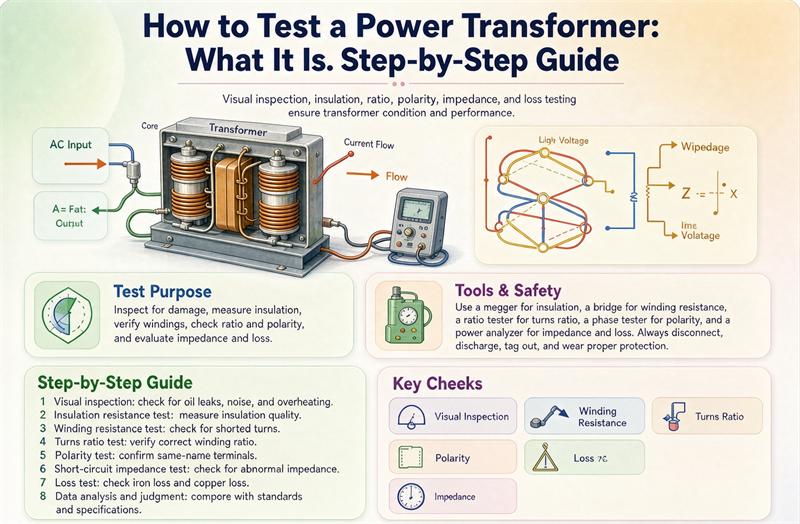
A power transformer is tested through a fixed sequence: first isolate it and prove it dead with lockout/tagout, then inspect it visually, then measure insulation resistance and polarization index, check the turns ratio on every tap, measure DC winding resistance, and finally run no-load and load tests, judging each reading against the nameplate and IEEE C57.12.90 or IEC 60076 limits. Get that order right and most failures show up before you ever energize the unit.
We build dry-type and oil-immersed units at TransNine Electric for North American and European buyers, and the question we hear most is not “what is a turns-ratio test.” It is “what tests should I actually require, and what numbers tell me the unit is good.” This guide answers both, in plain language a specifier or plant electrician can use.
The Three Test Stages You Should Know First
Before any tool comes out, know which kind of test you are doing. They are not the same, and mixing them up is how buyers get charged for work they did not need.
| Stage | When it happens | Who runs it | Core tests |
|---|---|---|---|
| Routine / factory FAT | Before the unit ships | Manufacturer | IR/PI, TTR, winding resistance, no-load loss, impedance, applied and induced AC, impulse |
| Commissioning / site SAT | On arrival or before first energization | Installer or third-party lab | Visual, IR/PI, TTR, winding resistance, SFRA, oil tests if oil-filled |
| In-service diagnostic | Periodic or after a fault | Owner or service contractor | IR/PI, DGA, BDV, thermography, dissolved-gas trend |
The steps below cover the commissioning and diagnostic work a buyer or operator controls. Factory FAT is the manufacturer’s job, but you should still see the test report before you pay.
What You Need: The Test Kit
You do not need a lab to do the basics, but you do need the right gear. A typical on-site kit:
- A calibrated multimeter rated CAT III or CAT IV for the voltage class.
- A 500 V to 5 kV insulation resistance tester (megger).
- A turns-ratio tester (TTR).
- A DC winding-resistance meter (micro-ohmmeter).
- A variable AC supply (variac) for no-load and load checks.
- An oil test kit (BDV and DGA sampling) for oil-filled units only.
- An SFRA analyzer for commissioning after shipping or after a fault.
- A thermal camera for load and connection checks.
- Lockout/tagout hardware, a permit to work, and arc-flash PPE.
If you are still sizing the unit, our transformer NEC calculator helps you confirm protection and fault-current numbers before you test them in the field.
Step 1: Safety Isolation (Do This Before Anything Else)
No test is worth a shock. De-energize the transformer on every incoming and outgoing side, apply lockout/tagout, open the disconnects, and verify zero voltage with a rated meter. Then bond the unit to ground and post the permit to work. Wear arc-flash PPE whenever you are near exposed bushings or terminations. Under no circumstance test a transformer that is still connected to a live source.
Why it matters to you: most transformer injuries during testing happen because someone assumed a feeder was dead. Prove it, do not assume it.
Step 2: Visual and Mechanical Inspection
Walk the unit before you apply voltage. Check oil level and look for leaks (oil-filled only), inspect bushings for cracks or carbon tracking, confirm nameplate data matches the order, and verify accessories (cooling fans, OLTC, gauges, pressure relief) are fitted and undamaged. Note any transit damage, because a dent can mean a shifted winding that only shows up later.
Why it matters to you: a 10 minute visual catches the problems a $5,000 test suite cannot, like a loose terminal that will arc on first load.
Step 3: Insulation Resistance (IR) and Polarization Index (PI)
Using a 5 kV megger (or a lower voltage for low-voltage units), measure resistance between each winding and ground, and between windings. Record the 1 minute reading as IR and the 10 minute reading as the basis for PI.
Acceptance you can trust:
- IR should exceed roughly 1 megohm per kilovolt of rating, with a practical floor around 100 megohms at the test voltage.
- PI (the 10 minute reading divided by the 1 minute reading) should be above 2.0. New dry units often read above 4.
Low IR points to moisture or contamination. A PI below 1.5 means the insulation is wet or dirty and the unit should not be energized until it dries or is cleaned.
Step 4: Turns Ratio (TTR) on Every Tap
Energize the primary with a low test voltage and read the secondary on each tap position. Compare the measured ratio to the nameplate. Per IEEE C57.12.90 the measured ratio should stay within about 0.5 percent of the declared value across all taps.
Why it matters to you: a wrong ratio means wrong voltage at your load, and it is the fastest way to confirm the tap changer is not damaged. This single test catches more hidden winding faults than any other.
Step 5: DC Winding Resistance
Inject DC current and measure resistance in each winding and phase, on every tap. The readings across phases should agree within about 5 percent of their average. A high or open reading flags a broken strand, a loose connection, or a bad tap-contact.
Why it matters to you: loose internal joints heat up under load and eventually fail. This test finds them cold, on a bench, for the price of an afternoon.
Step 6: No-Load and Load Tests
These confirm efficiency and regulation. The no-load test measures core (iron) loss and magnetizing current; the load test measures secondary voltage drop under a resistive load and the temperature rise. Compare no-load loss to the guaranteed value (IEC allows a tolerance band around the guarantee, commonly in the low double digits percent).
If losses are part of your buying case, our transformer loss and TCO calculator turns those nameplate loss figures into 30 year cost and payback numbers you can put in front of finance.
Step 7: Oil Tests (Oil-Filled Units Only)
Dry-type units skip this step entirely. For oil-filled transformers, draw a sample and run:
- Breakdown voltage (BDV): new mineral oil should clear above about 30 kV per ASTM D877 or D1816.
- Dissolved gas analysis (DGA): looks for acetylene, hydrogen, and ethylene that signal arcing, partial discharge, or overheating.
- Moisture content: high water accelerates insulation aging.
Why it matters to you: DGA is the early-warning system for internal faults. A rising acetylene trend can warn you months before a failure, which is the difference between a planned outage and a burnt unit.
Pass/Fail Numbers at a Glance
| Test | What it checks | Typical acceptance |
|---|---|---|
| Insulation resistance (IR) | Winding to ground and between windings | Above 1 MΩ per kV; floor about 100 MΩ |
| Polarization index (PI) | Insulation dryness and cleanliness | Above 2.0, often above 4.0 for new |
| Turns ratio (TTR) | Voltage ratio per tap | Within 0.5 percent of nameplate |
| DC winding resistance | Broken strands, loose joints, tap wear | Within 5 percent of phase average |
| Dissipation factor (tan δ) | Oil and paper degradation | Below 0.5 percent at 20 °C for new |
| No-load loss | Core and iron loss | Within the guaranteed tolerance band |
| Oil BDV | Dielectric strength | Above 30 kV for new mineral oil |
How Often Should You Test?
| Interval | Trigger | Tests |
|---|---|---|
| Commissioning | Before first energization | Visual, IR/PI, TTR, winding R, SFRA, oil |
| 1 year | First annual check | IR/PI, DGA, thermography |
| 3 to 5 years | Routine in-service | IR/PI, DGA, BDV, visual |
| After a fault | Event driven | SFRA, DGA, full diagnostic |
A unit that passes at commissioning and then sits untouched for a decade is a risk. The schedule above is the cheap insurance.
What to Put in Your Purchase Spec
This is the buyer angle most guides skip. When you order a transformer, write the required tests into the specification so the factory cannot ship without them:
- Routine FAT with a signed test report (IR/PI, TTR, winding resistance, no-load, impedance, impulse for units above a defined voltage).
- Acceptance limits stated in numbers, not “per standard.”
- For oil-filled units, DGA and BDV on the factory fill oil.
- For units above 1 MVA or after long shipping, require SFRA as a mechanical fingerprint.
Browse the product range to see which ratings and cooling classes we test to this routine, and match the spec to the unit you are buying.
Dry-Type vs Oil-Filled: The Testing Difference
Dry-type units need no oil tests, no oil-level or leak checks, and generally no SFRA unless shipped roughly or suspected of impact. Oil-filled units add the whole oil program (BDV, DGA, moisture) plus leak and level inspections. Everything else, the IR, PI, TTR, and winding-resistance steps, is the same for both. For data-center and harmonic loads, our transformer data-center calculator sizes K-rated and redundant dry-type units before you test them.
The Standards Behind the Numbers
The limits above come from published test codes. IEEE C57.12.90 is the North American test code for power transformers. IEC 60076-1 and IEC 60076-3 are the international equivalents for requirements and dielectric tests. Oil tests follow ASTM D877 and D1816 for BDV and related methods. Always confirm the exact acceptance value against the current edition of the standard and the unit’s routine-test report, because tolerances and thresholds shift between editions and between unit classes.
Wrapping Up
Testing a power transformer is a sequence, not a mystery: isolate safely, look at it, then prove the insulation, the ratio, the windings, and the losses against the nameplate and the relevant standard. Keep the pass/fail numbers from the table above on a single sheet, run them at commissioning and on schedule after that, and you will catch almost every failure before it becomes an outage. For more buyer-side guides on selection, standards, and naming, see the resources hub, and for real delivered jobs from data centers to solar farms, browse our project cases.
FAQ
What is the first step to test a power transformer? Safety isolation. De-energize every side, apply lockout/tagout, verify zero voltage with a rated meter, ground the unit, and wear arc-flash PPE. No electrical test should begin until the transformer is proven dead.
What tools do I need to test a transformer? A CAT III or CAT IV multimeter, a 500 V to 5 kV megger for insulation resistance, a turns-ratio tester, a DC winding-resistance meter, a variac for no-load and load checks, an oil test kit for oil-filled units, and lockout/tagout gear with arc-flash PPE.
What is a good insulation resistance reading? A practical rule is above 1 megohm per kilovolt of rating, with a floor around 100 megohms at the test voltage. The polarization index, the 10 minute reading divided by the 1 minute reading, should be above 2.0.
What is the acceptable turns ratio tolerance? Per IEEE C57.12.90 the measured turns ratio should stay within about 0.5 percent of the nameplate value on every tap position. A larger deviation signals a winding or tap-changer fault.
How often should a power transformer be tested? Run a full commissioning set before first energization, a basic check at 1 year, routine diagnostics every 3 to 5 years, and a full diagnostic after any fault. Oil-filled units add dissolved-gas analysis on that schedule.
Can I test a transformer while it is energized? No. Insulation, ratio, and resistance tests require the unit de-energized and isolated. Only voltage and load checks on a live system are done, and only with properly rated CAT IV instruments and PPE by qualified personnel.
What oil tests are needed for oil-filled transformers? Breakdown voltage should be above about 30 kV for new mineral oil per ASTM D877 or D1816, dissolved gas analysis watches for fault gases like acetylene and hydrogen, and moisture content is checked because water speeds insulation aging.
Which standards cover power transformer testing? IEEE C57.12.90 is the North American test code, IEC 60076-1 and IEC 60076-3 are the international equivalents, and ASTM D877 and D1816 cover oil breakdown voltage. Confirm exact limits against the current standard edition and the unit’s test report.