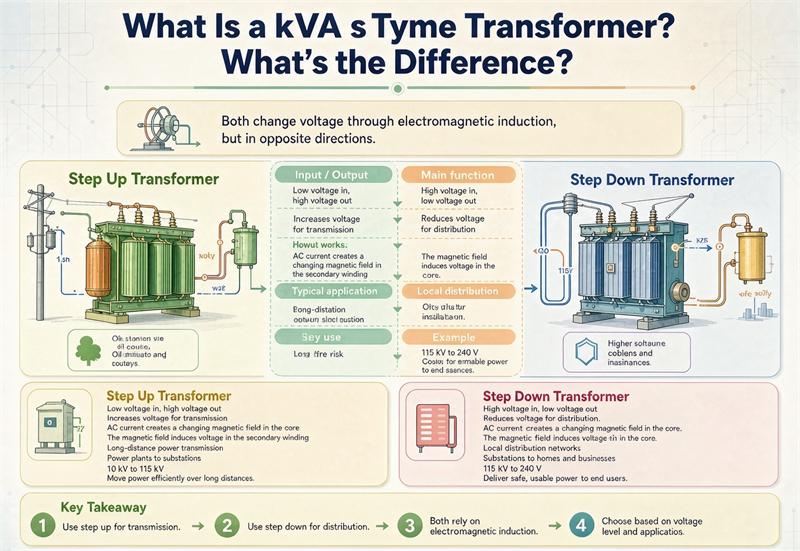
A step-up transformer raises the secondary voltage above the primary and lowers the current by the same ratio, while a step-down transformer does the reverse, lowering voltage and raising current, so the only real difference between the two is the direction the power flows. Everything else, from the core to the kVA rating, can be the same hardware wired the other way around.
If you are specing a unit for a project, the question is rarely “which is better.” It is “which way does my power need to go.” This guide walks through the turns-ratio math you can actually calculate, where each type belongs in a real system, whether you can run one backwards, and a short checklist you can paste into a request for quote. For the full catalog of transformer types and ratings, start from our home page.
Quick comparison at a glance
This is the table most buyers are really after. Keep it open while you read the sections below.
| Feature | Step-up transformer | Step-down transformer |
|---|---|---|
| Voltage change | Low to high | High to low |
| Current change | High to low | Low to high |
| Secondary turns | More than primary | Fewer than primary |
| Typical job | Generation, grid injection | Distribution, end-use equipment |
| Common example | 11 kV to 110 kV at a plant | 480 V to 208Y/120 V in a building |
| kVA rating | Set by load, not by direction | Set by load, not by direction |
How the turns ratio actually works
Both types obey the same rule. The voltage ratio equals the turns ratio:
V_secondary divided by V_primary equals N_secondary divided by N_primary.
Because a transformer loses very little power, the product of voltage and current stays about the same on both sides. So if voltage goes up ten times, current goes down ten times. That single line explains every “step-up raises voltage, step-down raises current” sentence you have read elsewhere.
Here is a number you can check yourself. Picture a step-up unit with 1,000 turns on the primary and 10,000 turns on the secondary. The ratio is 10 to 1. Feed it 11,000 V and the secondary puts out 110,000 V. The current drops to one tenth of what went in. Flip it around: a control transformer with 1,000 primary turns and 100 secondary turns is a 10 to 1 step-down, so 240 V in gives 24 V out and the secondary current is ten times the primary. Same math, opposite direction.
The winding with more turns is always the higher-voltage winding. That fact alone tells you, from a nameplate, which side is which.
Where step-up transformers belong
A step-up transformer lives wherever power has to travel as voltage instead of current. Raising the voltage cuts the current, and lower current means far less heat loss in the wires over a long run.
The classic spots:
- Power plants and generator terminals step voltage up before it leaves the site.
- Solar farms and wind plants step their output up to the grid voltage, often through a dedicated unit. Our piece on step-up transformers in renewable energy covers the role and selection in detail.
- A real example: a 50 MW solar PV plant step-up project where the array voltage is brought up to the utility interconnect level.
- International sites that need to push a local supply up to match imported equipment.
If your power starts low and needs to go far or onto the grid, you want step-up.
Where step-down transformers belong
A step-down transformer lives at the receiving end, where high transmission voltage has to become something a building, a machine, or a phone charger can use safely.
The classic spots:
- Utility substations step transmission voltage down toward distribution.
- Commercial and light industrial buildings take a 480 V service and step it down to 208Y/120 V for panels, receptacles, and HVAC.
- Electronics and adapters step mains voltage down to low direct current.
- Travel and import scenarios step a foreign mains voltage down (or up) to match the equipment you brought.
If your power arrives high and needs to become usable at the load, you want step-down.
Can you run a step-up transformer backwards?
Short answer: in principle yes, because a transformer is bidirectional. The windings do not care which side you call primary. Feed the original secondary and it becomes a step-down unit at the same ratio.
The longer answer is where every other guide stops short. Running a unit in reverse is not automatically safe or efficient:
- The winding you now feed was designed and insulated for its original voltage class. Feeding it a voltage it was not rated for can exceed its insulation.
- Cooling is usually sized for losses on the original high-voltage side. Reverse the flow and the hot spots move.
- The tap range and impedance were selected for one direction. Reversing can shift your output voltage outside tolerance.
- Efficiency and heating change. Small dry-type control and isolation transformers are often reversible when the nameplate says so, but large power transformers should not be run backwards without the manufacturer confirming the ratings.
So treat “it can be reversed” as “check the nameplate and ask the builder,” not as a free switch. If you genuinely need both directions, specify a reversible or double-rated unit up front.
Single-phase, three-phase, and the kVA myth
The step-up or step-down logic is identical whether the transformer is single-phase or three-phase. A three-phase unit is just three coupled windings, and the ratio applies to each one.
One myth is worth killing here: the kVA rating does not tell you the direction. A 1,000 kVA transformer can be built and connected as step-up or step-down; the kVA is the load it can carry, and that number stays the same either way (minus small losses). Buyers sometimes think a bigger kVA means “more step-up.” It does not. Capacity and direction are separate decisions. Pick the direction from your voltages, then size the kVA from your load.
Buyer checklist: step-up or step-down
Paste this into your request for quote so suppliers quote the same thing:
- Source voltage and load voltage. These two numbers decide the direction. Low to high is step-up; high to low is step-down.
- Flow direction. Generation, grid injection, or solar and wind points to step-up. Distribution, buildings, and equipment points to step-down.
- Required kVA from the actual load, now and a few years out. This is independent of direction.
- Single-phase or three-phase, matching your service.
- Installation environment: indoor or outdoor, dry-type or oil-immersed, cooling class, and enclosure rating.
- Standards for export: IEC 60076 for most international projects and IEEE C57.12.00 for North American style builds.
- If you might ever run it backwards, confirm reversibility on the nameplate before you buy.
You can browse the matching product lines once you know the direction and kVA.
Standards and nameplate: how to confirm what you have
Two standard families cover almost every unit you will meet. IEC 60076 is the international series for power transformers. IEEE C57.12.00 is the North American general-requirements standard. For export work, knowing which one your buyer expects saves a rejected submittal.
On the nameplate, the voltage ratio and the kVA are printed outright. Read the two voltage figures; the higher one sits on the winding with more turns, which tells you the designed direction. Our nameplate reading guide shows exactly which lines carry the ratio, impedance, and cooling class so you can verify a supplier’s claim instead of taking it.
Wrapping up
Step-up and step-down are not two different machines. They are the same machine described by the direction the power moves. Step-up raises voltage and lowers current for generation and long hauls; step-down lowers voltage and raises current for distribution and real loads. The turns ratio is the whole story, and you can calculate it from the winding counts. The one trap is reversibility: it works in theory, but only trust it when the nameplate and the builder say so. Size the kVA from your load, pick the direction from your voltages, and match the standard to your market. For more guides like this, browse the full resources library, and for real-world proof, see the project case studies.
FAQ
What is the difference between a step-up and step-down transformer? A step-up transformer increases the secondary voltage above the primary and decreases current by the same ratio. A step-down transformer does the opposite, lowering voltage and raising current. The only difference is the direction the power flows; the hardware can be the same wound the other way.
How do you calculate the turns ratio of a transformer? Divide the secondary voltage by the primary voltage. That ratio equals the secondary turns divided by the primary turns. For example, a 10 to 1 turns ratio turns 11,000 V into 110,000 V, or 240 V into 24 V, depending on which side you feed.
Can a step-up transformer be used as a step-down transformer? In principle yes, because a transformer is bidirectional. In practice, check the nameplate first. Reversing can exceed the insulation rating of the fed winding, move the cooling hot spots, shift the output voltage, and change efficiency. Small dry-type units are often reversible if marked; large power units need the manufacturer to confirm.
Does a step-up transformer change the kVA rating? No. The kVA rating is the load the transformer can carry and stays the same whether the unit is connected step-up or step-down, minus small losses. Capacity and direction are separate choices: pick direction from your voltages, then size kVA from your load.
Which is more efficient, a step-up or a step-down transformer? Neither has a built-in efficiency advantage. Both are the same device viewed from opposite ends, and modern units of either type typically run above 98 percent at or near rated load. Losses depend on design, size, and loading, not on the step direction.
Where are step-up transformers used? They sit wherever power must travel as high voltage to cut line losses: power plant and generator terminals, solar and wind farms injecting to the grid, and sites that need to raise a local supply to match imported equipment.
Where are step-down transformers used? They sit at the receiving end: utility substations, commercial and industrial buildings stepping 480 V down to 208Y/120 V, electronic adapters, and travel or import setups matching foreign mains voltage to local equipment.
How do I know if I need single-phase or three-phase? Match your service. A single-phase load such as small equipment or residential wiring needs a single-phase transformer. A three-phase service for buildings, motors, or industrial loads needs a three-phase unit. The step-up or step-down ratio applies the same way in both cases.