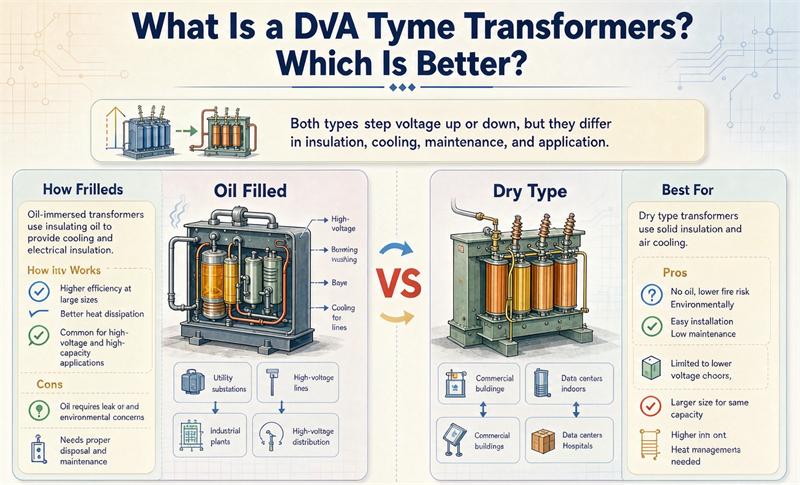
Neither oil-filled nor dry-type transformers are universally “better.” Oil-filled wins outdoors, at high voltage, and on upfront price. Dry-type wins indoors, on fire safety, and on maintenance. The right pick comes down to where it sits, your local fire code, the rating, and your load profile. If you are specifying a transformer for a project in the US, the EU, or anywhere buyers care about insurance and code, this guide walks you through the real tradeoffs. No jargon for its own sake. We will cover how each type works, a side by side comparison, where each one wins, what it actually costs over its life, the fire codes you will hit, and a short checklist you can take to your supplier.
Who this is for
You will get the most out of this if you are one of these:
- An electrical engineer or specifier weighing indoor vs outdoor placement.
- A facilities or procurement manager buying a unit for a building, plant, or utility.
- A contractor who needs to tell a client “oil or dry, and here is why.”
- A buyer comparing quotes and tired of salespeople pushing one type.
At TransNin Electric we build both, so we have no reason to steer you wrong. We just want the choice to make sense for your site.
At a glance: the quick comparison
| Factor | Oil-filled (liquid-immersed) | Dry-type |
|---|---|---|
| Cooling | Mineral or ester oil circulates (ONAN, ONAF) | Air, natural (AN) or fan-assisted (AF) |
| Typical voltage | Up to 765 kV, ratings past 1,000 MVA | Usually 35 kV and below, up to about 5 MVA |
| Fire risk | Flammable liquid; needs vault and containment | Non-flammable solid insulation, F1 fire class |
| Indoor use | Requires fire-rated vault, pit, suppression | Goes straight into occupied buildings |
| Maintenance | Oil tests, DGA, top-ups; 2 to 4 times the cost | Minimal; annual visual check plus fan test |
| Upfront price | Lower, the baseline | About 20 to 50 percent higher |
| Service life | 30 to 40 years with care | 25 to 30 years |
| Overload capacity | Higher thermal mass | Moderate; fans add roughly 15 percent |
| Environmental | Leak and spill risk; tank is recyclable | No fluid; simpler end of life |
| Best fit | Outdoor, substations, large ratings | Indoor, hospitals, data centers, dense urban |
That table answers most of the “which is better” question at a glance. The rest of this guide fills in the parts that actually change your decision.
How each type works, in plain language
Both transformers do the same job. They change one voltage to another using electromagnetic induction. The difference is what surrounds the windings.
An oil-filled transformer dips its core and coils in a tank of insulating fluid. The oil does two jobs at once. It insulates the live parts and it carries heat away. Because oil moves heat about a thousand times better than air, the same rating fits in a smaller, cheaper box, and it scales to enormous sizes.
A dry-type transformer skips the liquid. The windings sit in air, held by solid insulation such as epoxy resin (cast coil) or vacuum-pressure-impregnated varnish. No tank, no fluid, nothing to leak or burn. The trade is that air is a weak coolant, so dry units top out at lower voltages and ratings and need good room ventilation to hit nameplate capacity.
Here is the simple version. Oil is the marathon runner: efficient, tough, built for the long haul outdoors. Dry is the sprinter you can park next to people: clean, safe, low fuss, but with a smaller ceiling.
Where oil-filled wins
Pick oil-filled when the unit lives outside or carries serious power.
- Outdoor substations and pad-mounts. Weather does not bother a sealed tank, and you avoid the cost of a conditioned indoor room.
- Ratings above about 2,500 kVA. Dry-type is rarely built as a single unit past this point. Past 10 to 15 MVA, oil is effectively the only practical choice.
- High voltage. Oil handles 35 kV, 132 kV, 400 kV and beyond. Dry-type basically stops at 35 kV.
- Heavy or motor loads. Oil’s thermal mass shrugs off short overloads that would cook a dry unit.
- Upfront budget is tight. The bare unit costs less, and for a remote outdoor site there is no vault to build.
Our oil-immersed transformer line covers distribution and power ratings for exactly these jobs, from pad-mounts to substation units.
Where dry-type wins
Pick dry-type when the unit sits near people or where a spill would be a disaster.
- Indoor commercial and institutional buildings. Hospitals, schools, offices, and malls put the transformer inside the occupied space. No oil means no fire vault, no containment pit, no suppression system.
- Data centers and IT rooms. Clean, low maintenance, and close to the load, which cuts copper runs.
- Dense urban or basement sites. Fire codes in most jurisdictions push you to dry-type the moment the unit is indoors.
- Eco-sensitive locations. Water protection zones, reserves, and sites with strict spill rules favor zero-fluid designs.
- Low maintenance sites. If you have no staff to pull oil samples, dry-type just sits there and works.
Our dry-type transformer line spans cast-resin and VPI builds from 30 kVA up to 5 MVA, the range most commercial and industrial buyers actually spec.
The sticker-price lie: what TCO really shows
Most buyers reject dry-type on day one because the quote looks 20 to 50 percent higher. That comparison is incomplete. It ignores the civil work an indoor oil unit forces on you.
Here is a worked example for a 1,000 kVA unit going inside a US commercial building. Numbers are illustrative 2026 North American pricing; your quote will vary.
- Dry-type unit: about $32,000. No vault, no pit, no suppression. Installed cost: $32,000.
- Oil-filled unit: about $24,000 for the hardware, but the code requires a fire-rated vault, an oil containment pit, and a suppression system. Call that civil work $20,000. Installed cost: $44,000.
On total installed cost, the “cheaper” oil unit costs $12,000 more before it ever energizes. On a pure maintenance basis, dry-type saves roughly $1,100 a year (no DGA, no top-ups, no sampling), which pays back the $8,000 unit premium in about 7 years even before you count the avoided vault.
The rule is simple. For indoor installations, compare total installed cost, not the unit price. For outdoor, remote, or very large ratings, oil-filled usually wins on lifecycle cost.
The ester-fluid exception buyers miss
Natural ester fluids such as FR3 changed the fire story. They are biodegradable, less flammable than mineral oil, and carry higher fire points. In many codes an ester-filled unit qualifies for reduced clearances or even indoor placement that a mineral-oil unit could not get.
So if a supplier tells you “oil can never go indoors,” push back. The honest answer is “mineral oil rarely goes indoors, but ester-filled can, depending on the authority having jurisdiction.” We cover the cooling and fluid side in more depth in our cooling classes guide, because the AN/AF and ONAN/ONAF codes drive how much capacity you actually get.
Cooling classes and why they matter
Cooling is not just about staying cold. The letter code tells you how much transformer you bought.
- Dry-type: AN is natural air (the rating on the nameplate). AF adds fans and typically lifts capacity about 15 percent.
- Oil-filled: ONAN is natural oil and air. ONAF adds fans for more output. Forced modes (OFAF, OFWF) push large power units even higher.
If your load grows, a fan kit or a forced-cooling step can delay a replacement. Just confirm the de-rated temperature rise and ventilation with the manufacturer before you count on it.
Fire codes buyers actually hit
This is where indoor decisions get made.
- NEC Article 450. In the US, indoor oil-filled transformers above certain ratings must sit in a fire-rated vault with liquid containment. That is the single biggest reason US commercial jobs go dry-type.
- NFPA 850 and IBC separations. Power plants and large buildings layer on separation distances and fire suppression that dry-type avoids.
- EU and UK: EN 61936 and local building codes set similar spacing and fire-resistance expectations; dry-type with an F1 rating slots into occupied buildings far more easily.
- Insurers. Some carriers simply will not write mineral oil indoors without expensive mitigations, and a late discovery can force a redesign.
Codes differ by jurisdiction, so treat this as direction, not gospel. The practical takeaway: if the unit is indoors and people are nearby, assume dry-type unless your engineer shows you a code path for oil.
Common mistakes buyers make
- Comparing only the unit price. Vault, pit, cabling, and maintenance flip the ranking.
- Ignoring local codes and insurers. A jurisdiction or carrier can kill an oil-indoor plan after you have already specified it.
- Underestimating ventilation. Dry-type units lean on room airflow to reach nameplate. A hot, still room derates them.
- Skipping monitoring. Temperature relays on dry units and oil temperature, pressure, and gas alarms on oil units are cheap insurance.
- Forgetting growth. A slightly larger unit or a fan option often costs less than replacing a transformer that ran out of margin.
Quick decision checklist
Run your project down this list. The answer is usually clear by step four.
- Is it indoors and near people? If yes, dry-type.
- Is the rating above 2,500 kVA as a single unit? If yes, oil-filled.
- Is it above 10 to 15 MVA? If yes, oil-filled, full stop.
- Is the site outdoor and unoccupied? If yes, oil-filled.
- Is it in a water protection zone or eco-sensitive area? If yes, dry-type or ester-filled.
- Do you have staff for oil testing? If no, dry-type.
- Is upfront capital the only constraint? If yes, oil-filled hardware wins on price.
- Will the load swing hard or sit steady? Hard swings favor oil; steady favors dry.
The bottom line
There is no universal winner. Dry-type earns its keep indoors, on fire safety, and on maintenance. Oil-filled earns its keep outdoors, at high voltage, on big ratings, and on upfront price. Decide on location, fire rules, rating, and load profile first, then compare total cost over the unit’s life. When those facts are on the table, the right choice usually picks itself.
When you are ready to size one, browse our full range of transformer products, dig into the technical resources library, or look at delivered projects for sites like ours. Send us your load profile, voltage, and site conditions and we will return a standard rating the same week.
Frequently Asked Questions
Which is safer, oil-filled or dry-type?
For indoor use, dry-type is safer. With no flammable liquid there is no pool fire or spill risk. Oil-filled units run safely outdoors with proper containment, protection, and maintenance, but they carry a fire and leak risk that dry-type does not.
Which costs more upfront?
Dry-type usually costs 20 to 50 percent more for the same rating. The catch is installed cost: an indoor oil unit needs a vault, containment pit, and suppression, which can erase or reverse that gap.
Which lasts longer?
Well-maintained oil-filled transformers often reach 30 to 40 years. Dry-type units commonly reach 25 to 30 years in suitable conditions. Loading, temperature, and maintenance matter more than the type.
Can dry-type transformers be used outdoors?
Yes, if they sit in a suitable enclosure with the right IP rating and the ambient stays within the manufacturer’s limits. For large outdoor installations, oil-filled is usually more economical.
Can oil-filled transformers be used indoors?
Sometimes, but in most US jurisdictions an indoor mineral-oil unit needs a fire-rated vault and liquid containment per NEC 450. Ester-filled units can qualify for easier indoor placement depending on the local authority.
Which is more efficient?
Oil-filled units often hold a small efficiency edge at large ratings because oil cools better. Both types meet modern efficiency rules. Compare the guaranteed loss figures rather than assuming one type wins.
What rating is the cutoff between the two?
As a single unit, dry-type is rarely built above about 2,500 kVA, and it effectively stops being practical past 10 to 15 MVA. Above those points, oil-filled is the realistic choice.
What is natural ester fluid and does it change the choice?
Natural ester (for example FR3) is a biodegradable, less flammable insulating fluid. It can qualify oil-filled units for reduced clearances or indoor placement that mineral oil cannot get, blurring the usual oil-versus-dry fire line.
How do I decide for my specific project?
Start with location and fire code, then rating, load profile, and maintenance capability. If it is indoors near people, choose dry-type. If it is outdoor, large, or budget-led, choose oil-filled. Compare total installed cost, not just the unit price.