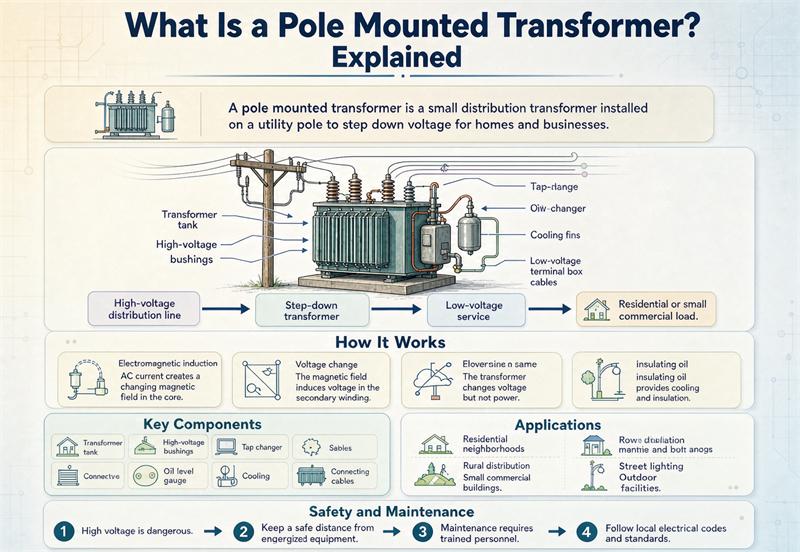
A pole mounted transformer is a distribution transformer bolted to a utility pole. It steps high voltage from overhead lines (usually 4 kV to 35 kV) down to safe levels like 120/240 V or 208/400 V for homes and businesses. It has no moving parts, runs outdoors for decades, and typically covers 10 kVA to 500 kVA. Here is the plain English version of how it works and how to buy one without surprises.
If you specify, purchase, or approve distribution equipment, this guide is for you. We will skip the textbook tone and focus on what actually matters when you order: the types, the numbers, the standards, and the spec sheet you hand your supplier.
Pole mounted vs pad mounted vs substation: the quick view
Buyers mix these up all the time, so here is the clean version before we go deeper.
| Type | Where it sits | Typical kVA | Best for |
| Pole mounted | On a utility pole | 10 to 500 | Rural, suburban, overhead networks |
| Pad mounted | On a ground pad, enclosed | 15 to 2,500 | Urban, underground, commercial |
| Substation | Fenced enclosure or building | 500 to thousands | Utility bulk supply, industrial parks |
A pole unit is the cheapest way to get power to a few customers spread along a line. When you go underground or need more capacity, you move to pad mounted or a compact substation.
How a pole mounted transformer works
Think of it as a voltage translator. High voltage comes in on the primary side. Inside the sealed tank, two coil sets wrap a steel core but never touch. The alternating current in the primary coil makes a magnetic field, and that field induces a lower voltage in the secondary coil. More turns on the primary than the secondary means the voltage drops.
That is the whole trick. No spinning parts, no fuel, nothing to wear out from motion. The oil inside (or the resin, in rare dry units) just keeps the windings cool and insulated.
Electricity flows in through the high voltage terminals on the pole, gets stepped down inside, and leaves through the secondary wires that run to the building or the street. The ratio of coil turns sets the output voltage, so matching the utility primary voltage is not optional. Get it wrong and the unit is scrap.
The main types you will actually see
Most catalogs sort pole transformers three ways: by phase, by protection, and by cooling.
| Category | Option | What it means | Common use |
| Phase | Single phase | One phase in, 120/240 V out | Homes, farms, small shops |
| Phase | Three phase | Balanced 3 phase out (120/208 or 277/480 V) | Commercial, light industrial |
| Protection | CSP (Completely Self Protected) | Fuse, arrester, breaker built into the tank | New US utility installs |
| Protection | Conventional | External cutout and arrester required | Retrofits, budget jobs |
| Cooling | Oil immersed (ONAN) | Mineral or ester fluid, natural cooling | The default everywhere |
| Cooling | Dry type | Air cooled, no oil | Fire sensitive or environmental sites |
Single phase dominates residential overhead distribution. The usual ratings run 10, 15, 25, 37.5, 50, 75, 100, and 167 kVA. Three phase units for pole or banked installations cover roughly 45 to 500 kVA.
CSP deserves a paragraph because it changes your install. A CSP unit packs the primary fuse, lightning arrester, and secondary breaker inside the tank. That cuts pole top hardware and speeds restoration. The catch: if the internal breaker trips, the utility lowers the tank to reset it. Most US utilities now mandate CSP for new overhead services, so check your local rule before you spec conventional.
Sizing: what kVA do you actually need
Here is the practical range buyers ask about most.
| Application | Typical kVA |
| Single home or small shop | 10 to 25 |
| Rural cluster (a few homes) | 37.5 to 75 |
| Small commercial or farm | 100 to 167 |
| Light industrial, three phase | 225 to 500 |
Size off your peak demand in kW, add diversity and future growth, and respect the utility loading target (often 50 to 75 percent continuous). Do not just grab the next size up. A bigger unit costs more and sits half loaded, which hurts efficiency and raises your no load loss bill for 30 years.
Cooling and the ONAN label
Almost every pole transformer is ONAN: Oil Natural, Air Natural. The fluid circulates by convection and the tank walls shed heat to the air. No fans, no pumps, nothing to maintain. Larger or special units may get bigger radiators, but you rarely see forced cooling on a pole because the moving parts add failure points.
If you want the full breakdown of cooling classes and when AN or AF ratings change your capacity, our cooling class guide walks through ONAN, ONAF, AN, and AF with the numbers.
Where they get used, and how the config changes
Rural setups lean on single phase units spread over long feeders, often at higher primary voltage to fight distance losses. Suburban networks mix single and three phase with more CSP for fast restoration. Urban jobs usually leave poles behind and go pad mounted or underground.
The unit also shows up well beyond homes: water pumping, grain drying, telecom towers, street lighting, and solar or wind interconnections in remote grids. Anywhere a line passes close and a small load needs steady voltage, a pole transformer is the low cost answer.
Standards and compliance you cannot ignore
This is where cross border buyers trip. The rules differ by market.
- United States: DOE 2016 efficiency (core and load loss limits), IEEE C57.12.20 for overhead distribution transformers, NEC Article 450 for installation, and NESC for pole clearances and grounding.
- Europe and most of the world: IEC 60076 series, plus local EN adoption and MEPS efficiency filings.
- Utility approvals: many US utilities keep their own accepted standards lists, so a unit that passes IEEE is not automatically approved on their poles.
Our IEC vs ANSI/IEEE standards piece maps the two frameworks side by side so your export unit clears both.
The spec sheet to send your supplier
Here is the gap almost no competitor fills. Before you ask for a quote, hand your factory these eight points. Miss one and you get a unit that fails inspection or will not mount.
- Primary voltage and connection (line to line, e.g. 12.47 kV or 13.8 kV).
- Secondary voltage (120/240 V split phase, 208Y/120 V, 277/480 V, etc.).
- kVA rating and phase (single or three).
- CSP or conventional, and the utility approval number if required.
- Cooling class (almost always ONAN) and fluid type (mineral oil or FR3 ester).
- BIL and insulation level matched to the local lightning profile.
- Efficiency level (DOE 2016 in the US, MEPS elsewhere) with guaranteed loss figures.
- Mounting hardware, bracket type, and pole class the unit must hang on.
The 2026 distribution transformer buyer’s guide expands each of these into a checklist you can paste into a purchase order.
Common mistakes that cost money
Buying the wrong primary voltage is the expensive one. A 13.2 kV unit cannot hang on a 34.5 kV line, and rerating is not a field fix. Second is skipping the utility approval, which means a passed factory test still gets rejected at the depot. Third is ignoring BIL in lightning prone areas, where a cheap insulation level fails on the first storm. Fourth is oversizing for “future growth” so far that the unit runs at 30 percent load and wastes energy for decades.
A real world note
We have shipped overhead and packaged distribution equipment for utility and EPC programs across multiple markets. You can see one example in our delivered projects, including an 11 to 33 kV compact substation program built for an overseas utility EPC. The same engineering discipline applies whether the transformer hangs on a pole or sits in a pad.
At TransNin Electric we build oil immersed and dry type distribution units in the standard kVA steps buyers actually spec, and we can turn your load profile into a standard rating the same week.
Conclusion
A pole mounted transformer is a simple, silent workhorse that drops overhead high voltage to usable levels for homes and small loads. Pick by phase and protection first, match the utility primary voltage exactly, confirm the local standard (DOE and IEEE in the US, IEC elsewhere), and send your supplier a complete spec sheet. Do those four things and the install goes smooth.
FAQ
What is the difference between a pole mounted and a pad mounted transformer? A pole mounted unit bolts to a utility pole and serves overhead networks at 10 to 500 kVA. A pad mounted unit sits in an enclosed cabinet on the ground, serves underground and urban networks, and reaches up to about 2,500 kVA. Pole is cheaper to install, pad is better for underground and higher load.
How long does a pole mounted transformer last? Industry data puts typical service life at 25 to 40 years with routine checks. Oil leaks, corrosion, and tank damage are the main failure drivers, so periodic inspection of fluid level and hardware matters more than the calendar.
What kVA ratings are common for pole mounted transformers? Single phase runs about 10 to 167 kVA, with 25, 50, and 75 kVA covering most homes. Three phase units for pole or banked service span roughly 45 to 500 kVA.
What does CSP mean on a pole transformer? CSP stands for Completely Self Protected. The primary fuse, lightning arrester, and secondary breaker sit inside the tank, which reduces pole top hardware. Many US utilities require CSP for new overhead installs, but a tripped internal breaker means lowering the tank to reset it.
Do pole mounted transformers use oil?
Almost all do. They are oil immersed (ONAN) with mineral oil or FR3 ester fluid for cooling and insulation. Dry type pole units exist for fire sensitive or environmental sites but cost more and run larger.
Can a pole transformer be three phase? Yes. Three phase pole transformers serve commercial and light industrial loads at 120/208 V or 277/480 V. Utilities also bank three single phase units to make three phase, which adds redundancy if one fails.
What standards apply to pole mounted transformers in the US? DOE 2016 efficiency rules, IEEE C57.12.20 for the product, NEC Article 450 for installation, and NESC for pole clearances and grounding. Many utilities also keep their own approved standards lists.
What primary voltage should I specify? Match the utility medium voltage exactly: common US values are 4.16, 7.2, 12.47, 13.2, 13.8, 24.9, and 34.5 kV line to line. A mismatch cannot be fixed in the field, so confirm with the utility before ordering.
How many homes can one pole transformer serve? A small single phase unit typically feeds about five to seven homes, depending on size and demand. In spread out rural areas one transformer may serve a single building.