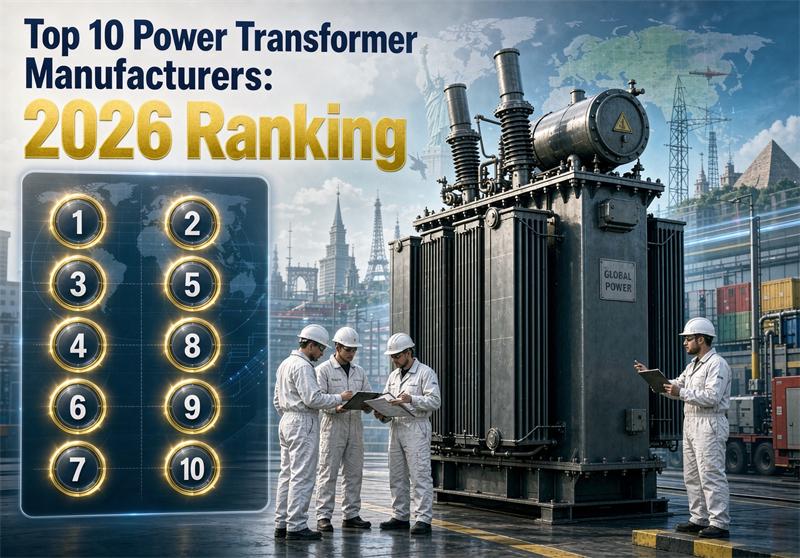
The top 10 power transformer manufacturers in 2026 are Hitachi Energy, Siemens Energy, GE Vernova, ABB, Schneider Electric, Mitsubishi Electric, HD Hyundai Electric, TBEA, China XD Group, and Hyosung. We ranked them by global market share, high-voltage capacity, and 2025–2026 order backlog. Below, we break down how to choose the right one for your voltage, budget, and lead-time reality.
If you came here for a name-drop list, you’ve got it in the table below. But here’s the part most “Top 10” articles skip: a ranking tells you who’s big, not who’s right for your job. A utility buying a 1,200 kV HVDC converter is shopping in a completely different store than a contractor speccing ten 2.5 MVA pad-mounts for a solar farm. We’ll cover both, and we’ve also compared the top transformer brands and suppliers head-to-head if you want the deeper side-by-side.
Why the 2026 ranking looks the way it does
Three things are reshaping the transformer market at once, and they’re all pushing lead times and prices up:
- Grid modernization. The U.S. IIJA and IRA, the EU’s grid-action plan, and similar programs elsewhere are pouring money into transmission and distribution upgrades.
- Data centers. AI and cloud demand is adding gigawatts of load that all needs step-down transformers, fast.
- Renewables. Every utility-scale solar, wind, and storage project ships with a step-up transformer.
The International Energy Agency has been clear that global electricity demand keeps climbing, and transformers are the bottleneck everyone is talking about. That backlog is why the biggest names below are booked 90 to 150 weeks out on high-voltage gear.
Quick answer: the 2026 top 10 at a glance
Share figures are industry estimates drawn from 2025–2026 corporate disclosures and analyst reports, not audited market-share audits. Treat them as directional.
| Rank | Manufacturer | HQ | Approx. global share* | Best known for |
|---|---|---|---|---|
| 1 | Hitachi Energy | Switzerland / Japan | ~18% | UHV/HVDC, eco-efficient fluids, digital substations |
| 2 | Siemens Energy | Germany | ~15% | HVAC, offshore-wind step-up, lifecycle service |
| 3 | GE Vernova | USA | ~12% | High-capacity EHV, extreme-environment units |
| 4 | ABB | Switzerland / Sweden | ~9% | Distribution, cast-resin, digital monitoring |
| 5 | Schneider Electric | France | ~8% | MV/HV distribution, EcoStruxure smart power |
| 6 | Mitsubishi Electric | Japan | ~7% | Nuclear-grade, high-reliability urban grid |
| 7 | HD Hyundai Electric | South Korea | ~6% | EHV, fast-growing export capacity |
| 8 | TBEA (特变电工) | China | ~5% | UHV, EPC turnkey, price-competitive volume |
| 9 | China XD Group (中国西电) | China | ~4% | UHV “national team,” full voltage coverage |
| 10 | Hyosung Heavy Industries | South Korea | ~3% | HV/EHV, desert/climate-tuned exports |
How we ranked them
We scored on three things buyers actually care about: global market share, high-voltage and extra-high-voltage capacity (because that’s where the real moat is), and 2025–2026 order backlog as a proxy for demand and reliability. We did not score on brand prestige alone, because a famous name won’t help you if its lead time is three years and your substation needs to energize next spring. Where we cite a number, it’s an estimate from public disclosures. We’d rather be honest about the limits of the data than hand you a fake “Trust Score 65/100” like some spun listicles do.
The top 10, one by one
1. Hitachi Energy. The clear front-runner. Formed from Hitachi’s acquisition of ABB’s Power Grids business, it owns the UHV/HVDC conversation and leads on natural-ester and digital (“TXpert”) transformer tech. If your project is 800 kV and up, this is the shortlist. Backlog is long; plan early.
2. Siemens Energy. The European and Middle East anchor. Strong in HVAC and offshore-wind step-up units, with a genuine full-lifecycle service story. Their Sensformer/IoT approach means digital monitoring is built in, not bolted on later. Payment terms can be stiff for smaller EPCs.
3. GE Vernova. The U.S. heavyweight post-spinoff. Agile on EHV and extreme-environment builds, deeply tied to North American grid-modernization funding. If “made and supported in North America” matters to your stakeholders, they’re a safe anchor.
4. ABB. Retained a big distribution and cast-resin footprint after the Hitachi deal. A go-to for fire-sensitive sites (hospitals, tunnels, high-rises) and industrial dry-type builds. Less of a player at the UHV top end.
5. Schneider Electric. Energy-management platform play. Strong in MV/HV distribution and smart-panel integration through EcoStruxure. Great if you want transformers as part of a managed power system rather than a standalone box.
6. Mitsubishi Electric. The reliability benchmark, with real nuclear-grade and compact urban-grid expertise. Less flashy on marketing, very serious on engineering.
7. HD Hyundai Electric. Quietly one of the fastest-scaling names, with heavy 2025–2026 capacity investment. Worth a hard look if you need EHV without the Tier-1 wait.
8. TBEA. China’s export champion: full 10 kV to 1,000 kV coverage, EPC turnkey capability, and volume pricing that’s hard to beat. The tradeoff is certification and lead-time diligence for Western markets. More on that below.
9. China XD Group. The UHV “national team” with the deepest high-voltage coverage in China and a massive install base. Strong on transmission-class jobs, lighter on distributed/commercial support outside Asia.
10. Hyosung Heavy Industries. Korean EHV exporter with a track record in hot-climate and Middle East projects. A solid alternative to the giants when you need climate-tuned specs.
US and European manufacturers buyers should know
If your project is funded or regulated in North America or the EU, “global top 10” isn’t the whole story. These names show up constantly in Western bids:
- Prolec GE: the Waukesha successor; broadest MV/HV service network in North America, lowest on-time-delivery default rate among the big domestic players.
- Virginia Transformer Corp: largest U.S.-owned custom power-transformer builder; multi-plant sourcing lets them hit 60–80 week custom lead times when peers quote 100+.
- WEG Transformers USA: fast-growing, strong distribution and power range, expanding U.S. footprint.
- ERMCO: leading U.S. oil-filled distribution builder.
- Hammond Power Solutions: largest North American dry-type manufacturer.
- Plus the U.S. and European operations of Siemens Energy and Hitachi Energy, which often bid as local entities.
Beyond the giants: where mid-tier and regional specialists win
Here’s the gap almost every “Top 10” list leaves open. Most real-world jobs are under 35 MVA, and that’s exactly where Tier-1 giants are slow, expensive, or simply not interested. Regional and niche builders, including dry-type and cast-resin shops, pad-mount specialists, and K-rated harmonic units, routinely beat the giants on lead time, price, and responsiveness for:
- Commercial buildings and hospitals (low-noise, low-loss dry-type)
- Data centers (K-factor-rated, 7×24 partial-load builds)
- Solar and storage step-up packages
- Utility distribution and pad-mounted programs
If you don’t need UHV, a focused regional specialist will often serve you better than a name on this list. At TransNin we sit in exactly that band, and our dry-type transformer line covers the 30 kVA to 5 MVA cast-resin and VPI builds most commercial and industrial buyers actually spec.
How to choose the right manufacturer for your project
This is the part that turns a ranking into a purchase. Score every shortlisted supplier on these five criteria, in this order:
- Voltage and MVA coverage vs. your spec. Does the vendor actually build your class, or are you asking them to stretch? A 33/11 kV 10 MVA unit is a different animal from a 400 kV 500 MVA one.
- Standards and certification stack. IEC 60076, IEEE C57.12.x, UL 1561/1562, CSA C88, CE, BIS IS 1180, whichever your market requires. No cert, no bid.
- Loss and impedance guarantees. Get no-load loss (W), load loss at 75 °C (W), and %Z in writing. These drive 30-year operating cost, not just first price.
- Lead time at your required kV class. Ask for the real booked date, not the catalog number. This is where giants lose and specialists win.
- Service and retrofit footprint in your region. Who shows up at 2 a.m. if it fails? Type-test record and local support matter more than a famous logo.
On 33/11 kV distribution work, lead time and loss guarantees usually beat brand prestige. On 400 kV and above, track record and HVDC experience dominate, and the field narrows to the Tier-1 names.
Lead times in 2026: how buyers are beating the backlog
The honest number: EHV equipment from the elite plants is running 90 to 150 weeks. That’s not a typo. Buyers who plan normally get crushed. The ones winning are doing three things:
- Dual-sourcing. Split the order between a Tier-1 anchor and a qualified mid-tier or regional builder so one bottleneck doesn’t stall the whole project.
- Buying standard ratings. Non-standard kVA and voltages add weeks or months. Standard NEMA/IEEE preferred ratings ship faster.
- Locking capacity early. For multi-year programs, reserve slot commitments instead of spot-buying.
If your job is distribution-class (≤35 MVA), you can often cut lead time dramatically by going with a specialist instead of waiting on a giant.
Standards and certifications you’ll actually need
Don’t let a sales deck substitute for the cert your market requires:
| Market | What you’ll typically need |
|---|---|
| European Union | CE + EN/IEC 60076, RoHS; EU Ecodesign (PEI) for applicable ranges |
| United States & Canada | IEEE C57 / ANSI, UL 1561 (dry-type) or UL 1562, CSA C88; DOE 10 CFR Part 431 Subpart K for distribution units |
| Middle East | IEC 60076 + SASO (KSA) or equivalent, plus high-temperature tuning |
| Australia / NZ | AS/NZS 60076 + SAA |
| India | BIS IS 1180 + efficiency-level compliance for DISCOM bids |
Two notes buyers miss: U.S. distribution-transformer efficiency lives in 10 CFR Part 431 Subpart K (not the appliance rule, 430), and China’s GB 20052 is a domestic minimum-energy standard, so overseas buyers should map it against IEC and EU Ecodesign rather than treat it as a global cert.
Global giants vs. regional specialists: quick comparison
| Global Tier-1 giants | Regional / mid-tier specialists | |
|---|---|---|
| Best for | UHV/HVDC, 400 kV+, utility transmission | ≤35 MVA distribution, commercial, solar, data center |
| Lead time | 90–150 weeks (EHV) | Often 30–70 weeks |
| Price | Premium | Competitive, volume-friendly |
| Certs | Full global stack | Strong in target markets, lighter elsewhere |
| Support | Global, but tiered by account size | Responsive, regional |
The bottom line
The 2026 top 10, Hitachi Energy, Siemens Energy, GE Vernova, ABB, Schneider Electric, Mitsubishi Electric, HD Hyundai Electric, TBEA, China XD Group, and Hyosung, are the names to know because they own the high-voltage market and the order backlog. But “biggest” and “right for you” are different questions. Start from your voltage, MVA, standards, and lead-time reality, score suppliers on the five criteria above, and don’t sleep on regional specialists for anything under 35 MVA.
If you want the full picture of what we make and where we fit, browse our product range or look at delivered projects, including the 11–33 kV compact substation programme we built for an overseas utility EPC. For more buyer-side guides, our resources library has selection and standards deep-dives.
FAQ
Who are the top 10 power transformer manufacturers in 2026?
Hitachi Energy, Siemens Energy, GE Vernova, ABB, Schneider Electric, Mitsubishi Electric, HD Hyundai Electric, TBEA, China XD Group, and Hyosung, ranked by global market share, HV/EHV capacity, and 2025–2026 backlog.
How long is the lead time for a power transformer in 2026?
EHV equipment from Tier-1 plants typically runs 90 to 150 weeks. Distribution-class units (≤35 MVA) from regional specialists often ship in 30 to 70 weeks. Dual-sourcing and standard ratings are the main ways buyers cut that down.
What’s the difference between a power transformer and a distribution transformer?
A power transformer handles the high-voltage transmission and sub-transmission steps (often 35 kV and up, large MVA). A distribution transformer steps voltage down to the level that feeds buildings and loads (typically ≤35 MVA, often pad-mounted or pole-mounted).
Which standards do I need for the US market?
For the U.S. and Canada, plan on IEEE C57 / ANSI, UL 1561 (dry-type) or UL 1562 (liquid-filled), and CSA C88. Distribution units must also meet DOE 10 CFR Part 431 Subpart K efficiency levels.
Is a bigger manufacturer always the better choice?
No. Below about 35 MVA, regional and mid-tier specialists usually beat the giants on lead time, price, and responsiveness. The giants earn their place on UHV/HVDC and 400 kV+ transmission work where track record matters most.
How do I compare transformer suppliers fairly?
Score them on five things in order: voltage/MVA coverage vs. your spec, certification stack for your market, written loss and impedance guarantees, real lead time at your kV class, and regional service footprint.
What certifications do European projects require?
Typically CE marking plus EN/IEC 60076 compliance and RoHS, with EU Ecodesign (PEI) efficiency rules applying to covered ranges. Specific tenders may add national requirements.
Are Chinese transformer manufacturers reliable for export?
Several manufacturers, TBEA and China XD among them, have large export track records and full voltage coverage. The diligence step is certification and lead-time verification for your specific Western market, not the build quality itself.
How much do power transformers cost?
It varies widely by rating, cooling, and specs; we don’t publish a flat price list because every unit is specced to order. The bigger cost lever is usually 30-year loss cost (no-load + load losses), not the first price. Get the loss guarantees in writing.
Cite this article
Want to reference this ranking? Use whichever format fits:
- Web: TransNin Electric. “Top 10 Power Transformer Manufacturers in 2026: Ranking, Market Share & How to Actually Choose One.” TransNin Electric, 18 Oct. 2026. https://www.transninelectric.com/resources/top-10-power-transformer-manufacturers-2026/
- APA: TransNin Electric. (2026, October 18). Top 10 power transformer manufacturers in 2026: Ranking, market share & how to actually choose one. Retrieved from https://www.transninelectric.com/resources/top-10-power-transformer-manufacturers-2026/
- MLA: “Top 10 Power Transformer Manufacturers in 2026: Ranking, Market Share & How to Actually Choose One.” TransNin Electric, 18 Oct. 2026, https://www.transninelectric.com/resources/top-10-power-transformer-manufacturers-2026/.
- Chicago: TransNin Electric. “Top 10 Power Transformer Manufacturers in 2026: Ranking, Market Share & How to Actually Choose One.” TransNin Electric. October 18, 2026. https://www.transninelectric.com/resources/top-10-power-transformer-manufacturers-2026/.
Ready to spec your transformer?
Three ways to move fast:
- Read the buyer’s guide. Our resources library (linked above) walks through ratings, cooling, and standards step by step, starting with the distribution transformer buyer’s guide.
- Size it. Tell us your voltage, MVA, and application and we’ll return a buildable spec and a realistic lead time.
- Talk to an engineer. Reach out through TransNin Electric for a same-week response on distribution and mid-voltage power transformers.