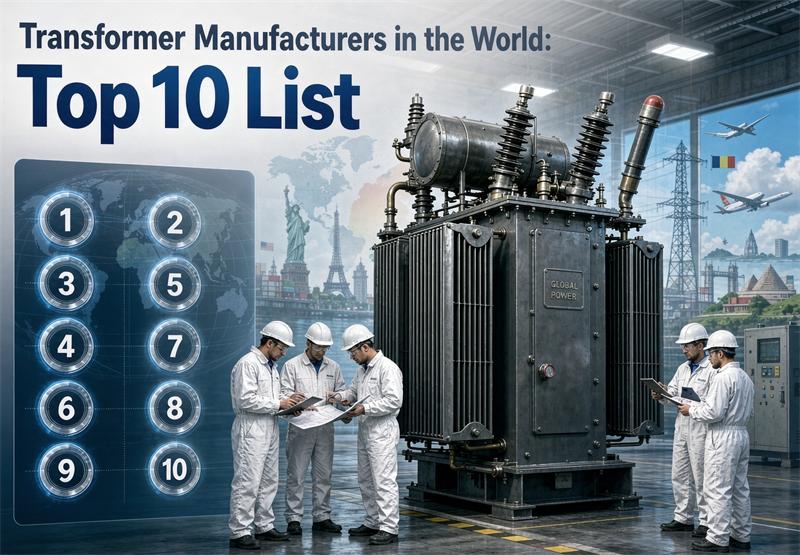
If you’re sourcing a transformer in 2026, you’ve probably seen a dozen “top 10” lists. Most rank companies by revenue and call it a day. That’s fine for trivia, but it doesn’t tell you which builder actually fits your project. This guide does both. Below is our shortlist of the 10 transformer manufacturers with the widest global reach and the deepest track record — Hitachi Energy, Siemens Energy, GE Vernova, Mitsubishi Electric, Toshiba, HD Hyundai Electric, Hyosung Heavy Industries, TBEA, WEG, and Prolec GE. After the list, we walk through what those rankings leave out: lead times, standards, tariffs, and total cost of ownership. Pick by fit, not by size.
The 10, At a Glance
Here’s the quick comparison. Revenue figures are 2024 numbers compiled by Blackridge Research; for some makers they’re parent-company totals, so read them as a scale signal, not a scorecard.
| Rank | Manufacturer | HQ | Best for | 2024 revenue* |
|---|---|---|---|---|
| 1 | Hitachi Energy | Switzerland | Utility-scale HVDC, GSU, digital units | ~$66.3B |
| 2 | GE Vernova | USA | GSU, autotransformers, HVDC | ~$54.4B (GE total) |
| 3 | HD Hyundai Electric | South Korea | EHV, GSU, mobile units | ~$48.1B |
| 4 | Schneider Electric | France | T&D equipment, medium-voltage | ~$39.7B |
| 5 | Siemens Energy | Germany | Large power, HVDC, grid | ~$37.7B |
| 6 | Mitsubishi Electric | Japan | Shell-form, large power | ~$35.8B |
| 7 | Toshiba | Japan | Gas-insulated, site-assembled | ~$34.0B |
| 8 | ABB | Switzerland | Drives, components, medium power | ~$32.5B |
| 9 | TBEA | China | UHV, HVDC, renewables | ~$13.2B |
| 10 | WEG / Prolec GE | Brazil / Mexico | Industrial, distribution, dry-type | n/a |
How we built this list: it’s an editorial shortlist based on global footprint and buyer relevance, not a certified ranking. Your “top 10” might look different once you filter by voltage, MVA, and where you’re shipping.
The 10 Manufacturers, One by One
1. Hitachi Energy
Spin-off of ABB’s grid business, based in Switzerland. They’re the name you’ll hear on almost every major HVDC and utility project. Strengths: digital transformers (TXpert), rupture-resistant designs, offshore wind pedigree. The catch: you’re queueing behind the biggest grids on earth, so lead times and price reflect that demand.
2. GE Vernova
The U.S.-headquartered energy arm of General Electric. Strong on generator step-up (GSU) units, autotransformers, and HVDC. Familiar with IEEE/ANSI and UL, which shortens the learning curve for North American buyers. Capacity is tight, same as everyone at the top.
3. HD Hyundai Electric
South Korean, and quietly one of the fastest-growing names in EHV and GSU units. Good reputation for mobile and phase-shifting transformers. A solid option if you want top-tier engineering without always going through the two European giants.
4. Schneider Electric
French, best known for medium-voltage switchgear and T&D systems rather than the largest power transformers. If your need is distribution-level and you want a single-source ecosystem, they’re worth a look.
5. Siemens Energy
German engineering, deep bench in large power and grid transformers plus HVDC. Like Hitachi, they’re a default for utility-scale work. Budget for a long timeline on the big stuff.
6. Mitsubishi Electric
Japanese, with a strong story in shell-form and large power units, including gas-insulated designs. Quietly reliable for power stations and EHV systems.
7. Toshiba
Also Japan. Their edge is gas-insulated and site-assembled transformers — handy when your substation footprint is tight or the site is hard to reach. Urban and transport projects lean on them for exactly that reason.
8. ABB
Still a major force in drives, components, and medium-power units even after the grid business moved to Hitachi. If you need the surrounding ecosystem more than a 500 MVA monster, ABB stays relevant.
9. TBEA
China’s export heavyweight for UHV, HVDC, and renewable-energy transformers. The value proposition is capacity and price, but verify standards alignment and approved-vendor status early — more on that below.
10. WEG and Prolec GE
WEG (Brazil) owns the industrial, distribution, and dry-type space across the Americas. Prolec GE (Mexico) covers distribution, pad-mounted, and network transformers with a familiar North American spec sheet. For many buyers, these two are the practical, faster-moving choices.
What the “Biggest” Lists Don’t Tell You
Here’s the part most rankings skip. A name on a list is not a supplier you can ship a project on. Five things actually decide whether a manufacturer is right for you.
Lead time is the real bottleneck
As of 2026, large power transformers in the roughly 5–50 MVA range commonly run 75–110 weeks from order to delivery in many regions. Material shortages and limited factory capacity are the cause, not laziness. If your schedule assumes 20 weeks, you’ll miss it. Ask for a dated, milestone-based plan before you compare bids.
Standards: IEC vs IEEE/ANSI
Most of the world runs on IEC 60076; North America and many utility specs use IEEE C57 / ANSI. Some projects mix both. Confirm the code before you request a quote, or you’ll compare units that aren’t built to the same rules. Every technical deviation should be declared and closed before purchase order.
Tariffs and country of origin
For U.S. buyers this is real money. Section 232 tariffs add 25% on imported transformers under HTS code 8504, with units above 10,000 kVA deferred to December 31, 2027. A low ex-works price can evaporate once landed cost and duties land on the invoice. Know your origin before you celebrate a cheap quote.
Sticker price is not total cost
A transformer runs for 30–40 years. Lower no-load and load losses can outweigh a higher purchase price many times over through energy savings. Ask every bidder to guarantee losses at your loading profile, then model the lifetime cost. The cheapest bid is rarely the cheapest owner.
Approved-vendor status and local support
Approval of a corporate brand doesn’t mean every factory is approved by your utility, owner, or authority having jurisdiction. Request references that match your voltage, MVA, and type — a shop with 33 kV distribution experience isn’t automatically proven on a 380 kV autotransformer. And confirm spares and service reach: a transformer with no local support is a single point of failure for decades.
How to Shortlist in 4 Steps
- Lock your spec. Voltage, MVA, type, cooling class, short-circuit level, environment, and the standard (IEC or IEEE). No spec, no fair comparison.
- Check approvals and references. Match the proposed factory to your approved-vendor list and ask for a like-for-like reference project.
- Model total cost. Include guaranteed losses, lead time risk, freight, duties, and 30-year energy cost — not just the bid number. A full buyer’s guide walks through this line by line.
- Verify the path to site. Confirm testing, shipping, install supervision, and spares. The best unit is worthless if it arrives late with no one to commission it.
Dry-Type or Oil-Immersed? That Choice Comes First
Before you pick a brand, pick a cooling and insulation method — it shapes almost everything downstream. Indoor, fire-sensitive, or urban sites usually want cast-resin dry-type units; outdoor substation and high-capacity roles lean oil-immersed. The trade-offs in cost, maintenance, and safety are worth a proper read — see our dry-type vs oil-immersed comparison before you commit.
FAQ
Who is the largest transformer manufacturer in the world?
By 2024 revenue, Hitachi Energy is the largest, followed by GE Vernova and HD Hyundai Electric. Revenue shows scale, not fit — the right pick depends on your voltage, MVA, and standards.
Which transformer manufacturer is best for the U.S. market?
GE Vernova and Prolec GE are U.S.-adjacent and fluent in IEEE/ANSI and UL. But “best” also means lead time and tariff exposure: Section 232 adds 25% on imported transformers under HTS 8504, with units above 10,000 kVA deferred to December 31, 2027.
What is the typical lead time for a large power transformer in 2026?
In 2026, large power transformers in the roughly 5–50 MVA range commonly run 75–110 weeks from order to delivery in many regions, driven by material shortages and limited factory capacity. Build this into any schedule.
IEC or IEEE/ANSI — which standard should my project use?
It follows your market. Most of the world uses IEC 60076; North America and many utility specs use IEEE C57 / ANSI. Some projects mix both. Confirm the code before requesting a quote so you compare like for like.
How do I verify a manufacturer is right for my project?
Check four things: (1) approved-vendor status with your utility or owner, (2) a reference list matching your voltage and MVA, (3) standards compliance with declared deviations, and (4) total cost of ownership, not just the sticker price. Lead time and local spares matter as much as the bid.
The Bottom Line
The top 10 list is a starting point, not an answer. Hitachi, Siemens, GE, the Korean and Japanese majors, and the Chinese and Latin American players each win in different lanes. The buyers who avoid surprises are the ones who vet on lead time, standards, tariffs, and lifetime cost — not the ones who simply picked the biggest name. If you want a second opinion on your spec, our product range, our buyer guides, and our shipped projects are open to look through.