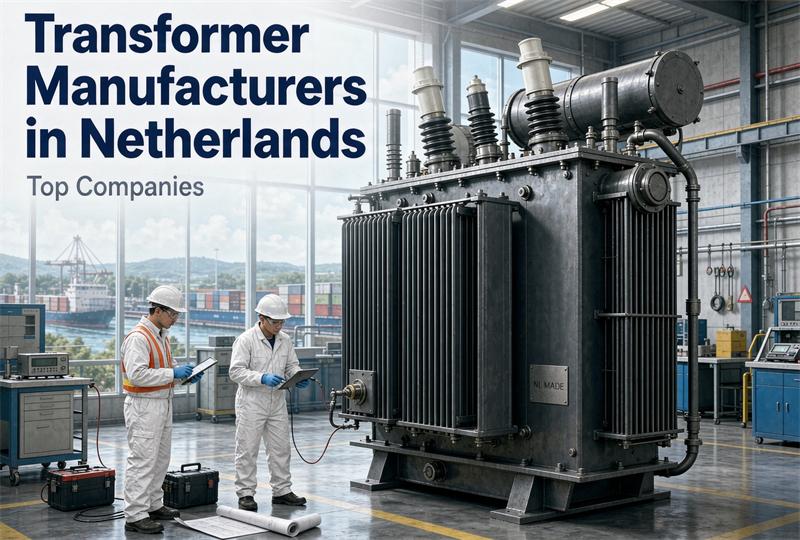
The Netherlands runs a small but technically strong transformer base centered on SGB-SMIT’s Nijmegen plant, IEO in Breda, and a cluster of specialized OEMs and EPC partners. Because 65–80% of Dutch demand is imported, domestic makers compete on custom engineering, IEC 60076 / Ecodesign Tier 2 compliance, and fast EU-grid support, not low volume price.What this guide covers
- Who are the leading transformer manufacturers in the Netherlands?
- What voltage and kVA ranges do Dutch transformer makers cover?
- How long are lead times for transformers from the Netherlands?
- What standards do Netherlands-made transformers comply with?
- How much do Dutch transformers cost versus import alternatives?
- Should you buy from a Dutch OEM or an export-oriented alternative?
- Frequently asked questions
Who are the leading transformer manufacturers in the Netherlands?
Start with a reality check. The Netherlands is not a high-volume transformer factory. Domestic production covers roughly 20–35% of national demand by value, and the rest, about 65–80%, is imported. The biggest import sources are Germany (30–40% of imports), Austria (15–20%), Turkey (12–15%), and a smaller slice from Asia. So when a buyer asks “who makes transformers in the Netherlands,” the honest answer is: a handful of serious plants plus a long list of multinational branch offices that sell imported units.
The companies that actually build to spec, in or near the country, break down like this:
- SGB-SMIT Group / Royal SMIT Transformers (Nijmegen). The country’s largest power-transformer plant. It builds generator step-up (GSU), grid-interconnect, and large distribution units up to 765 kV and 1,200 MVA, and can ship a finished unit to the Port of Rotterdam in about a day. This is the name that comes up for utility-scale and grid work.
- IEO Transformers (Breda, operating since 1945). A distribution and medium-voltage specialist. Typical output runs 50 kVA to 2,500 kVA in single-ratio units and up to 10 MVA, at system voltages to 36 kV. Units are designed and tested to IEC, NEN, BS, DIN, and VDE references, a good fit for DSO and commercial builds.
- PROTRAFO (Emmen, founded 2021). An engineer-in-the-Netherlands, build-with-audited-European-OEM-partners model. Their scope runs from design and FAT supervision through transport, on-site assembly, SAT, and energization across the EU, built to IEC 60076 and Ecodesign Tier 2. Useful when you need a single accountable partner rather than a loose bill of materials.
- Smaller specialists. ELEQ (Steenwijk) covers protection and measurement; Hapam (Bunschoten) builds HV disconnectors and earthing switches to 800 kV; Rotor (Eibergen, part of the WEG group), Trafo-Energie (Eindhoven), Van der Heijden, and several repair-and-refurbishment shops fill the custom and service niches.
- Multinational sales and service arms. Eaton, ABB (now Hitachi Energy in transformers), Siemens Energy, and Schneider Electric all run Dutch entities. Many of the units they place are imported from their German, Austrian, or Swedish plants rather than made locally. It is worth confirming before you assume “Netherlands-built.”
Where do these units actually end up? Dutch-specified and Dutch-built transformers feed the Port of Rotterdam and Amsterdam shore-power and crane loads, North Sea offshore wind interconnects, the country’s fast-growing data-center belt, and hydrogen and chemical clusters around the Rhine delta. That end-use mix is why distribution and custom MV units dominate local demand, while the largest power ratings are tied to grid and interconnect projects rather than high-volume commodity supply.
| Tier | Representative makers | Voltage / kVA | Typical lead time | Best buyer |
|---|---|---|---|---|
| Large power | SGB-SMIT / Royal SMIT (Nijmegen) | up to 765 kV · 15–1,200 MVA | 6–12 months build + 12–24 mo qualification | Utilities, TSO/DSO, GSU, grid interconnect |
| Distribution & MV | IEO (Breda), regional specialists | to 36 kV · 50 kVA–10 MVA | 6–20 weeks | DSOs, industry, commercial buildings |
| Project / EPC partner | PROTRAFO, system integrators | IEC 60076 · Ecodesign Tier 2 · EU build | 6–12 months turnkey | EPCs needing design-to-energization |
| Multinational catalogs | Eaton, ABB/Hitachi, Siemens, Schneider | broad; often imported units | varies by origin | Buyers wanting one vendor + local support |
What voltage and kVA ranges do Dutch transformer makers cover?
The short version: Dutch and EU-serving plants cover almost the entire spectrum, but they are strongest at the top and the custom middle, not at commodity distribution volumes.
- Distribution: 50 kVA to 10 MVA, system voltages to 36 kV. Standard pad-mounted and compact-substation units commonly sit in the 100 kVA to 5 MVA band.
- Dry-type / cast-resin: roughly 100 kVA to 16 MVA. Cast-resin lines (the Schneider Trihal class often quoted in the Dutch market) are popular for data centers, buildings, and fire-sensitive sites.
- Power, GSU, and grid interconnect: SGB-SMIT’s Nijmegen plant reaches 765 kV and 1,200 MVA, the utility and renewable-interconnect tier.
- Specialty: amorphous-core and natural-ester (bio-fluid) units are available from the Nijmegen plant; maritime and offshore variants come from smaller specialized shops.
One more spec detail that affects both price and lead time: efficiency class. EU tenders increasingly reference Ecodesign Tier 1 and Tier 2 no-load and load-loss bands, and a unit built to the tighter Tier 2 band costs more upfront but pays the difference back through losses over a 20–30 year life. Ask each supplier to quote against the same loss class so you are comparing like for like.
One practical note for specifiers: pin your exact preferred rating early. The common NEMA/IEC preferred ladder (1,000 kVA, 1,600 kVA, 2,500 kVA, and so on) exists for a reason. A size that lands between steps pushes you into a non-standard design, which quietly lengthens lead time and raises cost.
How long are lead times for transformers from the Netherlands?
Lead time is where Dutch and EU supply either wins or loses for you, depending on what you are buying.
- Domestic custom distribution: about 6–20 weeks. Air-insulated custom designs run 6–12 weeks; more complex multi-winding builds land at 10–20 weeks.
- European imports: roughly 10–16 weeks door to EU site.
- Asian supply chains: typically 18–30 weeks, ocean freight included.
- Large power transformers: 6–12 months to build, often longer once engineering and type testing are in the loop.
For imports, the clock does not stop at the factory gate. A unit built in Asia typically adds 4–6 weeks of ocean freight plus customs and final road haul, while a Dutch or EU build often reaches a Benelux or Rhine-region site in days by road. If your project has a fixed energization date, that freight window, not the build week, is usually the constraint you plan around.
The schedule risk most buyers underestimate is qualification, not manufacturing. For utility and DSO work, getting onto an approved vendor list takes 12–24 months before you can even bid. On top of that, non-recurring engineering (NRE) runs about €2,000 to €15,000 per project, amortized across the production volume.
Plan the whole chain, not just the build. For a US EPC, a 20-week EU build plus 2-day road freight is a very different plan than an 18-week Asian build plus 4–6 weeks ocean freight, port clearance, and your FAT/SAT window. Add the qualification clock on top if the end client is a utility.
What standards do Netherlands-made transformers comply with?
EU-built units are straightforward on paper. The baseline is IEC 60076 for power transformers (with IEC 60076-11 covering dry-type), EU Ecodesign Tier 2 loss limits via EN 50541, and CE marking under the Low Voltage Directive 2014/35/EU. EcoDesign Tier 2 is the current loss-efficiency floor most Dutch and EU tenders expect.
The catch is for non-EU buyers. US projects usually call for ANSI/IEEE C57.12.00 (liquid-immersed) or C57.12.01 (dry-type), NEC Article 450 protection rules, a 480 V secondary, and UL 1561 / 1562 listing. An IEC-only European unit may need re-certification or a dual-standard build to clear a US site. Our engineering resources include an IEC-vs-ANSI explainer that walks through that decision before you commit a spec.
Trade mechanics matter too. EU anti-dumping duties of about 5–15% apply to some Chinese large power transformers, and the relevant HS codes are 850421 (liquid dielectric, ≤ 650 kVA), 850422 (650 kVA–10 MVA), and 850423 (> 10 MVA). Rotterdam is the main entry point for both imports and Dutch exports, which is why logistics quotes from that port are worth pinning down early.
How much do Dutch transformers cost versus import alternatives?
Sticker price is the easy number and the least useful one. Here is the cost shape that actually drives a decision.
- Labor and structure premium: Dutch/EU custom units carry a 15–25% cost premium over Eastern European or Asian production for a comparable design. That gap is driven by labor: about €40–65 per hour in the Netherlands (roughly $43–$70) versus €12–22 in Eastern Europe and €5–10 in China.
- Brand and reliability premium: established EU makers add roughly 10–20% over Asian imports on the same spec.
- Channel margin: distribution and integrator margins run 20–35% on standard products and 15–25% on high-volume custom work.
- TCO, not sticker: the purchase price is often only 60–70% of lifetime cost. No-load and load losses over a 20–30 year life, logistics, duties, and qualification dominate the rest. A 1,000 kVA unit’s losses can outweigh the purchase delta across its service life, which is why efficiency class belongs in the spec, not the footnote.
To make the premium concrete without quoting live prices: on a 2,500 kVA distribution unit, a 15–25% Dutch/EU labor-and-structure premium plus a 20–35% channel margin can lift the invoice well above a direct import, but the import route carries its own adders: 5–15% anti-dumping duty on some large units, ocean freight, and a longer cash-cycle. Run both total landed costs before you commit, not after.
So the rule of thumb: a Dutch or EU builder makes sense when you need a certified, custom, or grid-specific unit with local FAT/SAT and fast spares. An import or export-oriented alternative makes sense when you need a standard catalog unit, are price-sensitive, or want flexible volume and global shipping.
Should you buy from a Dutch OEM or an export-oriented alternative?
This is the question the “top 10 list” articles never answer, because they are written to sell you one side. Here is a neutral way to frame it.
Choose a Dutch or EU OEM when: your unit must be certified for the EU grid; you need close engineering collaboration on a non-standard design; spares and service proximity matter; or the project sits on a utility-approved vendor list where local presence is part of the bid. The Nijmegen and Breda plants are genuinely strong here.
Consider an export-oriented manufacturer when: your spec is standard or near-standard; price and volume flexibility win the contract; or your project is outside the EU and you want one builder shipping to your port. These builders typically hold IEC and ANSI lines side by side and can match a US 480 V / UL requirement without a separate re-certification project, which removes a common cause of schedule slip on cross-border jobs. For a US EPC in particular, the spec mismatch is the deciding factor: US sites want ANSI/IEEE C57, NEC 480 V, and UL listing, so an EU-only IEC supplier adds re-certification work. A builder that routinely ships dual-standard transformer products (IEC plus ANSI, with UL where required) removes that friction. You can also review completed utility and EPC projects to see how similar units were specified, tested, and shipped.
The move that saves the most grief: qualify at least two supply routes in parallel (one EU/Dutch and one export-oriented) before the bid. Lead times, duties, and certification paths differ enough that a single-source plan usually leaves money or schedule on the table.
Frequently asked questions
Who is the largest transformer manufacturer in the Netherlands?
SGB-SMIT Group’s Nijmegen plant, trading as Royal SMIT Transformers, is the country’s largest power-transformer facility. It builds generator step-up, grid-interconnect and large distribution units up to 765 kV and 1,200 MVA, with direct shipping to the Port of Rotterdam in about a day.
Are transformers made in the Netherlands IEC and Ecodesign compliant?
Yes. Dutch and EU-based production is built to IEC 60076 and EU Ecodesign Tier 2 loss limits, with CE marking under the Low Voltage Directive as standard. Many units also meet NEN, BS, DIN and VDE references on request.
What is the typical lead time for a Dutch-made transformer?
Custom distribution units run about 6 to 20 weeks. Large power transformers take 6 to 12 months to build, plus 12 to 24 months of utility qualification on approved vendor lists. Asian-sourced alternatives often run 18 to 30 weeks door to door.
Can a US buyer import transformers from the Netherlands?
Yes, but US projects usually require ANSI/IEEE C57 and NEC/UL compliance at 480 V. An IEC-only EU unit may need re-certification, so an export-oriented builder that routinely ships dual-standard units (IEC plus ANSI, with UL where needed) tends to be simpler to qualify.
Why does the Netherlands import most of its transformers?
Domestic labor runs about €40 to €65 per hour and the country has little local core or winding capacity, making commodity units 15 to 25 percent more expensive than Eastern European or Asian production. The Netherlands therefore imports standard volumes and focuses its own plants on custom, certified designs.
Buyer’s checklist
Before you issue the RFQ, lock these five points: (1) exact kVA and kV rating on the preferred ladder; (2) IEC or ANSI/IEEE as the governing standard, plus UL if the site is in the US; (3) custom design versus catalog unit; (4) real lead time including qualification and ocean freight; (5) TCO, not sticker: losses, duties, and logistics included. Run a Dutch/EU OEM and an export-oriented builder side by side, and the right supplier usually becomes obvious.
If you want a second route in the mix, TransNine Electric builds to both IEC and ANSI specs and can quote against your kVA, kV, and efficiency class directly.