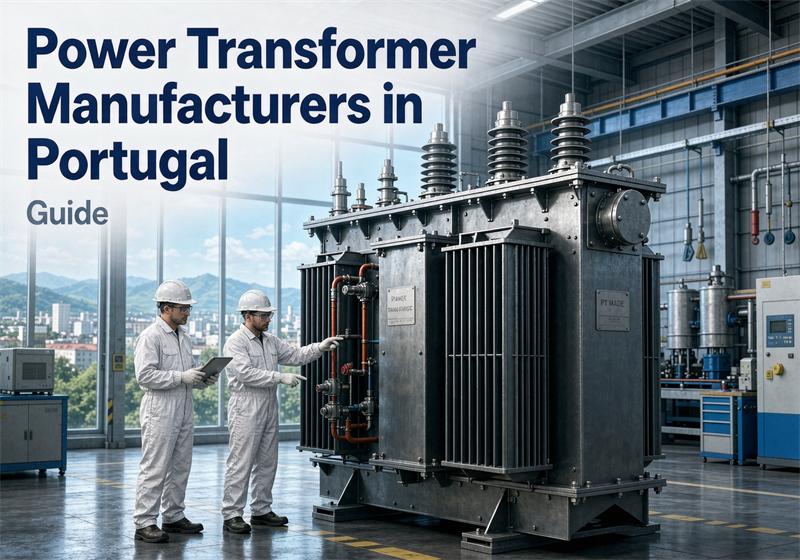
Portugal’s transformer base is small but real, led by EFACEC in Porto — shell-type units to 1,500 MVA at 525 kV, distribution from 50 kVA. Most 110 kV+ units still come from EU or export suppliers, with 2026 lead times from 20 months (EFACEC) to 60 months (Tier 1 OEMs). For US EPC and utility buyers, the real question is who can hit your voltage, MVA, and energization date — not who’s “listed” in Portugal.
If you’re scoping a substation, a GSU, or a renewables balance-of-plant package in or near Portugal, this guide skips the name-dropping. It walks through what’s actually built in the country, what it costs you in time, and how to weigh a Portugal-built unit against an export alternative without getting burned on compliance or delivery.
Does Portugal actually manufacture power transformers?
Yes — but “manufacture” covers a wide spread, and most of what gets called a “Portuguese transformer” is really a unit supplied by a foreign OEM into the Portuguese market.
The one name with genuine domestic depth is EFACEC, based in the Porto/Maia area. It has built transformers since 1949, ships to 114 countries, and has more than 100,000 units in service. Beyond EFACEC, a cluster of smaller specialists handles distribution and substation equipment — for example, EVA Elektromekanik, which builds dry-type and oil distribution units. For utility-scale 110 kV and above, Portugal still leans on EU OEMs and imports, but EFACEC’s shell-type line covers the upper end that most small countries can’t touch.
So the honest answer: Portugal is not a high-volume transformer nation like Germany or China, but it is a real manufacturing base — just a narrow one.
Why so narrow? Portugal’s own grid demand is modest, and Europe’s heavy transformer engineering sits mostly in Germany, Switzerland, and the Nordics. That leaves room for only one full-scale power-transformer maker — the rest of the local industry naturally specialized in distribution, service, and integration work, where the recurring volume actually is. If your spec is 25 MVA or below, or a mobile/substation package, that specialization is a genuine fit. Above it, you’re weighing EFACEC’s shell line against the EU majors and export suppliers — which is exactly the comparison this guide is built to support.
Who are the main power transformer manufacturers in Portugal?
Two Portuguese names matter. Everything else you’ll see in a “Portugal brands” list — Siemens Energy, Hitachi Energy, GE Grid Solutions, ABB, SGB-SMIT, Ormazabal, Arteche, WEG — are foreign suppliers serving the Portuguese market, not Portuguese manufacturers.
- EFACEC (Porto) — the only Portuguese maker with large-power capability, from distribution through 1,500 MVA shell-type units.
- EVA Elektromekanik — distribution and medium-voltage specialist; dry-type cast-resin and oil units, plus mobile substations.
Here’s how they stack up against the broader supply tiers you’ll actually be comparing them to:
| Supplier / tier | Voltage range | Max capacity | 2026 lead time | Best-fit buyer |
|---|---|---|---|---|
| EFACEC (Portugal, EU Tier 2) | up to 525 kV | 1,500 MVA shell / 350 MVA core; distribution 50 kVA–25 MVA | 20–28 months | 110–400 kV transmission, GSU, substations; US-operator 60 Hz versions available |
| EVA Elektromekanik (Portugal) | up to 36 kV | 2,500 kVA dry-type; oil distribution | project-by-project (weeks–months) | MV distribution, renewables BOP, compact substations |
| Tier 1 Western OEM (Siemens Energy, Hitachi, GE Vernova) | up to 1,100 kV | 1,000–1,300+ MVA | 48–60 months | Utility transmission with no near-term deadline |
| Export-oriented suppliers (EMEA / Asia) | 110–500 kV | up to ~1,000 MVA | 12–36 months | Cost- or schedule-driven 110–220 kV packages |
Lead-time figures: GridReadiness manufacturer tracker, June 2026. EFACEC and several EU Tier 2 makers also produce ANSI/IEEE 60 Hz units for US-operator European deployments.
What voltage and MVA classes can you actually source from Portugal?
This is where the directory sites go quiet. Here’s the concrete capability, drawn from EFACEC’s own product portfolio and EVA’s spec sheets.
EFACEC (Portugal):
- Shell-type power: up to 1,500 MVA at 525 kV (BIL 1,675 kV)
- Core-type power: up to 350 MVA at 525 kV
- Distribution (oil-immersed and eco-fluid): 50 kVA to 25 MVA at 72.5 kV
- Mobile / trailer units: up to 90 MVA at 245 kV (200+ units deployed worldwide)
Proof it builds at the top end, not just on paper: EFACEC supplied shell-type GSU transformers for a US nuclear plant — two units at 750 MVA / 500 kV and two at 760 MVA / 230 kV. It has also delivered 12 power transformers onto Spain’s 400 kV transmission network and supplied 410 kV units (245 / 90 / 65 MVA) for Portugal’s Alto Tâmega hydro complex.
EVA Elektromekanik (Portugal):
- Dry-type cast-resin: 50 kVA to 2,500 kVA, 1.1–36 kV, built to IEC 60076 with AN/AF cooling
- Oil-immersed distribution (conservator and hermetically sealed)
- Mobile substations (MV-LV, MV-MV, HV-MV) for disaster recovery and seasonal demand
The practical read: if you need ≤25 MVA distribution or ≤90 MVA mobile, Portugal can serve you domestically. Above ~350 MVA core (or anything needing the 1,500 MVA shell line), EFACEC is your only local option — and past that you’re comparing EFACEC against Tier 1 EU makers and export suppliers.
How long are lead times, and why do they drive your schedule?
In 2026, the transformer — not the grid connection — is usually the long pole in the tent.
- Tier 1 Western OEMs quote 48–60 months; GE Vernova is pushing 60+ months.
- EFACEC sits at 20–28 months.
- Qualified export suppliers often quote 12–36 months for 110–220 kV classes.
- The IEA puts the average large-power-transformer lead time near 200 weeks (about four years) across 2023–24, with some prices reaching 2.6× pre-pandemic levels (IEA, 2025).
Here’s the trap most teams fall into. They plan the grid connection first and order the transformer after — so the two timelines run in series instead of parallel. A 24-month French brownfield grid connection plus a 24-month EFACEC unit ordered late = 48 months to first power. Order both at month zero and you’re at 24 months. Pick Hitachi at 60 months and the transformer becomes the critical path no matter what else you do.
The fix is boring but decisive: open the transformer RFQ at project inception, and use a Letter of Intent or a refundable slot reservation to lock a build window before your design freezes. That single move can pull a 2029 energization target back into 2027–28.
Portugal vs. export alternatives: which is right for your project?
Plenty of guides frame this as “Portugal good, imports cheap.” The real trade is more textured.
Cost. Export suppliers often land 20–40% below Tier 1 ex-works pricing. But add ocean freight to Lisbon, Leixões (Porto), or Sines, import duty, and — for the EU — CBAM (Carbon Border Adjustment Mechanism) exposure on the embedded carbon. EFACEC sits in the middle: EU-made, a shorter queue than Tier 1, at a premium over Asia.
Compliance. EU makers build to IEC 60076 at 50 Hz. If you’re a US operator specifying 60 Hz / ANSI-IEEE C57 units, you need explicit compliance — EFACEC and some EU Tier 2 producers build ANSI/IEEE 60 Hz versions for exactly this case (GridReadiness, June 2026). Export suppliers vary widely; qualify per project, don’t assume.
Risk and QA. EU = shorter audit distance, familiar standards, shorter haul, easier FAT witness. Export = longer logistics, so you must verify the test bay, FAT reports, loss guarantees, and references at your voltage class before you commit.
Decision rule by use case:
- Utility 400 kV transmission with a 2030 horizon → Tier 1 or EFACEC.
- 110–220 kV with a 2027–28 deadline → EFACEC or a qualified export supplier.
- MV distribution / balance-of-plant → EVA or a local specialist.
- Cost-capped and schedule-tight → qualify an export supplier alongside EFACEC and compare on total landed cost and confirmed slot.
If you’re weighing a Portugal-built unit against an export option, it helps to compare certified product lines side by side — our power transformer product range lays out voltage classes, MVA tiers, and compliance footprints in one place.
How to qualify a power-transformer supplier (checklist)
Whether you buy Portuguese, EU, or imported, run every bid through the same gate:
One red flag worth naming: if a supplier can’t show a type-test report at your exact voltage class, or quotes a lead time wildly out of step with the market — say, 6 months for a 300 MVA / 400 kV unit when the field is quoting 20+ months — treat it as a scheduling risk, not a bargain. The cheapest quote that misses your energization date is the most expensive unit on the project.
- Certifications — IEC 60076 (or IEEE C57 for 60 Hz), ISO 9001, and valid type-test reports.
- References at your voltage/MVA class — not “we’ve shipped transformers,” but “we’ve shipped your class to a utility like yours.”
- FAT protocol — Factory Acceptance Test scope, plus the option of an independent witness.
- Loss guarantees — no-load (P₀) and load (Pₖ) losses, with impedance tolerance in writing.
- Build-slot confirmation — written lead time, with extension and penalty terms.
- Logistics — Incoterms (CIF/CFR to a Portuguese port), oil containment (SPCC-style), and road/rail weight limits for the final leg.
- For export only — CBAM exposure, certificate of origin, and a local partner for commissioning and service.
You can pull specification sheets, compliance documentation, and tender-support material from our technical resources library before you issue the RFQ.
FAQ
Does Portugal have its own transformer manufacturers?
Yes. EFACEC in Porto is the flagship, building shell-type units to 1,500 MVA at 525 kV and distribution transformers from 50 kVA, with 100,000+ units in 114 countries. Smaller specialists like EVA Elektromekanik handle distribution and MV equipment. Most large 110 kV+ units for utility projects are still built by EFACEC or imported from EU/export suppliers.
What is the largest power transformer made in Portugal?
EFACEC’s shell-type units reach 1,500 MVA at 525 kV (BIL 1,675 kV); core-type tops out at 350 MVA at 525 kV. On the distribution side, EFACEC covers 50 kVA–25 MVA, and EVA Elektromekanik builds dry-type cast-resin units up to 2,500 kVA at 36 kV.
How long does it take to get a power transformer in 2026?
Tier 1 Western OEMs quote 48–60 months; GE Vernova 60+. EFACEC quotes 20–28 months, and qualified export suppliers often 12–36 months for 110–220 kV (GridReadiness, June 2026). Order the transformer at project inception — not after grid approval — or it becomes your critical path.
Are Portuguese transformers IEC or IEEE compliant?
EFACEC and most EU makers build to IEC 60076 at 50 Hz. US operators specifying 60 Hz / ANSI-IEEE C57 units need explicit compliance — EFACEC and some EU Tier 2 producers manufacture ANSI/IEEE 60 Hz versions for US-operator European deployments (GridReadiness, June 2026).
Is buying from an export manufacturer cheaper than a European OEM?
Often 20–40% lower ex-works, but add sea freight, duty, and CBAM exposure for EU delivery, plus qualification cost. The right call depends on your voltage class, schedule, and whether you can absorb the compliance and QA burden. Compare total landed cost and a confirmed build slot, not the headline price.
Conclusion
Portugal’s real transformer capacity is narrower than a directory makes it look: EFACEC carries the large-power and distribution load, with MV specialists like EVA filling the distribution and substation gap. Everything else marketed as “Portugal” is imported or foreign-supplied. What actually decides your energization date isn’t the logo on the nameplate — it’s lead time, confirmed slot, and how early you order.
Match your voltage and MVA to the right tier, qualify every bid against the same checklist, and put a Portugal-built unit and an export alternative through identical scrutiny. As a global power-transformer supplier, we’ve shipped utility-grade units across Europe, North America, and the Middle East; you can review delivered substation and GSU projects to see how the capability plays out in the field. The buyer who treats Portugal as one option in a qualified shortlist — not a box to tick — is the one who powers on schedule.
Quick rule of thumb: under 25 MVA, buy Portuguese or local; 110–400 kV with a 2027–28 deadline, shortlist EFACEC and one export supplier; 400 kV transmission with no deadline, the EU majors still win on track record. Then let the checklist — not the country flag — make the call.