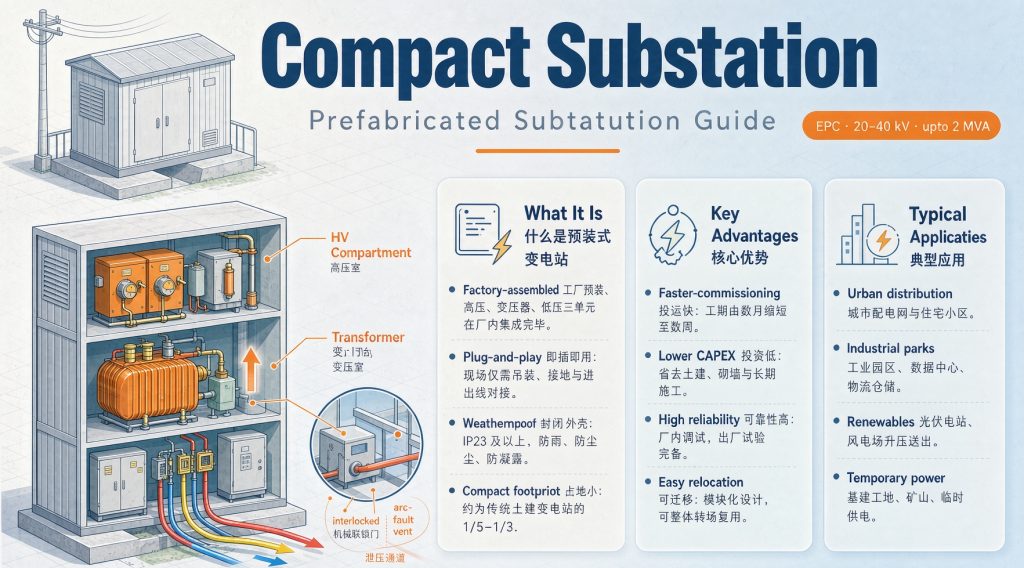
a compact substation is a factory-built, type-tested box that puts medium-voltage switchgear, a distribution transformer, and a low-voltage switchboard in one enclosure, wired and tested before it leaves the plant. You pour a pad, set it, terminate cables, and energize. The engineering work doesn’t disappear — it moves from your site to somebody else’s factory, which is the whole point.
Here’s what almost every guide on this keyword leaves out. The transformer inside that box is usually the same distribution transformer you’d buy standalone, which means US federal efficiency rules can follow it in. The enclosure has a temperature-rise class that decides whether your 1,000 kVA unit actually carries 1,000 kVA in August. And the IP rating you’re proud of works against you on cooling. None of that shows up in a “three compartments, five applications” article.
TransNine Electric builds and exports these units, and the pages ahead come from the RFQs we see go sideways. Let’s go through the seven blanks you have to fill correctly before you send one out.
Key numbers
| Item | Value | Why it matters |
| IEC 62271-202 scope | AC prefabricated substations above 1 kV up to and including 52 kV, up to 60 Hz | Tells you what the standard governs — and what it doesn’t |
| Enclosure classes | 5, 10, 15, 20, 25, 30 K | Permitted temperature difference between the transformer inside and outside air |
| Minimum enclosure protection | IP23D | IEC floor for the enclosure; higher is a choice, not a default |
| Mechanical impact | IK10 (20 J) | Doors and covers against vandalism and knocks |
| Main earthing conductor | ≥30 mm² copper | Must carry the rated short-time withstand current |
| Ambient basis for ratings | 40 °C max, 30 °C daily average, 20 °C annual average | IEC 60076 normal service conditions |
| Altitude limit before derating | 1,000 m (3,300 ft) | Above this, rated output has to be corrected |
| DOE coverage — input | ≤34.5 kV | 10 CFR 431.192 |
| DOE coverage — output | ≤600 V | A 4,160 V secondary is outside the definition |
| DOE coverage — frequency | 60 Hz | A 50 Hz unit isn’t a “distribution transformer” under the federal definition |
| DOE coverage — capacity | 10–5,000 kVA liquid-immersed, 15–5,000 kVA dry-type | Most compact substations sit inside this band |
| DOE compliance trigger | Manufactured or imported on or after April 23, 2029 | 89 FR 29834; your PO date is irrelevant |
| 1 kW of no-load loss | 8,760 kWh per year | Core loss runs 24/7, whether you load the unit or not |
| 20 ft ISO container max gross mass | 30,480 kg | The number that decides whether shipping is routine or a project |
So what exactly is a compact substation?
It goes by five names — compact substation, prefabricated substation, packaged substation, box-type substation, modular substation — and they describe the same animal: a single enclosure that shows up on site with the medium-voltage gear, the transformer, and the low-voltage board already inside, already interconnected, already tested.
The distinction that matters isn’t the name. It’s where the integration happened. In a conventional build, the foundation gets poured, switchgear arrives on one truck, the transformer on another, and a crew terminates and commissions outdoors for weeks. Weather, labor availability, and the order things show up in all become schedule risk. A compact substation turns most of that into factory floor work, where a mistake costs an hour instead of a week.
What’s left on site is genuinely short: set the unit on its pad, pull and terminate the incoming MV cable and the outgoing LV feeders, bond it to the earth grid, and commission. The schedule compression people quote for this isn’t magic — you’ve simply deleted the outdoor assembly and wiring steps.
The compact substation category spans roughly 30 kVA to 2,500 kVA at 10–35 kV in the IEC world. In North American voltage classes, that maps onto 12.47 kV, 13.8 kV, 24.94 kV, and 34.5 kV primaries with 208Y/120 V, 480Y/277 V, or 600Y/347 V secondaries.
One hierarchy note so you don’t chase the wrong document: this guide is about the assembly — the box, the switchgear, the clearances, the tests. If what you actually need to select is the transformer that goes inside it, that’s the equipment layer and a different spec sheet. Both matter; they’re just not the same purchase decision.
The three compartments, and what goes wrong in each
Every compact substation is built around three physically separated bays. The separation isn’t cosmetic — it’s what keeps a fault in one bay from becoming a fault in all three.
MV compartment. Terminations, load-break switches or vacuum fault interrupters, protection, and metering. Two things go wrong here. First, buyers specify “switchgear” without naming the switching device, then discover a load-break switch can’t interrupt a fault — that needs a vacuum interrupter or a breaker with a relay. Second, they forget to say whether they need loop-feed. A radial-feed unit has two or three bushings; a loop-feed unit typically has six and a three-position switch so you can sectionalize. Retrofitting loop capability in the field isn’t a thing.
Transformer compartment. Sealed tank for liquid-immersed, encapsulated windings for cast resin dry-type. The fluid choice is a real decision, not a checkbox: mineral oil, natural ester, or synthetic ester. Ester fluids carry a fire point above 300 °C, which is the threshold that changes how NEC 450.23 treats the installation near combustible construction. If your unit sits close to a building wall, that choice can be the difference between a simple pad and a fire-rated vault.
LV compartment. Main breaker, feeder breakers, metering, sometimes power factor correction. In the US this bay is where an IEC design most often fails inspection, because a European LV board is built to IEC 61439 and US inspectors look for a UL 891 listed switchboard or UL 67 panelboards. Same function, different evidence.
The full range of configurations we build is on the products page — worth a look before you freeze a spec, because a lot of “custom” requests turn out to be catalog.
The US code path: IEC 62271-202 doesn’t get you an inspection sticker
This is the section nobody writes, and it’s the one that decides whether your unit gets energized on schedule.
IEC 62271-202:2022 (Edition 3.0, published June 2022) is titled High-voltage switchgear and controlgear – Part 202: AC prefabricated substations for rated voltages above 1 kV and up to and including 52 kV. It’s a genuine product standard with type tests behind it: dielectric tests on the HV interconnections, a continuous-current (temperature-rise) test, short-time withstand, internal arc per Annex A, and a 20 J mechanical impact test on doors and covers.
What it is not is a US installation standard. There is no American counterpart that says “this complete box is approved.” The US path runs component by component:
- Transformer — ANSI/IEEE C57.12.00 for general requirements, C57.12.34 for pad-mounted compartmental self-cooled three-phase units, C57.12.28 for tamper-resistant enclosures, and C57.12.36 for liquid-immersed distribution substation transformers
- LV switchboard — UL 891 (switchboards rated 1,000 V or less) or UL 67 (panelboards)
- Enclosure — NEMA 3R for outdoor rain, sleet, and snow
- Installation — NFPA 70 (NEC), including working space under 110.26 and transformer provisions in Article 450
If you’re importing, the standards mismatch is the single biggest source of delay, and it’s worth reading IEC 60076 vs ANSI/IEEE for export transformers before you write the RFQ.
The four-question DOE coverage test
Federal efficiency rules apply to the transformer inside the box, not to the box. Under 10 CFR 431.192, a “distribution transformer” is one that:
- Has an input line voltage of 34.5 kV or less
- Has an output line voltage of 600 V or less
- Is rated for operation at 60 Hz
- Has a capacity of 10 kVA to 5,000 kVA (liquid-immersed) or 15 kVA to 5,000 kVA (dry-type)
Answer yes to all four and you’re in scope. A compact substation on a 13.8 kV primary with a 480Y/277 V secondary at 60 Hz is in scope. Swap the secondary for 4,160 V and you’re out — the output is above 600 V. The definition also excludes thirteen specific types, including autotransformers, drive (isolation) transformers, rectifier transformers, special-impedance transformers, and anything with a tap range of 20% or more.
The date that matters is the manufacturing or import date, not your PO date and not your delivery date. Per DOE’s April 2024 final rule (89 FR 29834), the amended efficiency levels apply to units manufactured or imported on or after April 23, 2029. A unit built in late 2028 and delivered in 2029 is judged on the old table.
Two practical consequences. “Meets DOE” is meaningless without the kVA attached — the minimum efficiency curve in 10 CFR 431.196 isn’t monotonic, and a 300 kVA unit is held to a stricter number than a 500 kVA unit. And coverage widens in 2029: ratings above 2,500 kVA weren’t federally covered at all before, and they will be.
60 Hz is not a detail
IEC equipment is designed around 50 Hz. US grids run 60 Hz, and the difference isn’t a formality: core loss, impedance, exciting current, and thermal behavior all shift with frequency. A 50 Hz core run at 60 Hz behaves differently than the nameplate suggests.
Every serious guide on this keyword brings up voltage and capacity and never mentions frequency. If you’re buying for North America, put “60 Hz” in the RFQ as an explicit line item, not an assumption.
Sizing: get the kVA right, then get the fault current right
Capacity first. Add up connected load, apply demand and diversity factors, divide by power factor, and round up to a standard rating. Then add headroom deliberately — not the reflex 20%, but a number tied to what you actually expect to add.
Then do the step that gets skipped: calculate the fault current the transformer can deliver, because that sets the interrupting and withstand rating of everything downstream.
Worked example. 1,000 kVA, 480 V secondary, 5.75% impedance:
- Full-load current = 1,000,000 VA ÷ (480 V × √3) = 1,203 A
- Available symmetrical fault current = 1,203 A ÷ 0.0575 = 20,918 A, call it 20.9 kA
- Next standard equipment rating: 25 kA
That’s what “25 kA” on a spec sheet is — the result of this arithmetic, not a default. If you don’t do it, you’re either buying switchgear you can’t coordinate or paying for capacity you don’t need. Note the direction: lower impedance gives you better voltage regulation and higher fault current. A 4.5% unit and a 6.5% unit are not interchangeable, and the fault duty difference is roughly 45%.
Then check your environment against the nameplate assumptions:
- Altitude. Standard ratings hold to 1,000 m (3,300 ft). Above that, cooling gets worse and you derate. Denver and anything in the Mountain West needs this on the RFQ.
- Ambient. IEC 60076 ratings assume 40 °C maximum, 30 °C daily average, 20 °C annual average. A Phoenix rooftop or a steel mill enclosure doesn’t look like that.
- Harmonics. Non-linear loads (VFDs, big rectifiers, DC fast chargers) need a K-factor rating, not just extra kVA.
Enclosure class: the rating almost nobody specifies
Here’s the parameter that decides whether your transformer delivers its nameplate in summer, and it’s absent from every page we sampled for this keyword.
IEC 62271-202 defines the rated power of a prefabricated substation as a three-parameter value: capacity, total losses, and temperature-rise limit. A real rating reads like 630 kVA – 5,500 W – 60/65 K O/W.
Then it defines six enclosure classes — 5, 10, 15, 20, 25, 30 — which express how much hotter the transformer compartment is allowed to run than the air outside. A Class 10 enclosure holds that difference to 10 K. A Class 30 permits 30 K.
You pick the class from two inputs: the annual average ambient temperature at the site and the expected load factor. Annex D of the standard gives the selection curves. The logic is straightforward: hot site plus high load factor means you need a low class number (better ventilation, more cooling capability), or you accept a lower permissible load factor.
This is why the choice has teeth. Specify Class 30 for a Gulf Coast site running at 0.9 load factor and you may own a unit that has to be derated every summer for the next twenty-five years. That’s not a paperwork error, it’s a permanent capacity loss nobody budgeted for.
And here’s the tension nobody mentions. IP rating and cooling pull in opposite directions. Everyone quotes IP54 or IP65 as if higher is simply better, but sealing the transformer compartment tighter restricts airflow, and restricted airflow moves you off the Annex D curve you thought you were on. The second digit is water ingress, and the “D” means the enclosure resists access by a wire probe — both good things for public safety. Just don’t buy a high IP and a high class number and assume you’re covered; ask the manufacturer to state the load factor the combination actually supports.
The other safety numbers worth naming explicitly:
- IP23D is the IEC floor for the enclosure; IP54 is common on MV and LV compartments where dust or driving rain is expected
- IK10 (20 J) for mechanical impact on doors and covers — this is the vandalism number
- Internal arc classification: IAC-A covers operators with doors open, IAC-B covers the public with doors closed, IAC-AB covers both. It has to be verified by type test with a stated arc current and duration, and the test covers HV switchgear and interconnections — not the transformer and not the LV side
- Earthing: main earthing conductor sized to carry the rated short-time withstand current, minimum 30 mm² copper, with all metallic enclosure parts bonded to it
If you’re deploying more than one unit, this decision multiplies. One wrong class on a single site is a derating problem; the same mistake across a thirty-site rollout is a programme problem. This 11 kV / 33 kV compact substation programme for a utility EPC is what holding one drawing set, one approved component list, and one enclosure class across every unit actually looks like.
The YBW series prefabricated compact substation is specified against ANSI/IEEE C57.12.00, C57.12.34, and C57.12.28, with a UL 891 listed LV switchboard, NEMA 3R enclosure, and 60 Hz rating — so the US component path above is already closed rather than something you discover later.
Four types, and when each one wins
European-style (three-compartment). Separate HV, transformer, and LV bays, each independently accessible and interlocked. Bigger footprint, easier to work on, accepts oil or cast resin, and scales to higher capacities with real protection and automation. This is the default for utility distribution, industrial plants, and anything you expect to expand.
American-style (integrated). The transformer and HV protection share one tank, with plug-in fuses and load-break switches. Very compact and cheap, and the natural choice for residential feeders and light commercial where the load is known and stable. What you give up is expansion headroom, automation, and access for maintenance.
Containerized / E-House. A 20 ft or 40 ft ISO structure, walk-in, with HVAC, lighting, and fire detection. You pick this when the site is remote, when you need the equipment indoors with room to work, or when you’re moving it later. Watch the mass: a 20 ft ISO container has a max gross of 30,480 kg, and payload is that minus tare. Above roughly 28 t of equipment, shipping stops being routine.
Non-walk-in vs walk-in. Non-walk-in units are serviced from outside through doors. Walk-in types have an internal operating gangway, which changes the footprint and adds ventilation, lighting, and egress requirements. IEC 62271-202 sets minimum dimensions for that gangway, and US installations additionally have to satisfy NEC 110.26 working space — roughly 3 ft to 4 ft of depth depending on voltage and condition. Don’t assume an IEC gangway dimension satisfies NEC, and don’t pour the pad until both are checked.
On applications: the reason compact substations took over DC fast charging is that packaged substations for charging sites collapse a long lead-time scope into one deliverable, and charging canopies don’t leave room for a fenced yard. Solar and BESS collector duty is the other big one, mostly because interconnection dates don’t move.
Site, foundation, clearances, and getting it through the gate
Four things kill compact substation projects after the PO is signed, and all four are knowable in advance.
Access. Get the shipping dimensions and mass in writing before you sign, then walk the route: bridge and culvert ratings, turning radius, overhead clearance, and whether the ground where the crane will stand can take an outrigger load. A unit that fits the pad but can’t reach it is a very expensive lesson.
Foundation. Usually a reinforced concrete pad with cable trenches and an earth grid, set above local flood level. In cold regions, frost depth governs — if the pad heaves, the enclosure racks and doors stop latching.
Clearances. Local utility standards often go beyond code. Some require 10 ft clear on the door side plus door swing, and more for larger units. Check the serving utility’s spec before the pad is poured, because it governs at the service position and it will be stricter than the catalog.
Thermal and corrosion. Hot sites want reflective finishes and, if needed, forced ventilation with thermostatically controlled louvers. Cold and coastal sites want enclosure heaters to control condensation, fully gasketed cable entries, and a corrosion class that matches the exposure — C4 or C5-M under ISO 12944 if you’re near salt. Enclosure coating is a small line item compared to replacing a cabinet in year eight.
Factory testing: what to demand before it ships
The advantage of a factory-built unit is that it can be proven before it leaves. Hold the manufacturer to it.
Type tests are done once on a design and establish that the design meets IEC 62271-202: dielectric withstand on HV interconnections, continuous-current (temperature-rise) test confirming the transformer stays within its enclosure class, short-time withstand, internal arc per Annex A for the claimed IAC, and the 20 J impact test. Note what the internal arc test does and doesn’t cover: HV switchgear and HV interconnections. Not the transformer, not the LV board.
Routine tests are done on every unit: applied and induced voltage withstand, insulation resistance, winding resistance, ratio and vector group check, and functional verification of interlocks, grounding continuity, and control circuits. Liquid-filled units get leak and pressure tests.
FAT is where you or your representative shows up. For utility work, ask for witnessed testing and for the reports in the documentation package, not just a certificate of compliance. More on what each routine test actually proves is in the resources library.
Where the money actually goes
We’re not going to print a price table. Every price table we found while researching this keyword was unsourced, and two tables on the same site disagreed with each other by more than a factor of two. A number you can’t check is worse than no number.
What we can give you is the structure, because the structure is what actually moves your budget:
- Transformer — the largest single line item, and it moves with copper or aluminum windings, loss tier, and fluid type
- MV switchgear — driven by switching device (load-break vs vacuum interrupter vs breaker), feed configuration, and fault rating
- LV switchboard — main breaker size, feeder count, metering, power factor correction
- Enclosure — material, corrosion class, IP and IK, thermal package
- Engineering and testing — drawings, type-test evidence, FAT, witnessed testing
- Freight and site work — ocean freight, inland haulage, crane, pad, termination
Then there’s the lifetime cost, which is the part procurement comparisons routinely skip. No-load loss runs 8,760 hours a year whether you load the unit or not. One kilowatt of core loss is 8,760 kWh annually — at an illustrative 13.9 ¢/kWh that’s about **$1,218 per kW per year**, and over a 25-year asset life a 2 kW difference between two quotes is roughly $60,000. Plug in your own tariff; the point is that the cheaper quote is often the one with the higher core loss, and the gap is paid for out of operating budget for decades.
The honest way to compare two bids is to ask for certified no-load and load loss values at your exact rating, capitalize them at your rate over your planning horizon, and add that to the purchase price. It takes twenty minutes and it changes the ranking more often than you’d expect.
The RFQ block
Copy this into your inquiry. Every line is a blank that costs money to fill in wrong.
Frequently asked questions
What is a compact substation?
A factory-assembled, type-tested enclosure containing medium-voltage switchgear, a distribution transformer, and a low-voltage switchboard, with internal interconnections, earthing, protection, and metering installed and tested before shipment. It’s also called a prefabricated, packaged, box-type, or modular substation. IEC 62271-202:2022 covers these units for rated voltages above 1 kV up to and including 52 kV.
How is a compact substation different from a pad-mounted transformer?
A pad-mounted transformer is one piece of equipment: a transformer in a tamper-resistant cabinet, typically built to ANSI/IEEE C57.12.34. A compact substation is an assembly that contains a transformer plus MV switchgear plus an LV switchboard. American-style integrated compact substations look similar to a pad-mount from the outside because the transformer and HV protection share one tank, which is why the two get confused.
What sizes do compact substations come in?
Common IEC ranges run from about 30 kVA to 2,500 kVA at 10–35 kV. In North American classes, primaries of 12.47 kV, 13.8 kV, 24.94 kV, and 34.5 kV with secondaries of 208Y/120 V, 480Y/277 V, or 600Y/347 V. Containerized and walk-in designs go considerably larger.
Do US efficiency rules apply to the transformer inside a compact substation?
Often yes. Under 10 CFR 431.192 a distribution transformer has an input of 34.5 kV or less, an output of 600 V or less, is rated 60 Hz, and falls between 10 and 5,000 kVA liquid-immersed or 15 and 5,000 kVA dry-type. A 13.8 kV to 480Y/277 V, 60 Hz unit meets all four tests. A 4,160 V secondary does not. The 2029 amended levels apply based on manufacturing or import date, not your purchase order date.
What IP rating should a compact substation have?
IP23D is the minimum IEC 62271-202 requires for the enclosure; IP54 is common on MV and LV compartments where dust or driving rain is a factor. But higher IP restricts airflow, so ask the manufacturer what load factor the combination of IP and enclosure class actually supports. Don’t specify IP in isolation.
What is an enclosure class under IEC 62271-202?
One of six classes — 5, 10, 15, 20, 25, or 30 — expressing the permitted temperature difference in kelvin between the transformer inside the enclosure and the ambient air outside. You select it from the site’s annual average ambient temperature and your expected load factor, using the curves in Annex D. Pick too high a number for a hot site and the unit has to be derated.
Can a compact substation go indoors?
Yes, but it changes the design. Indoor installations need attention to ventilation and heat rejection, fire separation, and often a less-flammable fluid. For liquid-immersed units, NEC 450.23 turns on fire point, and fluids above 300 °C are treated differently.
How long does installation take?
Site work is typically a matter of days rather than months: set the unit, terminate MV and LV cables, bond to the earth grid, and commission. The factory build and test period is the long pole, not the field work — which is the point of buying prefabricated. Your real schedule risk is design freeze and manufacturing lead time.
What tests should be done before shipment?
Type tests on the design (dielectric, temperature rise, short-time withstand, internal arc for the claimed IAC, mechanical impact) and routine tests on every unit (applied and induced voltage withstand, insulation resistance, winding resistance, ratio and vector group, functional checks of interlocks and grounding). Ask for a FAT with witnessed testing and get the reports in the documentation package.
What does a compact substation cost?
It depends on too many variables for a useful table — transformer size and loss tier, switchgear type and fault rating, LV board, enclosure class, corrosion protection, and freight all move it. What you should compare is purchase price plus capitalized losses: ask for certified no-load and load loss at your exact rating and run them over your planning horizon at your tariff.