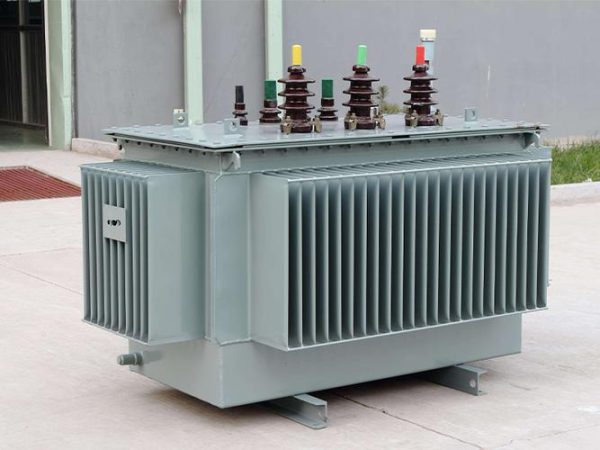
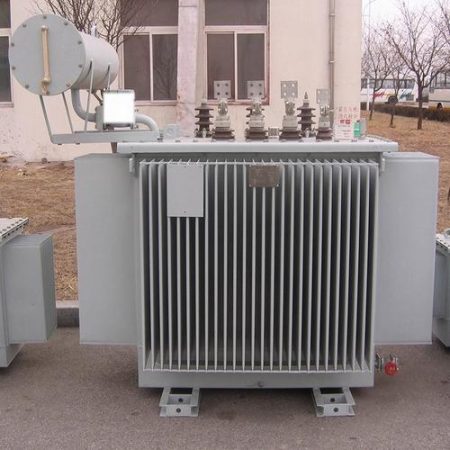
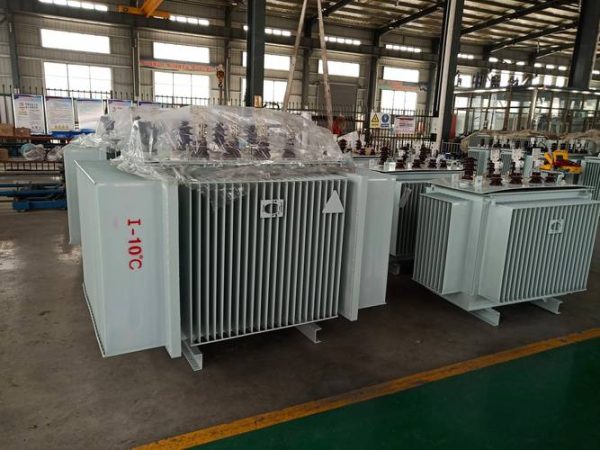
the S9-1600/10 is a 1,600 kVA, 10 kV primary / 0.4 kV secondary three-phase oil-immersed transformer from a design generation that predates China’s current minimum-efficiency rules. Its no-load loss of roughly 2,300 W is about double that of an S13 unit and several times that of an amorphous-core unit. If you are reading an old drawing or pricing a replacement, the specs below are what you need — but for any new installation you should be specifying S13/S20 or an amorphous-core design instead.
1. What the model code “S9-1600/10” actually means
| Character | Meaning |
|---|---|
| S | Three-phase (single-phase designs use “D”) |
| 9 | Design sequence number 9 — i.e. the efficiency generation, not a capacity or voltage code |
| 1600 | Rated capacity: 1,600 kVA |
| 10 | HV winding rated voltage: 10 kV |
Outside China, the same machine is described in an RFQ as: 1,600 kVA, 10 kV primary / 0.4 kV secondary, three-phase oil-immersed distribution transformer, Dyn11, 50 Hz, off-load tap changer ±5 % or ±2 × 2.5 % on HV. If you are writing a North American specification, that becomes 1,500 or 2,000 kVA (1,600 is not an ANSI standard rating), 13.8 kV primary, 480Y/277 V secondary, 60 Hz. The “S9” designation itself means nothing to a US AHJ or utility engineer — they will read the nameplate, not the model code.
One practical note on capacity: if you are weighing 1,600 kVA against the next size up, the 1,600 kVA and 2,000 kVA oil-immersed transformer comparison walks through the load-band logic and the loss-cost math for this exact rating.
2. S9-1600/10 reference specifications
These are the values typically quoted for this model. Treat them as reference data for comparison, not as a purchasable specification.
| Parameter | Typical value | Comment |
|---|---|---|
| Rated capacity | 1,600 kVA | IEC-aligned standard size; not an ANSI/IEEE standard rating |
| Voltage combination | 10 kV ±5 % or ±2 × 2.5 % / 0.4 kV | Off-load tap changer (DETC) on the HV winding |
| Vector group | Dyn11 (Yyn0 also offered) | Dyn11 is preferred — it blocks triplen harmonics and handles unbalanced single-phase loads better |
| Frequency | 50 Hz | 60 Hz must be declared at RFQ stage; it cannot be changed after the core is cut |
| No-load loss (iron loss) | ~2,200–2,400 W | The single most important number on this page |
| Load loss (copper loss) | ~15,000–16,500 W | Reference temperature — see the warning below |
| No-load current | ~0.6–0.8 % | |
| Short-circuit impedance | ~4–6 % | ~4.5 % or ~6 % are the usual values at this rating; confirm with your protection study |
| Insulation / cooling | Class A, oil-immersed, ONAN |
Check the reference temperature on that load loss. A 120 °C reference temperature is a dry-type convention (Class F, IEC 60076-11). For an oil-immersed transformer, load loss should be corrected to 75 °C under IEC/GB or 85 °C under IEEE C57.12.00. If a supplier quotes you 16,000 W “at 120 °C” for an oil unit, ask which standard they corrected to before you compare it with anyone else’s number — the difference between the two reference temperatures is worth several percent of the value.
3. Why S9 is no longer a specifiable design
It predates the efficiency rules that now apply. S9 was a mainstream Chinese distribution design before GB 20052 introduced mandatory minimum energy performance tiers. It sits below the current minimum threshold for new installations. Confirm the exact position of S9 relative to GB 20052-2020 Grade 3, and its listing status in the MIIT catalogue of eliminated high-energy-consumption products, before you state this in a tender response.
The problem is concentrated in no-load loss. A transformer burns its no-load loss 24 hours a day, 365 days a year, whether or not it is carrying any load. That is why the gap matters so much more than it looks: 2,300 W running continuously is 20,148 kWh a year before you deliver a single amp to a customer.
In practice it will not pass a modern review. New grid connections, utility metering points and most institutional or government-funded tenders now require Grade 2 or Grade 1. An S9 proposal will be rejected at specification review, not at the technical evaluation stage — which means the cheapest quote on the table is also the one most likely to cost you the job.
4. 1,600 kVA head-to-head: S9 vs S13 vs S20 vs amorphous core
| Design | Core type | No-load loss | Load loss | Versus S9 |
|---|---|---|---|---|
| S9-1600/10 (legacy) | Silicon steel | ~2,300 W | ~16,000 W | baseline |
| S13-1600/10 | Silicon steel | ~1,100 W | ~14,000 W | no-load −52 %, load −12.5 % |
| S20-1600/10 | Higher-grade silicon steel | confirm | confirm | typically ~10 % below S13 on both |
| SH15-type amorphous core | Amorphous metal | confirm | broadly comparable to S13 | no-load typically 60–70 % below S9 |
All figures other than the S9/S13 pair must be taken from the actual type-test report of the unit you are buying — do not populate a tender document from a comparison table, including this one.
If you want the current-generation drop-in equivalent to an S9, the S20 series oil-immersed distribution transformer is the natural replacement at this rating. Where the transformer will run lightly loaded most of the day — a plant with a night shift, a warehouse, a campus — an amorphous-core 10 kV unit cuts no-load loss far harder and pays back faster.
5. What the losses actually cost you: worked example
Use this, and substitute your own numbers:
Annual loss energy, in kWh per year: E = P0 × 8760 + Pk × β² × 8760, where P0 is no-load loss in kW, Pk is load loss at rated in kW, and β is the average load factor (0–1).
At a 50 % load factor, 1,600 kVA:
| S9 | S13 | Difference | |
|---|---|---|---|
| No-load: P0 × 8,760 | 2.3 kW → 20,148 kWh | 1.1 kW → 9,636 kWh | 10,512 kWh |
| Load: Pk × 0.25 × 8,760 | 16.0 kW → 35,040 kWh | 14.0 kW → 30,660 kWh | 4,380 kWh |
| Total per year | 55,188 kWh | 40,296 kWh | 14,892 kWh |
At US$0.10/kWh that is about $1,489 per year, or roughly $29,800 over a 20-year life undiscounted — before any maintenance.
At a 30 % load factor (light industrial, low night and weekend load): S9 ≈ 32,762 kWh/yr, S13 ≈ 20,659 kWh/yr, a saving of 12,103 kWh or about $1,210 per year.
Note where the money is: 71 % of the total saving at 50 % load factor comes from no-load loss alone. That is the single most useful thing to understand about this decision, and it is why an amorphous core — which attacks no-load loss specifically — beats a better silicon-steel design on lightly loaded circuits.
A caution about figures you may have seen. A commonly circulated comparison claims “18,000 kWh/year for S9 vs 9,500 kWh/year for S13.” Those numbers only account for no-load loss, and even on that basis they do not reconcile: 2,300 W × 8,760 h = 20,148 kWh, not 18,000. And excluding load loss understates the real saving by roughly 30 %. Run the formula above with your own load factor and your own tariff.
If you want to set this up in a spreadsheet against your tariff structure, the worked examples and TCO templates in the resource library are built for exactly this calculation.
6. About that ¥68,000 (≈ US$9,400) price
A quoted all-copper S9-1600/10 at around ¥68,000 converts to roughly US$9,400 at ¥7.2/USD. Before you anchor on that number, check what it actually covers:
- New or refurbished? A price materially below a new compliant 1,600 kVA oil unit usually means used or refurbished stock. Ask directly, and ask for the test report that came with the unit.
- What is excluded? China ex-works pricing normally excludes export packing, inland haulage, ocean freight, insurance, duties, and installation. It also excludes any 60 Hz redesign and any IEC/IEEE or UL witness testing your market requires.
- What is the real comparison? A meaningful comparison is total cost of ownership: purchase price + 20 years of loss energy + maintenance + the cost of a forced outage. On that basis the S9’s purchase-price advantage typically disappears confirm: payback period against your actual price delta — most documented cases fall between 2 and 6 years, not the 1–3 years sometimes quoted.
The 2026 power transformer buying guide covers how to structure an RFQ so that quotes come back comparable — the single biggest source of “cheap” quotes is suppliers quoting to different scopes.
7. When an S9 still makes sense
There are three legitimate cases:
- Like-for-like emergency spare in an existing substation, where changing impedance or vector group would force a protection re-coordination study you cannot do during an outage.
- Short-term temporary power — a site running for a few months — where the efficiency penalty never accumulates.
- Asset recovery, where you are scrapping or reselling an existing unit.
It does not make sense for a new grid connection, a utility metering point, any project with an efficiency mandate, or any export shipment into a market with minimum energy performance standards. If you are replacing an in-service S9 and the site duty is heavy industrial — arc furnaces, rolling mills, large motor starting — short-circuit withstand matters more than loss level, and you should see what was actually specified on jobs like the steel plant modernization programme.
8. Replacement specification checklist
- Start from a load study, not from the old nameplate. Record peak demand, average load factor, and the motor-starting profile. The old unit’s rating was probably chosen against a load profile that no longer exists.
- Fix voltage and frequency first. 10 kV becomes 12.47 or 13.8 kV in North America; 0.4 kV becomes 480Y/277 V (600Y/347 V in parts of Canada); 50 Hz becomes 60 Hz. None of these can be corrected after manufacture.
- Write guaranteed loss figures into the contract, with the test standard named (IEC 60076 or IEEE C57.12.90) and the reference temperature stated. “Meets Grade 2” is not a number.
- Use a standard ANSI rating for US and Canadian projects: 1,500 kVA or 2,000 kVA, not 1,600 kVA. A non-standard rating turns a commodity unit into a custom build, with the lead time and price that implies.
- Decide oil versus dry on the location, not on habit. Oil wins outdoors on first cost, overload capability and heat rejection; dry wins indoors on fire safety. If the decision is not obvious, work through the oil-immersed versus dry-type selection guide before you freeze the single-line.
- Specify protection and monitoring. Oil-immersed units above confirm: threshold litres/gallons may fall under spill-prevention rules; sealed designs without a conservator cannot take a Buchholz relay and rely on a pressure-relief device instead. Say which you are getting.
- Request the full test package. Routine tests per unit, type-test report for the design, and — where applicable — the efficiency documentation your market requires. Our walkthrough of how to read a transformer nameplate and technical parameters lists the fields buyers most often misread during acceptance.
9. FAQ
Can I still install an S9-1600/10 on a new project?
In China, no for any grid-connected or utility-metered installation — it sits below the GB 20052 minimum for new equipment. Confirm the exact tier position before you put this in writing. In North America the equivalent constraint is the DOE distribution transformer standard at 10 CFR Part 431, Subpart K (§§ 431.196–431.198) confirm: coverage threshold and whether a 1,600 kVA unit falls inside it; above that threshold, efficiency is enforced by your contract, not by regulation — which is exactly why guaranteed loss values belong in the purchase order.
How do I read the model code “S9-1600/10”?
S = three-phase, 9 = design sequence (the efficiency generation), 1600 = rated capacity in kVA, 10 = HV rated voltage in kV. None of it translates to a North American spec; write out capacity, primary voltage, secondary voltage, vector group, frequency, impedance and cooling instead.
Is 1,600 kVA a standard size in the United States?
No. ANSI/IEEE standard three-phase ratings step 750 → 1,000 → 1,500 → 2,000 → 2,500 kVA. A 1,600 kVA unit is a custom build in that market, so specify 1,500 or 2,000 kVA unless you have a reason not to.
Will a 10 kV / 0.4 kV transformer work on a US site?
Not directly. North American primaries at this capacity are 12.47 kV or 13.8 kV, and the secondary should be 480Y/277 V. Order 60 Hz if that is your grid — a 50 Hz core run at 60 Hz will over-flux, and a 60 Hz requirement cannot be retrofitted to a 50 Hz design.
How much electricity does an S9 waste compared with an S13?
At a 50 % load factor and 1,600 kVA, about 14,900 kWh a year — roughly $1,490 at $0.10/kWh, and close to $30,000 over a 20-year life. About 71 % of that saving comes from no-load loss alone.
Is the “load loss at 120 °C” figure correct for an oil-immersed unit?
No — 120 °C is a dry-type Class F reference temperature. Oil-immersed load loss is corrected to 75 °C (IEC/GB) or 85 °C (IEEE). Always ask which convention the quoted figure uses.
Should I buy a used S9 as a spare?
Only if you need an exact electrical match for an existing S9 and cannot re-coordinate protection during an outage. Insist on a recent test report, an oil dielectric test, and a written statement of what the price includes.