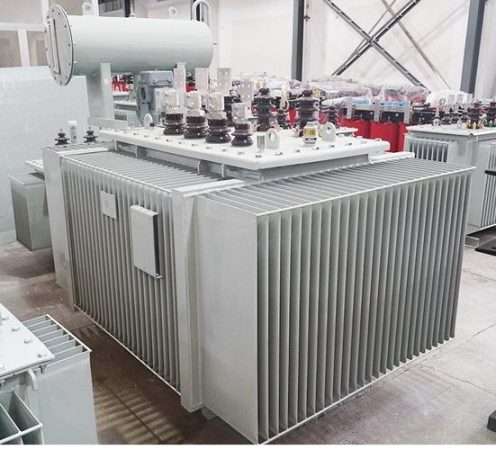
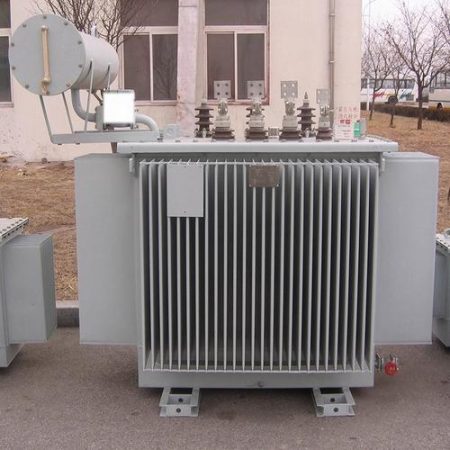
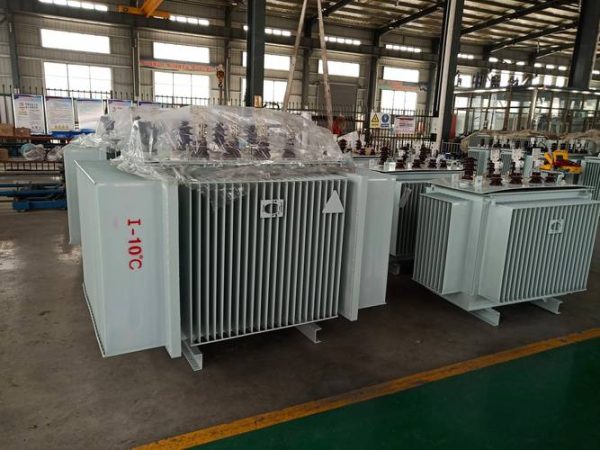
an SBH15 is a three-phase, oil-filled, hermetically sealed distribution transformer with an amorphous metal core. The amorphous core cuts no-load loss to roughly 30 percent of what an S11 silicon-steel unit of the same kVA would draw, which is why it pays for itself on lightly loaded circuits — rural feeders, residential districts, commercial buildings with a low load factor. It is not a “better transformer” in every respect: the load loss is comparable, the core is physically larger, and it is sensitive to mechanical stress. This page explains the model code, the material science, the real parameters by rating, and where an SBH15 earns its premium.
1. What the Model Code Means
Chinese transformer type codes are dense. Read SBH15 left to right:
| Character | Meaning | What it implies for you |
|---|---|---|
| S | Three-phase | Single-phase units use D |
| B | Amorphous alloy core | The low-loss core material, not silicon steel |
| H | Hermetically sealed tank | No conservator; oil never contacts outside air |
| 15 | Performance level code | Loss level under the GB series; higher number = lower loss |
The H is the part buyers most often overlook. Dropping the conservator (the oil reservoir tank you see on top of conventional units) means oil volume change with temperature is absorbed by the elastic corrugated fin walls of the tank itself. The oil and the core are permanently isolated from atmospheric oxygen and moisture, which is what lets the manufacturer claim maintenance-free service and an oil life of [Confirm] 25 years or more under normal duty.
Two consequences follow, and both matter at the specification stage:
- No gas-actuated (Buchholz) relay. Without a conservator there is no gas collection space, so protection comes from a pressure-relief device and a sudden-pressure relay instead. Confirm which devices the supplier actually fits.
- The tank, not the oil level gauge, is your condition indicator. Ask what monitoring the unit ships with — a pressure/vacuum gauge, a dial-type oil level indicator, or simply a sealed cap.
2. Why Amorphous Metal Is Different
Amorphous alloy is made by quenching a molten mix — typically iron with nickel, cobalt, silicon, boron and carbon — fast enough that no crystal lattice forms. Solidifying in about a microsecond leaves a glass-like atomic structure. That structure produces a genuinely different set of properties:
| Property | Amorphous alloy | Grain-oriented silicon steel | What it means in practice |
|---|---|---|---|
| Structure | Isotropic, no crystal grains; no defects pinning domain walls | Anisotropic, grain-oriented | Very low excitation power — the core magnetises easily |
| Thickness | ~0.027 mm | ~0.23-0.30 mm | Much thinner ribbon, so eddy-current loss collapses |
| Stacking factor | 0.75-0.80 | ~0.96 | More of the core volume is air, so the core must be physically bigger |
| Resistivity | 3-6 × silicon steel | Baseline | Further suppresses eddy currents |
| Hardness | ~5 × silicon steel | Baseline | Hard to shear; the core is wound, not stacked |
| Stress sensitivity | High | Low | Mechanical shock and clamping pressure raise losses |
The last row is the one that catches project owners out. Because the ribbon is stress-sensitive, an amorphous core that is mishandled in transit or over-tightened in its frame can lose part of the advantage you paid for. In practice that means:
- Specify that the core is supported, never lifted by, and that lifting lugs attach to the tank frame.
- Ask for the no-load loss to be re-measured after delivery as an acceptance test, not just on the factory report.
- Treat any transformer that has been dropped or has taken a hard impact as suspect until re-tested.
3. Standard Ratings and Service Conditions
Typical catalogue envelope for the SBH15 line:
- Voltage class: 10 kV primary, 0.4 kV secondary (other ratios, including 20 kV and 35 kV primaries, are built to order)
- Capacity range: 30 kVA to 2,500 kVA
- Vector group: Dyn11 as standard on the ratings below
- Mounting: indoor or outdoor
- Altitude: up to 1,000 m on the standard build; high-altitude and corrosion-protected versions are custom
On ambient temperature, the source material gives two different figures — -45 °C to +40 °C as the service envelope, and -40 °C to 120 °C elsewhere. Those are not two versions of the same number: -40 °C is plausibly the low-ambient limit for a cold-climate build, while 120 °C is the Class A insulation hot-spot temperature limit, not an ambient temperature. Get the supplier to state ambient limits and winding/oil temperature limits as separate line items before you commit.
For cold-climate duty, the specification question is the oil, not the core: confirm the pour point of the insulating oil ([Confirm] naphthenic mineral oil or a low-pour-point alternative), because at -40 °C the oil — not the steel — is what determines whether the unit starts and cools correctly.
Cooling is entirely passive. These are ONAN units: oil circulates by natural convection and dissipates through the corrugated tank walls. There is no fan, no pump, and no control cabinet to maintain. If you want to compare that against fan-assisted or forced-oil designs, our rundown of transformer cooling classes (ONAN, ONAF, OFAF) covers the trade-offs.
4. Core Parameters by Rating
Guaranteed values for the common ratings, 10/0.4 kV, Dyn11:
| Rated capacity (kVA) | Voltage ratio | Vector group | No-load loss (W) | Load loss (W) | No-load current (%) | Short-circuit impedance (%) | Total weight (kg) |
|---|---|---|---|---|---|---|---|
| 160 | 10/0.4 kV | Dyn11 | 100 | 2,200 | 0.6 | 4 | ~1,233 |
| 250 | 10/0.4 kV | Dyn11 | 140 | 3,050 | 0.6 | 4 | ~1,348 |
| 400 | 10/0.4 kV | Dyn11 | 200 | 4,300 | 0.5 | 4 | ~1,698 |
| 630 | 10/0.4 kV | Dyn11 | 320 | 6,200 | 0.3 | 4.5 | ~2,015 |
| 1,000 | 10/0.4 kV | Dyn11 | 450 | 10,300 | 0.3 | 4.5 | ~3,200 |
Two things worth reading off this table. First, the no-load current drops to 0.3 percent at the higher ratings — that is a hallmark of an amorphous core and it means less reactive draw on a lightly loaded feeder. Second, the weight is high for the kVA: a 1,000 kVA unit at around 3,200 kg is noticeably heavier than an equivalent silicon-steel design, because the lower stacking factor and lower design flux density force a bigger core and more copper. Budget for the foundation and the crane accordingly.
Verify every one of these against the delivered nameplate — the fields buyers most often mis-read are set out in our walkthrough of how to read a transformer nameplate and technical parameters.
5. The Four Things You Are Actually Buying
Energy saving. High permeability and very low coercivity in the amorphous ribbon give a no-load loss around 30 percent of an S11 silicon-steel unit of the same rating. On a circuit with a low load factor, the no-loss term runs 8,760 hours a year whether or not anyone is drawing power, so the saving accumulates continuously. The manufacturer’s claim is payback of the purchase premium in [Confirm] 3 to 5 years — treat that as a function of your load factor and your tariff, not a fixed number. Work it out yourself:
“ Annual loss energy (kWh) = P0 × 8760 + Pk × β² × 8760 P0 = no-load loss (kW) Pk = load loss at rated power (kW) β = load factor (average load ÷ rated capacity) “
At a 400 kVA unit, P0 = 0.20 kW gives about 1,752 kWh/year from no-load loss alone. Compare that against the same rating in silicon steel and multiply by your tariff. Note what the formula shows: amorphous only improves P0. If your load factor sits above roughly 0.5, the Pk term dominates and the premium takes much longer to recover.
Low noise — with a caveat. The amorphous ribbon’s magnetostriction coefficient is about 25 ppm. That figure is often quoted as evidence of quiet operation, but the comparison runs the wrong way: grain-oriented silicon steel has near-zero magnetostriction, which is precisely why it is quiet. Amorphous cores are, all else being equal, more prone to hum. Well-built SBH15 units still meet a low sound level through core clamping, damping and tank design, and [Confirm] ≤ 55 dB(A) at the specified measurement distance is a reasonable target for residential siting — but you must ask for the guaranteed sound level in dB(A), the measurement standard used, and the distance, rather than accepting “low noise” as a specification.
Reliability. The core is a three-phase, four-frame, five-limb wound structure, and the low-voltage winding is typically copper foil rather than wire. Foil winding gives a much better ampere-turn balance and far better axial strength under short-circuit forces than a wire-wound LV. Combine that with vacuum oil filling under a sealed tank and you get a unit with no breathing, no moisture ingress, and no oil processing schedule.
Temperature stability. Amorphous metal holds its magnetic properties across a wide temperature band and does not age the way an organic insulation system does, which suits unattended outdoor locations and cold northern sites.
6. Where the SBH15 Fits — and Where It Does Not
Good fits:
- Rural and suburban distribution where load factor is low and the transformer runs energised around the clock
- Commercial buildings and residential districts with a strong overnight base load but a low average
- PV and wind collection circuits, where the transformer sees long idle or light-load periods
- Replacement of high-loss legacy units on retrofit programmes
Poorer fits:
- Near-continuous high load factor (steel, chemical, data-centre process loads). Here the load-loss term dominates and the amorphous premium earns little. A high-efficiency silicon-steel oil-immersed design will usually win on total cost of ownership.
- Noise-critical indoor locations. If the room has no acoustic separation, compare the guaranteed dB(A) of both technologies before choosing.
- Fire-sensitive or sealed indoor rooms. That is a dry-type question, not an oil question. If you need cast resin rather than oil, the dry-type amorphous option is the SCBH15 amorphous alloy dry-type transformer; the general decision framework is laid out in oil-immersed vs dry-type: how to choose.
On renewables specifically, matching transformer capacity to inverter output is not the same calculation as matching it to a building load — see what was engineered for a 50 MW solar PV step-up application for a worked example.
Browse the full product catalog for the ratings actually held in stock, the resource library for the underlying selection maths, and the project case studies for delivered installations.
7. Specifying One for a North American Project
If the unit is destined for the US, Canada, or any 60 Hz market, four items must be raised at the enquiry stage, because none can be fixed after the core is cut:
- Voltage. A 10 kV primary has no direct US equivalent; specify the actual primary (commonly 12.47 kV or 13.8 kV, or 34.5 kV for the larger ratings) and the actual secondary — 480Y/277 V is standard, with 600Y/347 V common in parts of Canada. Do not order “10/0.4 kV” and expect it to land on a US utility.
- Frequency. 50 Hz is the design default. State 60 Hz explicitly in the RFQ; it changes core design, losses and impedance.
- Efficiency compliance. GB loss levels are China’s MEPS. For the US, DOE 10 CFR Part 431 Subpart K (§§ 431.196-431.198) governs efficiency for liquid-immersed distribution transformers, with IEEE C57.12.00 / C57.12.90 as the construction and test standards. Confirm in writing which standard the guaranteed losses are certified against, and get the efficiency tier stated as [Confirm] DOE 2016 level or the applicable tier for this kVA and voltage.
- Listing and labelling. UL or cUL listing is a separate exercise from IEC/GB compliance. Do not assume it — ask, and get the file number.
8. Buying Checklist
- Guaranteed no-load loss and load loss in watts, at the specified frequency, with the standard they were measured under.
- Guaranteed sound level in dB(A), with measurement standard and distance.
- Short-circuit impedance and confirmation of short-circuit withstand testing.
- Vector group and whether a neutral is brought out on the secondary.
- Ambient temperature range, altitude rating, and oil type with pour point.
- Fittings: pressure-relief device, sudden-pressure relay, oil level indication, drain and sampling valves.
- Handling instructions covering core support and post-delivery no-load loss re-testing.
9. FAQ
How much quieter is an amorphous core than silicon steel?
Usually it is not quieter — that claim is backwards. Amorphous ribbon has a magnetostriction coefficient around 25 ppm, while grain-oriented silicon steel is near zero, so amorphous cores tend to hum more, not less. A well-built SBH15 still achieves a low sound level through clamping and tank damping, and a target of 55 dB(A) or below at the specified measuring distance is realistic for residential siting. Ask for a guaranteed dB(A) figure with the standard and distance stated, rather than accepting “low noise.”
Is the SBH15 the same thing as an SCBH15?
No. SBH15 is oil-immersed and sealed; SCBH15 is a cast-resin dry-type with an amorphous core. Both use the same core material and both cut no-load loss sharply. The choice is driven by fire code and location: oil-immersed outdoors and in dedicated substations, dry-type indoors and in occupied buildings. Where fire separation cannot be provided, the dry-type is the one to specify.
Does the sealed tank really mean zero maintenance?
It means no oil handling — no sampling schedule, no filtration, no topping up, because the oil never contacts air. It does not mean zero inspection. You still want periodic checks of the pressure-relief device, the tank for corrosion or oil weeping at welds, terminal tightness, and infrared scanning of bushings and connections under load. Note also that with no conservator there is no Buchholz relay, so internal fault protection relies on pressure devices.
What is the realistic payback on the amorphous premium?
Run it with P0 × 8760 + Pk × β² × 8760 and your own tariff. Amorphous improves only the no-load term, which accrues every hour of the year regardless of load — so payback is fastest when the load factor is low. A distribution transformer sitting at 20-30 percent average load can recover the premium in roughly three to five years, while one running at 70 percent or more may never justify it on energy alone.
Why is the unit heavier than a silicon-steel transformer of the same kVA?
Two reasons compound. The ribbon is only about 0.027 mm thick, so the stacking factor is around 0.75-0.80 versus roughly 0.96 for silicon steel — more of the core window is air. And the saturation flux density of amorphous metal is lower, so the core is designed at a lower flux density and needs a larger cross-section. More core and more copper means more steel and more weight, which you should allow for in foundation and lifting plans.
Can the unit be repaired in the field?
Effectively no, at least not at the core. Amorphous ribbon cannot be re-cut and re-stacked the way silicon-steel laminations can, and the core is stress-sensitive. A failed amorphous core is normally a factory-level replacement. What can be serviced in the field is the oil, the bushings, the gasket set and the fittings.
Does shipping damage the core?
It can. Amorphous alloy is markedly stress-sensitive, and mechanical shock or over-tightening of the frame raises no-load loss. Specify that the core is supported rather than lifted, require the unit to be shipped and handled per the manufacturer’s instructions, and make a post-delivery no-load loss measurement a condition of acceptance.
What do I need to state in an RFQ for a 60 Hz market?
Primary and secondary voltage at the actual system values, frequency (60 Hz), kVA rating, vector group, impedance, ambient and altitude, efficiency standard (DOE 10 CFR Part 431 Subpart K for the US), required listing (UL/cUL), and the guaranteed loss and sound-level figures you want written into the contract. Anything relating to the core — voltage, frequency, impedance — has to be right at the enquiry stage; it cannot be corrected after manufacture.