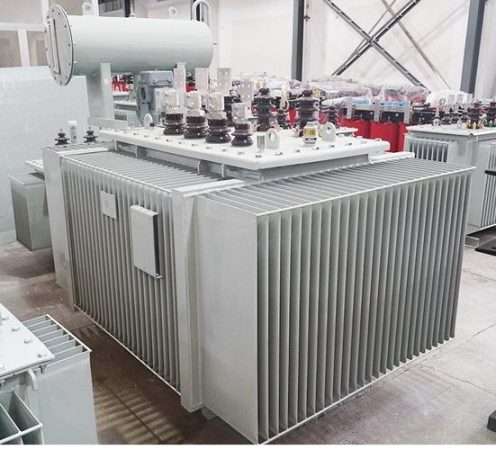
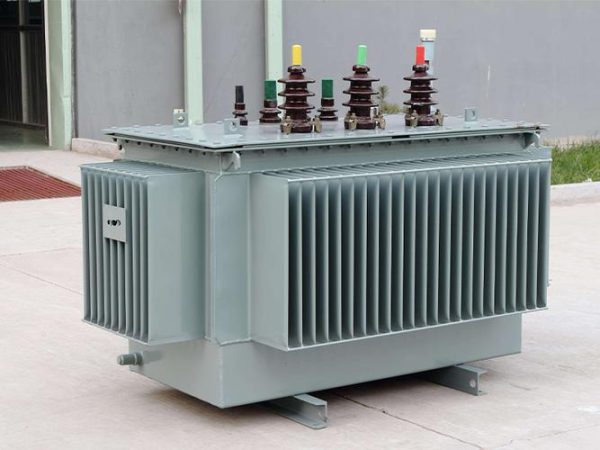
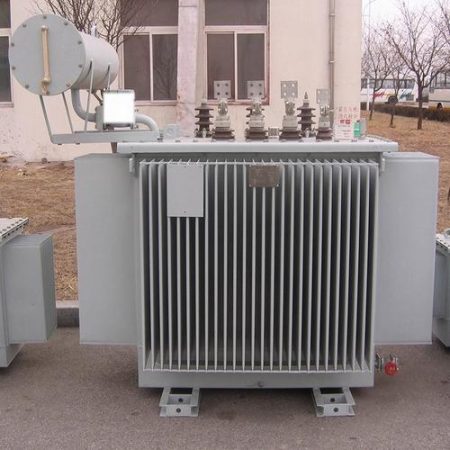
The S20 series is a three-phase, oil-immersed distribution transformer built to China’s Grade-2 energy efficiency tier. It is the default choice for new industrial plants, utility and rural grid upgrades, and renewable projects where the spec calls for lower losses than the older S13 family without paying for the top tier. This page is deliberately narrow: it decodes the model code, lays out the technical parameter table, and covers the selection checks — it is the reference sheet you keep open while reading a quotation, not another general product overview. For the application-side story, see the S20 series oil-immersed distribution transformer product page and the wider oil-immersed transformer range.
1. What the S20 Series Is
Item What the source specifies Efficiency tier Grade 2 under GB 20052-2020 (China MEPS for distribution transformers) Applications Industrial and mining enterprises, urban grid, rural grid rebuild, renewable power stations Loss improvement vs. S13 No-load loss about 20% lower; load loss about 10% lower confirm the direction — see note below Environmental Meets China’s low-carbon policy; selected ratings available with bio-based (natural ester) insulating fluid as an option Phase / construction Three-phase, oil-immersed, ONAN self-cooled, sealed or non-sealed tank Two contradictions you should resolve before publishing or quoting. (1) An earlier brief on the same series states the loss split the other way round — no-load about 10% lower, load about 20% lower versus S13. Both cannot be right, and the difference changes which duty cycles justify the upgrade. (2) Section 4 of the source tells buyers to verify the unit “meets Grade-1 efficiency,” while the rest of the document, including the header, says Grade 2. Pull the actual type-test report and the efficiency label filing number rather than inheriting either statement.
A note on the fluid option: bio-based ester fluid is biodegradable and raises the fire point, which is why some buyers want it near waterways or indoors. It is not a drop-in substitution — ester has different viscosity and dielectric behaviour, gasket and paint compatibility has to be verified, and it changes how the unit is classified and maintained. Ask the factory to quote it as a defined variant with its own test report, not as a footnote. Confirm whether the target market’s fire authority and insurer accept the ester-filled variant.
2. Decoding the Model Code
The type designation packs five pieces of information into one string. Using the source’s example, S20-M-630/10:
Field Value in the example Meaning Phase code SThree-phase. Ddenotes single-phaseLoss / efficiency code 20Loss tier defined against the 2020 edition of the Chinese efficiency standard Tank construction MFully sealed (hermetically sealed) tank. No M= non-sealed, with a conservator / breathing arrangementRated capacity 630630 kVA HV side voltage class 1010 kV primary So
S20-M-630/10reads as: three-phase, Grade-2 loss tier, hermetically sealed, 630 kVA, 10 kV primary.Three things buyers get wrong here:
Mis the single most consequential letter in the string, because it decides whether you have a maintenance-free unit or one with an oil level you have to check. See section 4.- The number after
Sis not “20 kV” and not a model year. It is a loss tier tied to a specific edition of the efficiency standard. If your target market uses DOE 10 CFR 430 or EU Ecodesign PEI instead, this code means nothing to the local authority having jurisdiction — you need the loss values in kW, not the code.- The
/10is the primary only. The secondary is almost always 0.4 kV and is not shown. If your project needs 0.69 kV (common for mining and some PV inverter duty) or 0.22 kV, that is a separate line item in the order, not a different model code.3. Technical Parameter Table (Typical Values)
Parameter Unit Typical value / range Note Rated capacity kVA 30 – 6,300 Standard ratings: 50, 100, 200, 315, 500, 630, 800, 1,000, 1,250, 1,600, 2,000 HV rated voltage kV 6, 10, 11, 35 10 kV is the default LV rated voltage kV 0.4 0.22 kV, 0.69 kV and others on request No-load loss (P₀) W Per capacity tier — from the type-test report Given as about 20% below S13 Load loss (Pₖ) W Per capacity tier — measured at 75 °C Given as about 10% below S13 No-load current (I₀) % ≤ 0.5 – 1.2 Larger ratings sit at the low end Short-circuit impedance (Uₖ) % 4 – 6 for 10 kV class; typically 6.5 – 8 for 35 kV class Confirmed per rating on the nameplate Insulation level – LI75 AC35 / LI125 AC55 (10 kV class) Lightning impulse withstand / power-frequency withstand Cooling – ONAN (oil natural, air natural) Sealed units are designed for long maintenance-free service Temperature rise limits K Top oil ≤ 55, winding ≤ 65 Referenced to a 40 °C ambient Sound level dB ≤ 45 – 55, capacity dependent Given as 3 – 5 dB below S13 Every one of these fields has a nameplate counterpart, and the fields buyers most often mis-read — impedance tolerance, whether Pₖ is quoted at 75 °C or at some other reference, and how the sound level was measured — are set out in our guide to reading a transformer nameplate and technical parameters.
Two values in this table need correcting before the page goes live. IEC 60076-2 gives a top-oil temperature rise of 60 K and an average winding rise of 65 K for oil-immersed units; the source’s 55 K top-oil figure is tighter than the international default and should be confirmed against the actual test report. Separately, the source lists two insulation levels for the 10 kV class (LI75 AC35 and LI125 AC55). Those belong to different voltage classes — pick the one that matches the ordered rating. In North American terms these translate to BIL and applied-potential levels under IEEE C57.12.00, not to the LI/AC shorthand.
4. Losses, Temperature Rise and What to Verify
The source references a loss table “by capacity tier” but does not supply the values. Rather than publish numbers that will end up in a tender document, here is the structure and the arithmetic you need to fill it in:
“
Annual loss energy (kWh) = P₀ × 8,760 + Pₖ × LF² × 8,760 P₀ = no-load loss, kW Pₖ = load loss at rated current, kW LF = average load factor“Unit rates worth memorising, using the source’s ¥0.8/kWh (~US$0.11/kWh at ¥7.2 to the dollar):
- 1 kW of no-load loss ≈ 8,760 kWh/year ≈ ¥7,008/year ≈ US$973/year. It is burned every hour of every day, loaded or not.
- 1 kW of load loss at a 60% load factor ≈ 3,154 kWh/year ≈ ¥2,523/year ≈ US$350/year. Load loss only exists when current flows, and it scales with the square of the load.
That asymmetry is the whole basis of the S20 argument. A transformer that sits at 20–30% load most of its life — a rural feeder, a plant with one shift, a solar plant at night — is dominated by no-load loss, and that is exactly where the S20 premium pays back fastest. A unit running near nameplate is dominated by load loss, and there the premium takes much longer to recover.
Two verification steps the source is right to insist on:
- Get the type-test report, not a percentage. “20% lower than S13” is a marketing statement. What belongs in the contract is the guaranteed P₀ and Pₖ in watts at 75 °C, with the IEC 60076-1 tolerance stated, plus a penalty clause if the measured values exceed them.
- Check the efficiency label filing number. Chinese efficiency labels carry a filing number that can be looked up. Ask for it, and confirm which edition of GB 20052 the test was run against.
For the cooling row, note that ONAN is a self-cooled rating with no fans and no pump — which is precisely why a sealed S20-M can be left alone for years. If a quotation offers a higher rating out of the same tank, it is doing so by adding fans (ONAF), and that changes the noise figure, the maintenance profile, and the loss of cooling on fan failure. The full letter scheme is explained in transformer cooling classes, ONAN / ONAF / AN / AF.
5. Sealed (S20-M) Versus Non-Sealed (S20)
Sealed — S20-M Non-sealed — S20 Tank Hermetically sealed; oil never contacts ambient air Breathing tank with a conservator or air space Moisture and oxidation Effectively excluded Oil oxidises and absorbs moisture over time Routine work Minimal — no oil level or silica-gel checks Periodic oil level check, breathers, oil testing Best fit Humid, coastal, dusty or polluted sites Clean, dry, staffed substations First cost Higher Lower Choose the sealed version whenever the site is coastal, humid, dusty, or left unstaffed for long stretches — a sealed tank removes the single most common cause of long-term insulation degradation. The honest trade-off: a hermetically sealed tank has no conservator, so there is nowhere to fit a Buchholz (gas-actuated) relay. Protection on a sealed unit relies on a pressure-relief device plus pressure/sudden-pressure relays and the electrical protection scheme. If your protection philosophy requires Buchholz, you need the non-sealed construction, and that is a design decision to make before ordering rather than after.
6. Custom Options Worth Asking For
All of these must be declared at enquiry stage. Several cannot be retrofitted:
- On-load tap changing, e.g. ±4 × 2.5% (nine positions). Needed where the supply swings beyond what a fixed ratio tolerates. Note that a de-energised tap changer (DETC in US practice) only allows adjustment with the unit out of service, which is fine for seasonal grid variation but useless for intra-day swings. If the voltage moves during the day, you want a true OLTC — see the SZ11 on-load voltage regulating transformer for how that duty is built.
- Enclosure / ingress protection — IP23 where condensation or dust is present. Be aware that IP ratings describe the enclosure, and for outdoor oil-filled equipment in North America the relevant benchmarks are NEMA 3R and, for pad-mounted tamper resistance, IEEE C57.12.28.
- Corrosion protection to ISO 12944 C2–C5. C4 for coastal and light industrial, C5 for offshore and heavy chemical. Underspecifying this is the most common reason a coastal unit looks ten years old after three.
- K-13 harmonic design. Rectifiers, VFDs, and PV inverters inject harmonics that heat a standard transformer well beyond its rating. A K-13 design (K-factor per IEEE C57.110) with an appropriately de-rated core and a transposed or foil low-voltage winding handles it. Tell the factory the actual harmonic spectrum — “some harmonics” is not a specification.
- Bio-based ester fluid, as covered in section 1.
7. Sizing, Applications and Payback
Sizing. Size to the load study with a margin, not to a guess. For general distribution, sum the connected load, divide by the power factor, and apply a 1.2–1.3 margin; for motor-heavy or inverter-fed plant, 1.3–1.5 to cover starting and harmonic currents. Then round to the next standard rating from the list in section 3 — and check the next rating up as well, because the price step is often small while the loss step is favourable.
Where S20 is the right call:
- New projects. Grade 2 is the practical compliance floor for new Chinese installations, and it is a defensible spec for export projects where the buyer wants documented losses without paying top-tier money.
- Retrofits. Replacing S9 and S11 stock with S20 is the classic efficiency retrofit. The source claims a 2–5 year payback at ¥0.8/kWh — treat that as a claim and check it with the arithmetic in section 4. Take your actual ΔP₀ and ΔPₖ, your actual load factor, and your actual tariff; if the numbers give you six years, say six years.
- Renewable projects. Solar and wind duty means long light-load hours plus inverter harmonics, which is the combination that flatters low no-load loss while punishing a standard winding. Get the inverter spectrum into the enquiry, and see how that duty is handled on the step-up transformers for a 50 MW solar PV plant project. Completed installations across these sectors are collected under projects.
8. FAQ
Is S20 the same as Grade-1 efficiency?
No. Under GB 20052-2020, S20 sits at Grade 2; S22 is the Grade-1 tier confirm the current mapping. If a quotation claims Grade-1 performance on an S20 model, ask for the type-test report and the label filing number before believing it.
What does the “M” in S20-M-630/10 actually buy me?
A hermetically sealed tank. Oil never meets ambient air, so moisture ingress and oxidation essentially stop and routine oil maintenance goes away. It costs more, and it eliminates the conservator — which means no Buchholz relay.
Should I specify sealed or non-sealed for a coastal site?
Sealed, without much debate. Salt-laden humid air is exactly what a breathing tank draws across its silica gel. Pair it with ISO 12944 C4 or C5 corrosion protection and stainless or hot-dip galvanised fittings.
How do I check the 2–5 year payback claim myself?
Compute annual loss energy with
P₀ × 8,760 + Pₖ × LF² × 8,760for the old unit and the new one, take the difference in kWh, multiply by your tariff, and divide the price premium by that number. Use your measured load factor, not a nameplate assumption.Can I get 480 V secondary for a North American project?
Yes on the LV winding, but that is only one of several changes. You also need the primary wound for 12.47 kV or 13.8 kV rather than 10 kV (4.16–7.2 kV for the 6 kV class, 34.5 kV for the 35 kV class), a 480Y/277 V secondary (600Y/347 V in much of Canada), 60 Hz design, IEEE C57.12 terminology for BIL and impedance, and LV terminations arranged for the local cable practice. 60 Hz must be declared at enquiry — after the core is cut, it cannot be changed.
Does a sealed tank mean zero maintenance?
Not zero, but close. Plan on periodic visual inspection, infrared scanning of terminations, checking the pressure-relief indicator, and keeping the cooling surfaces clean. What disappears is oil level checks, breather changes, and routine oil sampling.
Why does the source give two different insulation levels for 10 kV?
Because LI75 AC35 and LI125 AC55 belong to different voltage classes. Only one applies to the unit you are ordering — take it from the nameplate, not from a summary table.
What should I send with an enquiry to get a firm price and lead time?
Capacity, primary and secondary voltage, frequency, vector group, impedance, sealed or non-sealed, cooling class, enclosure and corrosion category, ambient and altitude, harmonic spectrum if any, and efficiency target with the standard edition. Browse the full product catalog to fix the ratings, and the resource library covers the specification detail.
Technical Specifications
| Rated Capacity | 30~6300 |
|---|---|
| Voltage Class | 6, 10, 11, 35 |
| Phase | Single |
| Cooling Type | ONAN |
| Standards | IEEE |
| Lead Time | 30 |