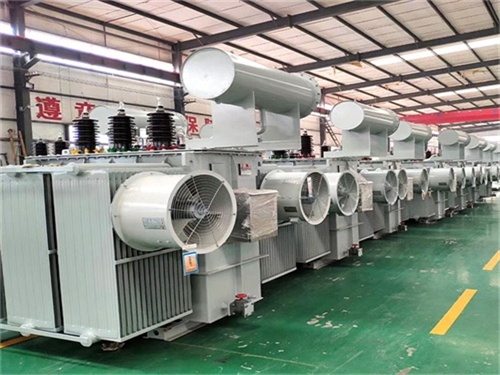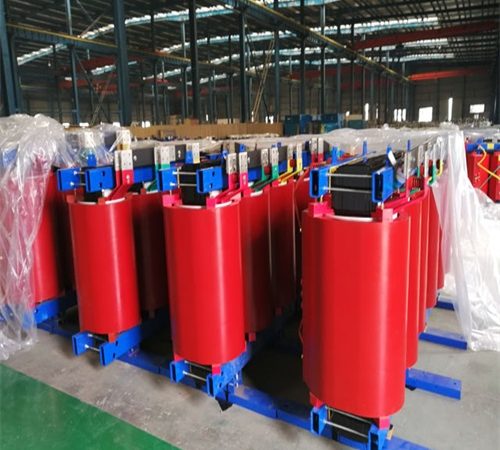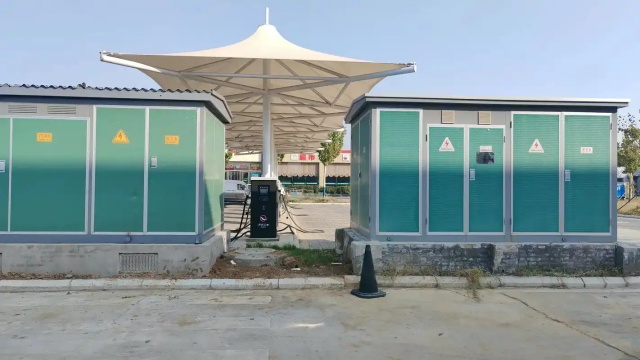
An EV charging station transformer is a factory-assembled packaged substation — also called a prefabricated, compact or kiosk substation — that steps medium-voltage utility power down to the low voltage your chargers actually use: 10 kV or 35 kV to 380 V on IEC projects, and 12.47 kV or 13.8 kV to 480Y/277 V across North America. Inside one enclosure it combines medium-voltage switchgear, the transformer itself, low-voltage distribution, metering and protection. Unlike a general-purpose industrial transformer, a charging-duty unit is engineered for load that swings from idle to full output in seconds, so it holds voltage steady when every stall is occupied, absorbs the harmonics that charger rectifiers push back into the grid, and eliminates the need to build a dedicated electrical room.
Designed and type-tested to: IEC 62271-202 (prefabricated substations) · IEC 60076 series · IEEE C57.12.00 / C57.12.90 · NEC Article 450 · ISO 9001 confirm certificates actually held; anything not held should read “available on request”
What an EV charging station transformer does
A charging site has one job: deliver power on demand, every time a driver plugs in. The transformer is what makes that possible.
It takes the medium-voltage utility feed and converts it into usable low-voltage service — 380 V in IEC markets, 480Y/277 V in the US and Canada — for both DC fast chargers and Level 2 AC chargers. Because the unit is pre-assembled and tested at the factory, it arrives as a single skid or pad-mounted package: set it, terminate the cables, commission it, energize. There is no concrete electrical room to build, no separate switchgear lineup to coordinate, and far fewer trades on site.
It also protects the site. Overload protection, short-circuit protection, harmonic mitigation, thermal monitoring and remote supervision are built into the package rather than added later.
The enclosure configuration most charging sites specify is the YBW series prefabricated compact substation, which integrates the transformer with MV and LV gear in one weatherproof housing up to 2500 kVA.
Why charging loads break general-purpose industrial transformers
A distribution transformer sized for a factory, a mall or an office tower assumes a load profile that is broadly predictable. A charging site is the opposite — and that difference is where most field problems come from.
1. Load that swings from idle to full output in seconds
A site can sit at near-zero load at 6 a.m. and draw full nameplate power at 6 p.m. Charger power electronics also ramp hard rather than softly. Every one of those transitions is a thermal and mechanical cycle on the windings; over a ten-year site life, that cycling — not steady-state loading — is what ages a transformer prematurely.
2. Voltage sag and fluctuation at peak
When eight DC fast chargers demand full power at once, the voltage at the end of a long LV run drops. Chargers respond by throttling output or dropping the session, which shows up in app reviews as “charger is slow” or “session failed”. Purpose-built units are specified with tighter impedance control and, where the site warrants it, on-load or off-circuit tap adjustment to keep secondary voltage inside band.
3. Harmonic distortion from charger rectifiers
DC fast chargers are large rectifiers. Without mitigation they inject 5th, 7th, 11th and 13th harmonics back into the transformer, raising winding temperature, tripping sensitive protection and, on sites with a shared service, drawing complaints from other tenants on the same feeder. A charging-duty transformer accounts for this in its design; a standard industrial unit does not.
4. Downtime costs far more than the transformer
An offline fast-charging bay loses revenue every hour and damages the operator’s brand. That is the real argument for specifying a unit built for charging duty rather than the cheapest transformer that meets the kVA number.
Technical specifications
Specify these parameters before you request pricing. Values below are the standard configuration for IEC markets; North American equivalents are noted where they differ.
| Parameter | Typical specification |
|---|---|
| Rated capacity | 630 – 2500 kVA (charging-duty range) |
| Primary (MV) voltage | 10 kV or 35 kV (IEC) · 12.47 kV / 13.8 kV (ANSI) |
| Secondary (LV) voltage | 380 V (IEC) · 480Y/277 V, 600Y/347 V in Canada (ANSI) |
| Vector group | Dyn11 — suppresses triplen harmonics and provides a four-wire secondary |
| Short-circuit impedance | 4 – 5 % for 10 kV class · 6 – 7 % for 35 kV class |
| Winding material | Copper or aluminium confirm per quotation |
| Insulation / temperature rise | Class F (outdoor) or Class H (indoor); winding rise ≤ 100 K for Class F |
| Cooling | ONAN (oil) · AN / AF (dry) |
| Enclosure rating | IP54 standard outdoor · IP65 / NEMA 4X for coastal and salt-fog sites · NEMA 3R where the AHJ requires a NEMA rating |
| Ambient temperature | −25 °C to +40 °C standard · −40 °C and +50 °C variants available |
| Noise level | insert measured dB(A) from the type-test report; do not quote a generic figure |
| Grounding | Ground resistance ≤ 4 Ω; ≤ 1 Ω for a shared grounding system |
| Monitoring | Voltage, current, winding temperature, with alarm and trip outputs; Modbus RTU/TCP to the site controller |
| Standards | IEC 62271-202, IEC 60076 series, IEEE C57.12 series; GB 20052 (China MEPS) quoted alongside IEC and DOE parameters confirm current GB 20052 edition and grade mapping |
Oil-immersed vs dry-type: which fits your site
Both types are available standalone or inside a factory-assembled enclosure. See the full transformer product range for every series.
| Oil-immersed (S20 / S22 series) | Cast resin dry-type (SCB13 / SCB14 series) | |
|---|---|---|
| Typical models | S20 series oil-immersed distribution transformer | SCB13 series cast resin dry-type transformer |
| Cooling and overload | Excellent heat dissipation; high short-term overload capability | Air-cooled; lower thermal mass, so sustained overload capacity is smaller |
| Fire and environmental | Requires an oil containment pit, fire separation distances and, in the US, SPCC consideration | Flame-retardant and self-extinguishing; no oil, no pit, no soil-risk paperwork |
| Noise | Slightly higher under forced cooling | Quieter — the usual choice wherever neighbours are close |
| Cost | Lower capital cost per kVA | Higher capital cost, lower siting friction |
| Best fit | Highway service areas, logistics yards, open-air charging hubs, heavy-truck depots | Underground residential garages, shopping malls, indoor parking decks, any occupied building |
Rule of thumb: if the unit sits outdoors with clear separation and the site is cost-sensitive, oil-immersed wins. If it sits under, inside or next to occupied space — or the AHJ is strict about fire — dry-type is the safer specification, even at a higher price per kVA.
Capacity selection by site type
Charging duty is intermittent, so capacity is not simply the sum of the charger nameplates. Use a diversity factor for how often stalls are simultaneously occupied, then a safety margin on top.
| Site type | Typical charger build-out | IEC rating | Nearest common ANSI rating |
|---|---|---|---|
| Neighbourhood / retail / small commercial | 4 – 8 DC fast chargers, plus Level 2 | 630 kVA or 800 kVA | 750 kVA |
| Fleet depot, bus depot, industrial park | 8 – 16 DC fast chargers | 1000 kVA or 1250 kVA | 1000 kVA or 1500 kVA |
| Ultra-fast hub, heavy-truck charging | Large high-power clusters | 1600 – 2500 kVA | 2000 kVA or 2500 kVA |
Two cautions. First, plan the second phase now — pad space, duct banks and busway capacity are far cheaper to install at day one than to retrofit. Second, do not simply oversize: a substantially oversized transformer runs at poor loading, and on a 24/7 site the no-load loss dominates lifetime cost.
For the full sizing formula, diversity factor tables and worked examples, use the EV charger transformer sizing, selection and installation guide — it covers the arithmetic in depth; this page is the product and configuration layer on top of it.
Where these units are deployed
- Municipal and curbside fast-charging sites
- Residential communities and apartment complexes
- Industrial parks and logistics / heavy-truck yards
- Shopping centres, retail plazas and commercial mixed-use
- Highway service areas and motorway corridors
- Bus depots and fleet electrification yards
- Integrated PV + battery storage + charging (PV-storage-charging) sites
Because the structure is standardised, the same platform works for new-build sites and for retrofits of older charging locations where the existing service has run out of headroom.
Built-in advantages worth specifying
Enclosure durability. IP54 is the standard outdoor rating — dust-protected and splash-proof, with corrosion-resistant coating for coastal salt-fog and humid upland sites.
Monitoring. Continuous measurement of voltage, current and winding temperature, with automatic alarm and trip. For an operator running dozens of unstaffed sites, remote visibility is what turns reactive maintenance into planned maintenance.
Lower losses. Low-loss core steel reduces no-load loss, which matters most on sites that idle overnight. Where a site runs light for long periods, the SCBH15 amorphous alloy dry-type transformer cuts no-load loss substantially — insert the measured percentage reduction from the type-test report. Note the trade-off: amorphous cores are typically a few dB noisier, so indoors next to occupied space, SCB13 with vibration isolation often meets the acoustic limit more easily.
Charger protection. Harmonic suppression on the LV side protects charger power modules from voltage distortion and extends service life across the whole site electrical system.
Standards and compliance
| Market | Applicable standards |
|---|---|
| Global / EU / Asia | IEC 62271-202, IEC 60076-1/-2/-3/-5/-10/-11, EN 50588-1 |
| North America | IEEE C57.12.00 / C57.12.90, NEC Article 450, NEC 110.26 working clearances, IEEE 80 grounding |
| Energy performance | EU Ecodesign 2019/1783 (PEI) · DOE 10 CFR 430 (US distribution transformers) · GB 20052 (China MEPS) confirm DOE applicability and tier for each rating |
| Product safety marking | UL / cUL listing status state only what is actually held; otherwise “available on request” |
| Quality systems | ISO 9001 / 14001 / 45001 confirm certificates held |
Not every market reads these the same way. If you are exporting or specifying across regions, the IEC 60076 vs ANSI/IEEE comparison for export transformers explains which standard governs your project and where the two systems diverge.
What to specify before you request a quote
Seven pieces of information let a manufacturer quote accurately instead of defensively:
- Utility service — available medium voltage, fault level, and the utility’s own interconnection requirements
- Charger build-out — number of dispensers, kW per dispenser, DC fast vs Level 2, and any smart-charging or load-management scheme
- Site constraints — indoor or outdoor, underground garage, coastal exposure, ambient temperature range
- Acoustic limit — fixed by neighbours, local ordinance or the landlord, not by preference
- AHJ requirements — local fire separation, containment and working-clearance rules
- Growth plan — phase two stalls, and whether solar or storage will be added later
- Standards — IEC or ANSI/IEEE, plus any utility-specific material specification
If your site is indoors or below grade, start with the dry-type transformer selection guide — indoor siting drives the whole specification.
FAQ: EV charging station transformers
What is a packaged substation for EV charging, and how is it different from a pad-mounted transformer?
A packaged substation integrates medium-voltage switchgear, the transformer, low-voltage distribution, metering and protection in one factory-built enclosure. A pad-mounted transformer is just the transformer in a tamper-resistant cabinet — you still provide the switchgear, metering and LV panel separately. For a charging site, the packaged unit usually wins because it collapses several trades into a single factory-tested delivery.
Do small charging sites need their own transformer?
Not always. A handful of Level 2 chargers can often run off an existing building service. Once you add DC fast charging — or the existing service has no spare capacity — a dedicated transformer is normally required. The deciding factor is the utility’s available fault level and whether the existing service can carry the added load without an upgrade.
Can one unit serve a solar-plus-storage-plus-charging site?
Yes, and it is increasingly the default for larger sites. Specify it up front: the transformer has to accommodate reverse power flow from PV and the bidirectional behaviour of a battery inverter, and the protection scheme must be coordinated for both directions. Retrofitting this later is significantly harder.
Why does my site trip or sag during peak charging, and will a purpose-built unit fix it?
Three usual causes: capacity sized off nameplate with no diversity factor, impedance too high for the LV run length, or harmonics from charger rectifiers tripping sensitive protection. A charging-duty transformer addresses the second and third directly; the first is a sizing decision, not an equipment defect.
How much space and installation time does it save versus a built electrical room?
You skip the room entirely. A packaged unit needs a level pad or a raised plinth, cable terminations and commissioning — typically days rather than weeks, with no wet trades and no separate switchgear room coordination. Exact footprint varies with rating and configuration.
What harmonic performance should I ask for, and do I need active filtering?
That depends on your charger mix and the utility’s harmonic limits at the point of common coupling. Start by asking for the measured THD at full charger output, then compare it against the applicable limit. Active filtering is a fix, not a default — many sites meet limits with transformer design and LV-side mitigation alone.
What enclosure rating do I need for a coastal or dusty site?
IP54 is the standard outdoor baseline. For coastal salt-fog, heavy industrial dust or wash-down areas, specify IP65 or NEMA 4X and upgrade the corrosion protection system accordingly — enclosure corrosion, not electrical failure, is the most common cause of premature outdoor unit failure in those environments.
What information do you need to quote an EV charging station transformer?
Utility service voltage and fault level, charger count and kW per dispenser, indoor or outdoor siting with ambient range, acoustic limit, applicable standard (IEC or ANSI/IEEE), target capacity, and any AHJ or utility-specific requirements. With those seven items a manufacturer can quote firm numbers rather than a range.