
Choosing a transformer manufacturer comes down to seven weighted checks: standards fit, verifiable test evidence, an auditable quality system, honest production capacity, references at your voltage and kVA, transparent commercial terms, and real after-sales reach. Score each candidate out of 100 and award on the score, not the brochure. In 2026 the binding constraint is schedule, not price — pad-mount units are quoting 40–65 weeks and substation units 75–110 weeks — so a supplier’s ability to prove a production slot is worth as much as its price.
Here’s the thing almost every “how to choose a transformer manufacturer” article gets wrong. They give you a list of things to look for — experience, quality, capacity, support — and then stop. That’s not a decision process, it’s a wish list. You can read ten of them and still have three quotes on your desk and no defensible way to rank them.
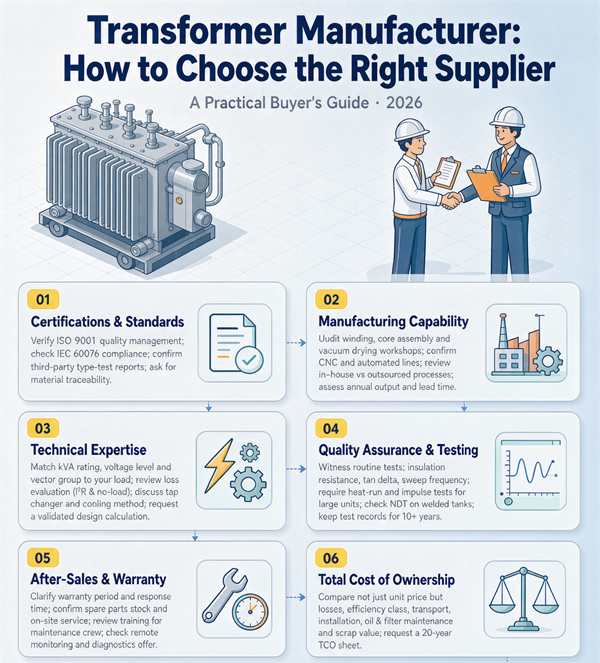
This guide is the part they skip: how to turn three shortlisted suppliers into one purchase order, with numbers you can actually check.
The 60-second version
- Score, don’t browse. Seven weighted criteria, 100 points total. Award at 85+, award with conditions at 70–84, second-source only at 55–69, drop below 55.
- In 2026 you’re buying a production slot, not a unit. Published lead times: pad-mount 40–65 weeks, substation 5–50 MVA 75–110 weeks, generator step-up 100–150+ weeks, dry-type under 2 MVA 20–32 weeks. Ask for the slot, not the promise.
- “UL listed” means nothing without a file number. UL 1561 is dry-type general purpose and power. UL 1562 is dry-type distribution, over 600 V (601–35,000 V). Liquid-filled distribution transformers above 600 V are listed under UL category XPLH. Look the file up in UL Product iQ before you sign.
- ISO 9001 is a floor, not evidence. Verify the certificate number in IAF CertSearch, then check that the scope says manufacturing at the factory address — not “sales of electrical equipment” at an office address.
- Budget 2–4 weeks and $800–$2,500 to verify a supplier before you commit. That is cheap next to a 40-week mistake.
- Compare on total owning cost, not price: TOC = P + A × NL + B × LL. Public-power and co-op evaluation factors run as high as about $6.35/W for no-load loss (A) and $1.23/W for load loss (B) at a 30% capacity factor — and B rises to about $3.67/W at 70%.
- Normalize the quotes before you compare them. Three bids at the same kVA are usually three different scopes: EXW vs DDP, aluminum vs copper, guaranteed vs typical losses, FAT included vs extra.
- US efficiency compliance tightens on April 23, 2029, and it keys off the date the unit was manufactured or imported — not your PO date. Make the supplier state in writing whether your unit is a covered distribution transformer under 10 CFR 431.192.
- Warranty is typically 12–24 months, but the trigger matters more than the length. “24 months from shipment” can leave you with nothing at energization. Push for energization or acceptance.
- Buy one, then buy many. A single pilot unit with a witnessed FAT is what catches a vector group mismatch, a wrong bushing, or a tap-changer error before you have 24 of them on a ship.
What you’re actually buying
A transformer is a 25- to 40-year asset with a short list of failure modes, and nearly all of them trace back to decisions made inside a factory you will never visit. Core steel grade. Conductor cross-section. Dryness of the insulation before oil filling. Tightening pressure on the core. Whether the routine test report is real or templated.
None of those appear on a datasheet. All of them are visible in a factory that expects to be checked.
That’s the reframe: you are not buying a spec, you’re buying a factory’s willingness to be verified. A supplier who answers verification requests quickly and specifically is telling you something. One who answers slowly and generally is telling you more. If you need a refresher on the parameters that end up on the nameplate — and therefore on your RFQ — start with our guide to reading a transformer nameplate and technical parameters.
Step 1: Pick the type of supplier first
Before you evaluate companies, decide which category of supplier you need. This step is skipped by every guide on page one of Google, and it’s where most buyers waste the most time — comparing a domestic OEM against a remanufacturer because both “sell transformers.”
| Supplier type | Best for | 2026 lead time | Cost position | Main risk |
|---|---|---|---|---|
| Tier-1 OEM (global brands) | Utility transmission, GSU, brand-mandated specs | 75–150+ weeks | Highest | Slot allocation; you are not their priority account |
| Domestic mid-tier builder | Custom ratings, short runs, US-content requirements | 30–80 weeks | High | Capacity fully booked; less price flexibility |
| Import factory, direct | Distribution and medium-power volume, budget-led projects | 12–36 weeks + freight | Low | Verification burden; documentation and after-sales distance |
| Distributor / stockist | Standard ratings, urgent replacement | 1–4 weeks if in stock | Highest per unit | Limited to catalog configurations |
| Remanufacturer | Storm response, bridging a long OEM order | 4–6 weeks | 50–70% of new | Warranty and testing scope vary widely |
Lead times are indicative and vary by rating, voltage class, and order quantity. Sources disagree by a factor of two or more — see Step 6 before you plan a schedule around any single number.
Two practical notes. First, a domestic unit is often quoted around 10–15% above an imported equivalent; whether that premium is worth it depends entirely on your schedule risk, not on patriotism. Second, mixing categories is usually the right answer: buy your critical units from the supplier that can prove a slot, and your standard replacements from whoever has stock.
Not sure which product family you’re even shopping for? The two main branches are oil-immersed distribution transformers for outdoor and utility duty, and cast resin dry-type transformers for indoor, fire-sensitive, and low-maintenance sites.
Step 2: The 100-point supplier scorecard
This is the piece nobody on page one gives you. Take your shortlist of three to five suppliers and score each one. Do it before you read the prices — price is only one row of seven.
| # | Criterion | Weight | Full marks look like | Zero looks like |
|---|---|---|---|---|
| 1 | Standards and certification fit | 20 | Type-test reports to the exact standard your AHJ and utility want, model-specific, current | A logo sheet and “compliant with IEC/IEEE” |
| 2 | Verifiable test evidence | 20 | Serial-number-specific routine reports; witnessed FAT offered by default | “All units are tested” with no report sample |
| 3 | Quality system and auditability | 15 | ISO 9001 verified in IAF CertSearch with manufacturing scope; third-party audit welcomed | Certificate PDF that can’t be found in any register |
| 4 | Capacity and schedule honesty | 15 | Names a production slot, shares 8 quarters of OTD data | “Usually 12 weeks” with no backlog detail |
| 5 | References at your voltage and kVA | 10 | Three contactable references at ≥ your rating and voltage class | References only at half your rating |
| 6 | Commercial transparency and TCO | 10 | Guaranteed loss values with penalties; itemized scope; A/B evaluation supported | One number, no scope statement |
| 7 | Service, spares, and warranty | 10 | Named response time, spares commitment period, warranty from energization | “We will support you” |
Score each row 0–10, multiply by the weight, divide by 10, and add them up.
| Total score | What it means | What to do |
|---|---|---|
| 85–100 | Verified capability | Award. Still run a witnessed FAT on the first unit. |
| 70–84 | Capable with gaps | Award with conditions: pilot order, liquidated damages, tighter milestone reporting |
| 55–69 | Marginal | Second source only, on non-critical units, with a reduced order quantity |
| Below 55 | Unverified | Drop. Do not let price pull this one back onto the list. |
The weighting isn’t arbitrary. Criterion 1 and 2 carry 40 points between them because those are the two things you cannot fix after the fact. A supplier with beautiful service and a weak test bay will ship you a unit you can’t energize. If your project is export-bound, criterion 1 gets sharper — our comparison of IEC 60076 versus ANSI/IEEE standards covers which one your destination actually requires.
Step 3: Verify the paperwork in 90 seconds per certificate
Every guide says “verify certifications.” Almost none say how. Here’s the routine — it takes about 90 seconds once you’ve done it twice.
- Get three data points: the certificate number, the full legal name of the certifying body (not “certified by TÜV” — the actual entity), and the expiry date. A supplier who can’t produce all three is either disorganized or bluffing.
- Check the certifying body in IAF CertSearch. If the named body isn’t there, the certificate isn’t IAF-accredited and carries very little weight. This single filter catches most fake certificates.
- Pull the record from the body’s own public register. Enter the certificate number. Confirm three fields match: the legal entity name, the scope, and the current status. A “withdrawn” status is conclusive even if the supplier still has the PDF.
- Check expiry and the last surveillance audit. ISO certificates run on a three-year cycle with annual surveillance audits. A certificate valid to 2028 whose last surveillance was 18 months ago is not in good standing.
The scope field is the one that matters and the one buyers skip. An ISO 9001 certificate scoped to “sales of electrical equipment” at an office address tells you nothing about the factory. You want the scope to say manufacturing, at the address you were told is the factory.
Then do the same thing for tests. A complete IEC 60076 or IEEE C57 type-test report typically runs 50–120 pages, with test circuit diagrams, measured values, instrument calibration records, and laboratory signatures. A cover page with a pass stamp is not a report. Cross-check the report number with the issuing laboratory — KEMA, CESI, and ASTA will all confirm a report on request. If you’re not sure which tests should be in the package at all, our walkthrough of transformer routine testing lists what every unit should pass before shipment.
The UL question almost every buyer gets wrong
If you’re buying for the US market, read this section twice. There is a wrong answer circulating on page-one content right now, and it will cost you an inspection failure.
UL issues three different marks, and buyers mix them up constantly:
- UL Listed — the complete product, as installed, evaluated against the applicable standard. This is the mark your inspector wants.
- UL Recognized — a component only. A recognized coil inside an unlisted assembly does not make the assembly listed.
- UL Classified — a specific property, such as fire resistance, evaluated against a limited scope.
Now the part that’s wrong across much of the industry. You will find articles stating that UL 1562 covers liquid-filled and pad-mounted transformers. It does not. UL’s own published scope for UL 1562 reads: “These requirements cover single-phase or three-phase, dry-type, distribution transformers, including solid cast and resin encapsulated transformers… rated for a primary or secondary voltage from 601 to 35,000 V.” Dry-type. The companion standard UL 1561 covers dry-type general purpose and power transformers.
Liquid-filled distribution transformers above 600 V are listed under UL category code XPLH — described in UL Product iQ as “Transformers, Distribution, Liquid-filled Type, Over 600 Volts.” You can confirm this yourself: search UL Product iQ for any listing and read the category description on the file.
So the rule is simple:
- Never accept “tested per UL 1561” or “UL compliant” on a datasheet. Without a file number behind it, the mark is just ink.
- Ask for the file number and the exact model numbers it covers. Then look it up in UL Product iQ and check that the category description matches what you’re buying.
- Match the listing to the construction. A dry-type listing doesn’t cover an oil-filled unit, and vice versa. Our dry type transformer guide explains where each construction actually belongs.
One more thing worth asking: whether the listing covers the Canadian market too. A US UL listing alone does not get you into Canadian utility work — that needs a cUL listing against the CSA series.
Step 4: Audit the factory — 12 points
For orders above roughly $50,000, commission a third-party pre-shipment inspection. Above roughly $100,000, do a full factory audit. Budget $800–$2,500 for the inspection and 2–4 weeks for the document checks that come first.
If you can’t travel, don’t skip it. Live video tours, in-process photos, and a witnessed FAT over video capture most of the value. A supplier who refuses every form of verification has already answered your question.
| Category | Check | What “pass” looks like |
|---|---|---|
| Business | License and registered scope | Scope says manufacturing, at the factory address |
| Export record | Documented shipments to your region in the last 24 months | |
| Capacity cross-check | Claimed monthly output is consistent with floor area and shift pattern | |
| Equipment | Winding machines | Rated for your largest unit at your voltage class |
| Vacuum drying oven | Fits your largest unit; holds specified temperature and vacuum | |
| Test bay | Can energize at rated voltage and measure no-load loss, load loss, and impedance | |
| Process | Winding | Tension control, insulation placement, tap-lead quality observed in progress |
| Core stacking | Step-lap joints, interlaminar insulation, clamping pressure | |
| Oil filling (or resin casting) | Filtration and vacuum fill, then sealing — or mixing, degassing, and cure control | |
| Quality system | Incoming materials | Certificates for core steel grade, conductor, oil, insulation paper |
| In-process inspection | Documented hold points with records you can review | |
| Final test report | Format per IEC 60076-1, tied to the unit serial number |
One thing auditors consistently report: the test floor visit is worth more than the document review. Watching a routine test being run on a real unit tells you whether the lab is a working lab or a showroom. Ask to see calibration stickers on the instruments and to watch a no-load loss measurement live.
If you want to see what a documented programme looks like from the buyer’s side, the project case studies on our site show FAT witnessing and third-party inspection written into the scope rather than bolted on.
Step 5: Make the quotes comparable
This is where most “comparisons” quietly fail. Three bids arrive. One is EXW, one is CIF, one is DDP. One quotes aluminum windings, one quotes copper. One gives guaranteed losses, one gives typical losses. One includes FAT, one charges extra. They are not comparable, and picking the lowest number here is how buyers lose money for a decade.
Build a technical compliance matrix and make every supplier fill in the same rows:
| Line item | Supplier A | Supplier B | Supplier C | Your pass condition |
|---|---|---|---|---|
| Rated kVA / cooling class | Matches your load study | |||
| HV / LV and BIL levels | Matches system insulation coordination | |||
| Vector group | Matches existing switchgear | |||
| Impedance (%Z) | Within fault-level and voltage-drop limits | |||
| Tap range and tap changer type | Off-load vs on-load per your voltage profile | |||
| Fluid / insulation system | Per site fire code | |||
| Governing standard | IEC 60076 or IEEE C57 — named, not “both” | |||
| Guaranteed no-load loss (W) | With tolerance and penalty | |||
| Guaranteed load loss at 75 °C (W) | With tolerance and penalty | |||
| Tests included in price | Routine + type/special as required | |||
| Delivery term (Incoterm) | Same term for all three | |||
| Lead time to port / site | Stated as a date, not a duration | |||
| Warranty trigger and length | From energization or acceptance |
Then convert losses into dollars
Once losses are on the same basis, use the total owning cost formula that utilities have used since the 1970s:
TOC = P + (A × NL) + (B × LL)Where P is the bid price, NL is guaranteed no-load loss in watts, LL is guaranteed load loss at rated load in watts, and A and B are your loss evaluation factors in dollars per watt.
Two illustrative bids at 2,500 kVA, using the upper-end public-power factors filed in DOE’s rulemaking docket — A = $6.35/W, and B = $1.23/W at a 30% capacity factor:
| Bid 1 | Bid 2 | |
|---|---|---|
| Price (P) | $62,000 | $78,000 |
| No-load loss (NL) | 1,900 W | 2,600 W |
| Load loss (LL) | 26,000 W | 19,000 W |
| TOC at 30% load factor (B = $1.23/W) | $106,045 | $117,880 |
| TOC at 70% load factor (B = $3.67/W) | $169,485 | $164,240 |
Read that table again, because it’s the whole lesson. At a light load the cheap unit wins by about $11,800. At a heavy load the expensive unit wins by about $5,200. The right answer depends on your load profile, not on the price. That’s why criterion 6 on the scorecard rewards suppliers who will quote guaranteed losses and accept penalty clauses — and why you should demand them.
Three cautions. Get your own A and B factors from your utility or your energy model; the figures above are the upper end of a public-power range, not a universal constant. Confirm the reference temperature — IEEE-corrected load loss at 75 °C and ENERGY STAR’s 85 °C basis are not the same number. And remember that lower no-load loss usually means a better core, while lower load loss usually means more conductor; you’re choosing where the material went. Our oil-immersed versus dry-type comparison walks through how that trade plays out between constructions, and an amorphous alloy core is one way to push no-load loss down hard when your load factor is low.
Step 6: Pressure-test the delivery date
In 2026, supplier selection is schedule selection. Here’s what four different published sources reported this year:
| Equipment | Reported 2026 lead time | Source |
|---|---|---|
| Dry-type, 0–2 MVA | 20–32 weeks | Terrapin Construction Group |
| Distribution, under 500 kVA | 12–20 weeks | Fluxco |
| Distribution, 500 kVA–2.5 MVA | 16–28 weeks | Fluxco |
| Distribution class, standard | 26–40 weeks | DistroForge |
| Distribution, new OEM | 30–50 weeks | Miami Transformers |
| Pad-mount distribution | 40–65 weeks | Terrapin Construction Group |
| Substation, 5–50 MVA | 75–110 weeks | Terrapin Construction Group |
| Generator step-up, >50 MVA | 100–150+ weeks | Terrapin Construction Group |
| Large power transformer | 30–36 months | DistroForge, citing GAO |
Those ranges disagree by a factor of three, and that’s the point: any single number you’re given is a claim, not a fact. Custom designs, unusual voltages, and special test requirements typically add another 4–12 weeks.
Four questions that separate a real slot from a hope:
- What is your current backlog at my voltage class, and when does my unit physically enter production? Not “what’s your lead time” — when does my slot start.
- Can you share two references from the last 24 months who received their unit on the quoted date? And let me call them.
- What was your on-time delivery rate over the last eight quarters? Suppliers who track it know it. Suppliers who don’t, don’t.
- What happens if you slip? Is there a liquidated damages clause, and does it apply to the dates I actually care about?
If the answer to question 4 is silence, you’ve found the most expensive term in the contract. For schedule-critical work, the mitigations that show up again and again are: book the slot against a preliminary specification and freeze the design fast to hold your queue position, run a pilot unit with a witnessed FAT, dual-source between two qualified suppliers, and use a remanufactured unit as a bridge. We’ve done exactly that on a hyperscale data centre programme and a 50 MW solar PV plant, where energization dates were contractually fixed.
12 red flags — and what a good answer sounds like
A red flag list is only useful if you know what a passing answer looks like. Here are both.
| Red flag | What you’ll hear | What a real manufacturer says |
|---|---|---|
| Won’t allow any factory verification | “Confidentiality policy” | “Here’s a live tour slot, or send SGS/BV/TÜV” |
| No in-process photos or FAT video | “We’ll send some later” | Sends shop-floor photos dated this week |
| Vague about test bay capability | “We test everything” | Names max test voltage and lists which tests are in-house |
| No engineer on the technical call | Sales-only contact | Design engineer joins the second call |
| Price 30–40% below the field | “We’re more efficient” | Itemized cost breakdown with material grades |
| Certificate scope says “sales” | “Same company” | Manufacturing-scope certificate at the factory address |
| Type-test report is a cover page | “That’s all we have” | 50–120 page report with circuit diagrams |
| UL claim with no file number | “UL compliant” | File number you can look up in Product iQ |
| Can’t state standards applicability | “We meet all standards” | “Your unit is/isn’t a covered distribution transformer because…” |
| No references at your rating | “Similar projects” | Three references at ≥ your kVA and voltage |
| Unrealistic delivery promise | Half everyone else’s time | Explains what’s driving the date |
| Won’t commit to loss guarantees | “Typical values are fine” | Guaranteed values with tolerance and penalty |
That ninth row is the one most buyers don’t think to ask. If your unit is a distribution transformer under the federal definition — roughly, input at or below 34.5 kV, output at or below 600 V, 60 Hz — then DOE efficiency applies, and the compliance date that matters is April 23, 2029, keyed to the date of manufacture or import. Step-up units, and anything with a secondary above 600 V, fall outside that definition. A supplier who can’t tell you which side of that line your unit sits on does not understand your market, no matter how good their brochure is.
Commercial terms that decide the outcome
Two suppliers can score identically and still be a decade apart in what they cost you. The difference is in the terms.
- Incoterms. EXW means you own freight, insurance, export clearance, and inland heavy haul from the factory gate. DDP means they do. Get every bid on the same term before you compare a single number.
- Payment structure. A common shape is a deposit, a milestone payment at FAT or at shipment, and a balance on acceptance. Tie at least one payment to a document you can actually verify.
- Liquidated damages. Agree a weekly rate and a cap. Check the cap against your real exposure — a 5% cap on a critical-path unit is not a remedy, it’s a rounding error.
- Warranty trigger. Standard warranties run 12–24 months. The length matters far less than the start point: shipment, energization, or acceptance. Push for the latest of the three.
- Spares and obsolescence. Bushings, tap changers, gaskets, fans, and monitoring modules. Ask how long spares are guaranteed available after the warranty ends.
- Documentation package. Routine and type test reports, outline drawings, wiring diagrams, transport and rigging drawings, O&M manuals, and — for oil-filled units — oil analysis and any dissolved gas baseline.
- Liability. Check the cap. A supplier who limits liability to the invoice value has priced your downtime at zero.
The 25-question supplier questionnaire
Send this to every candidate. Their answers are your scorecard evidence.
1.  Are you the manufacturer of these units, or a trading company?
2.  What is the registered scope and address on your business license?
3.  Can you provide your ISO 9001 certificate number and certifying body?
4.  Does that certificate's scope cover transformer manufacturing at the factory address?
5.  Can we verify it in IAF CertSearch today?
6.  What is the date of your most recent surveillance audit?
7.  Provide your UL file number(s) and the model numbers each covers.
8.  Which UL category code applies to our unit?
9.  Provide a full type-test report for this rating and voltage class. How many pages is it?
10. Which tests are routine, which are type, and which are special — for this unit?
11. What is the maximum voltage your test bay can handle?
12. Which tests are performed in-house versus outsourced?
13. Can you provide calibration records for your test instruments?
14. Will you allow a witnessed FAT, in person or by live video?
15. Will serial-number-specific routine test reports be in the handover package?
16. What are the guaranteed no-load and load losses, at what reference temperature, with what tolerance?
17. Will you accept a penalty clause against those guaranteed values?
18. What is your current backlog at our voltage class, and when would our unit enter production?
19. What was your on-time delivery rate over the last eight quarters?
20. Give us three references at or above our kVA and voltage class, in our region if possible.
21. What is your warranty length, and what event triggers it?
22. Who responds to a field failure, within what time, and from where?
23. How long are spare parts guaranteed available after warranty expiry?
24. Which Incoterm is this quote on, and what exactly does it exclude?
25. Is this unit a covered distribution transformer under 10 CFR 431.192? Please answer in writing.
Questions 1–5 alone will usually move one name off your list. If your requirement is specialized — an on-load voltage regulating transformer, a furnace duty transformer, or a prefabricated compact substation — add one more: how many units of this exact type have you built in the last three years, and can I talk to two of those buyers?
Bottom line
Choosing a transformer manufacturer is not a matter of finding the best brand. It’s a matter of running the same verification process on every candidate and letting the score decide. The suppliers who score well are almost always the ones who wanted to be checked.
The short version: verify the paperwork before you read the price, normalize the quotes before you compare them, and convert losses into dollars before you award. Do those three things and you’ll avoid nearly every expensive surprise in this category.
| If you are… | Start with | Weight hardest |
|---|---|---|
| A utility buying distribution units | Tier-1 OEM plus a qualified second source | Capacity honesty, references, loss guarantees |
| A data centre developer | Domestic builder or import factory with proven stock | Slot proof, LDs, K-factor and harmonic competence |
| A solar or storage developer | Import factory with dual-standard design | Standards fit, DOE scope question, step-up experience |
| An industrial plant | Distributor or remanufacturer for replacements | Lead time, warranty trigger, spares availability |
| An overseas EPC | Import factory with export track record | Certification fit, documentation, FAT witnessing |
| A hospital or high-rise | Cast resin dry-type specialist | Fire safety, noise, partial discharge performance |
From here, the transformer knowledge base has the technical follow-ups: our pad mounted transformer buying guide covers sizing and site requirements, and the power transformer buying guide covers ratings above distribution class.
Frequently asked questions
How do I choose a transformer manufacturer?
Score candidates on seven weighted criteria — standards fit, test evidence, quality system, capacity honesty, references, commercial transparency, and service — out of 100 points. Verify certificates in IAF CertSearch and UL listings in Product iQ before comparing price. Award at 85+, award with conditions at 70–84, and drop anyone below 55.
What certifications should a transformer manufacturer have?
At minimum, ISO 9001 with a scope covering transformer manufacturing at the factory address, plus IEC 60076 or IEEE C57 type-test reports for the exact rating you’re buying. For North America, ask for UL or cUL file numbers and verify them. CE is self-declared and carries less weight than a witnessed test report.
How do I verify a transformer manufacturer’s ISO certificate?
Get the certificate number, the full legal name of the certifying body, and the expiry date. Look the body up in IAF CertSearch, then pull the certificate record from the body’s own register. Confirm the entity name matches, the scope says manufacturing at the factory address, and the status is active with surveillance audits current.
Is UL 1562 for oil-filled transformers?
No. UL’s published scope for UL 1562 covers dry-type distribution transformers rated 601 V to 35,000 V, including cast and resin-encapsulated units. Liquid-filled distribution transformers above 600 V are listed under UL category code XPLH. Always confirm the file number and category description in UL Product iQ.
What’s the difference between a transformer manufacturer and a trading company?
A manufacturer owns the factory, the production equipment, and the test bay. A trading company buys from factories and resells, adding a layer between you and production. Check the business license scope, demand in-process photos, and ask to see the test bay. Refusal of any verification is a strong signal.
How long does it take to get a transformer in 2026?
Published 2026 figures range widely by type and source: dry-type under 2 MVA at 20–32 weeks, distribution class at 12–50 weeks, pad-mount at 40–65 weeks, substation 5–50 MVA at 75–110 weeks, and generator step-up above 150 weeks. Custom or special-test units add 4–12 weeks.
How much does a third-party factory audit cost?
Pre-shipment inspections are commonly quoted between $800 and $2,500, and are worth doing for orders above roughly $50,000. A full factory audit by SGS, TÜV, or Bureau Veritas costs more and is usually reserved for orders above $100,000. Budget 2–4 weeks for the document checks that come first.
Should I buy a transformer from China?
It depends on your rating, your market, and your verification capacity. Chinese factories span the full quality range, and the risk is concentrated in the tier where trading companies pose as factories. If you verify certificates independently, demand a full type-test report, and run a pilot unit with a witnessed FAT, the risk is manageable.
What is a witnessed FAT?
A factory acceptance test performed at the manufacturer’s facility before shipment, witnessed by you or your appointed inspector. It confirms the unit meets the agreed specification and typically covers ratio, winding resistance, insulation resistance, no-load loss, and load loss measurement. Attend in person, join by live video, or appoint a third party.
How should I compare transformer quotes?
Put every bid on the same Incoterm and then build a technical compliance matrix so all three fill in identical rows. Convert losses to dollars using TOC = P + A × NL + B × LL with your own A and B factors. Compare total owning cost, not price.
What warranty should I expect?
Standard warranties run 12 to 24 months. The length matters less than the trigger — push for energization or acceptance rather than shipment, since a long lead time plus a shipment-triggered warranty can leave you with almost no coverage at startup.
What should be in the documentation package?
Routine and type test reports tied to the serial number, certified outline and rigging drawings, wiring and schematic diagrams, O&M manuals, material declarations, and for oil-filled units the oil analysis and a dissolved gas baseline. Ask for the list in writing before the PO, not after shipment.