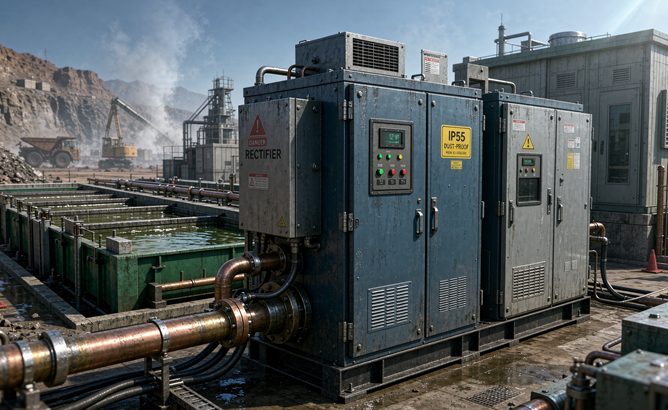
A rectifier on a mine site loses three ways before it ever carries current. Seal it against dust and the box runs 20 to 30 °C hotter inside. Put it at 3,600 m and the air that cools it is about 70% as dense as at sea level, so the current you actually get is roughly 74% of the nameplate. Then make the site a twelve-hour drive from the nearest spare part, and one unplanned outage on a 50 kt/yr copper line can cost more than half a million dollars in delayed metal. Design for those three together, or the plant will pay for each one separately.
Numbers worth quoting
Every figure below has a stated source or a stated assumption. Argue with the assumption if you like; that is better than guessing at a site.
- Air density at 3,000 m is 74% of sea level and at 4,000 m is 67%. Less air means less convective cooling for the same load.
- A totally sealed enclosure with heat-generating equipment inside can run 20 to 30 °C above ambient without forced circulation.
- Current derating for power modules is commonly 1% per 100 m above 1,000 m. A 10 kA unit gives about 7,400 A at 3,600 m and 7,000 A at 4,000 m.
- IEC 60076-11:2018 clause 10.3 reduces the permitted winding temperature rise by 0.5% per 100 m for natural air cooling and 1% per 100 m for forced air above 1,000 m. That is a temperature-rise limit, not a current rating.
- IEEE C57.96 gives a different number: 0.3% per 100 m for self-cooled and 0.5% per 100 m for forced-air dry-type units. IEEE C57.12.00 uses a dielectric correction factor of 0.80 at 3,000 m and 0.67 at 4,500 m. These three standards are not describing the same thing.
- At copper near $10,000 to $13,400 per tonne, a 50 kt/yr SX-EW line produces about 152 tonnes a day, or roughly $505,000 to $677,000 of metal per eight-hour shift.
- A 12-pulse rectifier cuts ideal current THD from about 31.1% to 15.2%; a 24-pulse unit reaches 7.6%. Pulse count is still a power-quality decision, but on a weak remote grid it is also an availability decision.
The site is part of the circuit
What electrowinning actually demands
Electrowinning is a low-voltage, high-current job. A copper cell sits near 2.0 V, zinc a little higher, and the line current is measured in tens of thousands of amps. Cells connect in series to build bus voltage, and the rectifier pushes a steady current through them while the operator controls current density at the cathode. This part is well covered elsewhere, so this article takes it as read. The question here is different: what happens to that rectifier once you bolt it to a concrete pad on a windy ridge at altitude, three hours from a technician?
Three penalties that multiply
The three site factors are usually specified on three different drawing sets. Dust goes to the enclosure vendor. Altitude goes to the transformer vendor. Remote operation goes to the controls vendor. Nobody adds them together, which is the problem, because they interact.
Dust pushes you toward a sealed box. A sealed box traps heat. Altitude removes part of the cooling capacity you were counting on to deal with that heat. Heat shortens the life of semiconductors, capacitors and insulation, and it drives derating that quietly reduces the current you can actually deliver. Remote location turns every one of those accelerations into an expensive visit. The effects compound rather than add.
An illustrative combined case at 3,600 m makes the point. Sea-level air is assigned cooling capacity 1.00; at 3,600 m it is about 0.70. Add a sealed enclosure that contributes 25 °C of internal rise, and that same 25 °C consumes about 36 °C worth of sea-level cooling headroom. You have lost roughly 30% of your heat-removal capacity and, depending on which derating rule you apply, 20 to 26% of your current. A nameplate 10 kA circuit may be a 7.4 kA circuit on that pad.
Altitude: four numbers that are not the same number
The four metrics
This is the single most common source of bad RFQs. Buyers see “1% per 100 m” in one datasheet, “0.5% per 100 m” in a standard, and a dielectric correction of 0.80 in a third document, and assume somebody is wrong. Usually everybody is right, because they are measuring different things.
| Metric | Source | Rule above 1,000 m | At 3,600 m | What it actually controls |
|---|---|---|---|---|
| Module output current | Common power-module datasheets | Derate 1% per 100 m | about 74% of rating | How many amps the semiconductor bridge will deliver continuously |
| Winding temperature rise, natural air | IEC 60076-11:2018 cl. 10.3 | Reduce permitted rise 0.5% per 100 m | about 87% of sea-level limit | The thermal limit the transformer must be tested against |
| Winding temperature rise, forced air | IEC 60076-11:2018 cl. 10.3 | Reduce permitted rise 1% per 100 m | about 74% of sea-level limit | Same, with fans running |
| Dry-type load current | IEEE C57.96 | 0.3% per 100 m self-cooled, 0.5% forced air | about 92% / 87% of rating | A conservative planning derate for dry-type windings |
| Dielectric strength | IEEE C57.12.00 correction table | Factor 0.80 at 3,000 m, 0.75 at 4,000 m | about 0.77 | External clearances and bushing withstand, not cooling |
Two useful rules follow. First, write down which metric a number belongs to before you put it in a specification. Second, check whether the vendor’s “high-altitude design” addresses cooling, insulation, or both. A unit with oversized bushings and unchanged cooling will survive a flashover test and still run hot.
Why the dielectric side matters more than people expect
Lower air density breaks down at a lower voltage. Internal insulation in an oil-filled transformer does not care, because oil and paper are sealed from the atmosphere. External insulation does: bushings, terminations, air clearances and cable boxes all depend on the surrounding air. A design that passes a lightning-impulse test at sea level can flash over at altitude unless clearances are increased.
For a rectifier system this shows up at the medium-voltage incoming line and at any dry-type transformer in the skid. Ask for the altitude-corrected clearances and the test altitude on the type-test report, not just a statement that the unit is “suitable for 4,000 m.” If the report was written at 1,000 m and the site is at 3,600 m, you have a document, not evidence.
Cooling is the harder half
Natural convection falls off a cliff
At 2,000 m the air is about 82% as dense as at sea level; at 3,000 m it is 74%; at 4,000 m it is 67%. Fan power cannot fully buy this back, because a fan moves the same volume of thinner air carrying fewer molecules. What helps is more surface area, shorter heat paths, forced air with real static-pressure margin, or moving the heat into water.
The closed-box tax
A ventilated enclosure can be filtered. A sealed enclosure cannot, and that is exactly why the internal temperature climbs. Technical guidance for IP55 enclosures puts the rise at 20 to 30 °C above ambient when internal equipment is dissipating heat and there is no forced circulation. On a 45 °C mine-site afternoon, 25 °C of internal rise puts you at 70 °C inside the box before the rectifier has added its own losses.
One practical consequence: specify the ambient temperature at the enclosure, not at the weather station. A black cabinet in direct sun is not at air temperature. Sunshades, light-coloured finishes and insulation buy real capacity here, and they cost far less than the next size up of rectifier.
When water cooling wins
At high current and high altitude, water cooling stops being a luxury. Removing heat through a liquid loop decouples the semiconductor losses from ambient air density. The trade is real: you are adding pumps, a heat exchanger, water treatment and a leak path to a remote site. Neeltran, for example, offers deionized-water-to-air and deionized-water-to-water systems alongside oil-cooled transformers, and Dynapower offers both thyristor and IGBT topologies with cooling chosen to suit the site. The right answer is site-specific, not a default.
Dust: IP ratings, filtered air, and the trap in “more is better”
Read the two digits properly
In IEC 60529 the first digit is solids and the second is water. IP55 is dust-protected, meaning some dust may enter but not enough to interfere with operation, plus low-pressure jets from any direction. IP65 is dust-tight with the same water protection. IP66 adds powerful jets, IP67 temporary immersion, IP68 continuous immersion under stated conditions.
For a high-current rectifier in a dry, dusty mine environment, IP6x is often the wrong target. Dust-tight usually means a sealed box, and on a hot high-altitude site the sealed box is what kills you thermally. IP54 or IP55 with filtered, positive-pressure ventilation is frequently the better engineering answer, provided the filters are accessible and the fan system has enough static-pressure margin to keep the cabinet slightly above ambient pressure.
What actually stops dust from ruining the electronics
Three failure paths matter in practice.
Conductive dust on windings and boards. Fine mineral dust plus humidity makes a conductive layer. On dry-type transformers this can lead to partial discharge and tracking, which is why filtered air inlets are specified on forced-cooled units in corrosive or dusty plants. On control boards, conformal coating is the standard defence against condensation and contamination.
Abrasion in fans and louvers. Dust is not just an insulation problem; it grinds. Fan life on an unfiltered high-altitude cabinet can be measured in months, and a failed fan on a derated rectifier is an immediate outage risk.
Cable entries and gaskets. Every cable gland is a potential ingress point. Bottom entry, removable gland plates with IP-rated fittings, continuous EPDM or silicone gaskets, and multi-point latches are the details that decide whether the IP rating on the drawing survives year two.
Corrosion is the silent partner
Mines are rarely only dusty. Salt spray on a coastal site, acid and alkali vapours in a processing plant, and sulphur compounds near smelters all change the enclosure choice. ISO 12944 C4 and C5 coating systems, 316 stainless fasteners in severe environments, and sealed junction boxes belong in the specification when the air is corrosive. A powder-coated mild-steel cabinet that is fine inland can be a write-off in two years at a coastal concentrator.
Remote: availability is the product
The cost of one outage
Take a 50 kt/yr copper SX-EW line running 330 days a year. That is about 152 tonnes a day. At $10,000 per tonne an eight-hour outage delays roughly $505,000 of production; at $13,400 per tonne, about $677,000. This is delayed throughput, not a book loss, but the cash-timing and contract consequences are real, and they repeat every time the rectifier trips.
Now compare that with the cost of redundancy. Adding an N+1 module or a second rectifier circuit costs a fraction of one avoided outage on a line this size. This is the honest reason to specify redundancy at a remote site: not because the brochure says “reliable,” but because the arithmetic says a spare is cheap next to a callout.
Remote monitoring that earns its keep
Remote monitoring is worth paying for only if it changes an outcome. A PLC modem that streams current, voltage, transformer temperature and harmonic alarms to the control room can catch a rising thermal trend before it becomes a trip. Dynapower, for instance, pairs 24/7 telephone support with preventative-maintenance programmes, spare-parts packages, operator training and field service. That package is an availability contract, not a feature list.
Specify what is monitored, at what interval, and what happens with the data. Ask for:
- DC current and voltage per circuit, with a stable constant-current loop even during upstream voltage dips.
- Winding and semiconductor temperatures, with alarms and trip interlocks.
- Fan status, filter differential pressure, and coolant flow and temperature on water-cooled units.
- Harmonic and power-factor readings at the incoming line, because a weak grid and a rectifier interact.
- A communication protocol the site already uses, typically Modbus RTU or TCP, IEC 61850 on larger substations, or a vendor protocol with a documented gateway.
The weak-grid problem nobody puts in the datasheet
Remote mines are often at the end of a long line or running on diesel during transitions. Voltage sags, brownouts and frequency excursions are normal, not exceptional. Rectifier modules specified for these sites advertise an 85 to 305 VAC input range and 45 to 65 Hz tolerance so they stay up through generator changeovers. A high-current electrowinning rectifier will not have the same input span, but the design question is identical: what does the constant-current loop do when the incoming voltage moves?
Ask the vendor for the ride-through and recovery behaviour, not just the steady-state accuracy. A control system that holds current through a sag and comes back without an operator reset is worth more on a remote site than a tenth of a percentage point of accuracy. Harmonic filters and power-factor correction also matter more here, because a weak system has a lower short-circuit ratio and the same 6-pulse current distortion produces a bigger voltage distortion.
Worked case: a 10 kA circuit at 3,600 m
This is an illustration with the assumptions written down, not a quotation.
Site and load: copper electrowinning, one 10 kA nominal circuit, 3,600 m elevation, 45 °C maximum ambient, mineral dust, weak incoming grid, 12-hour drive to the nearest service centre.
Step 1, current. Module derating of 1% per 100 m above 1,000 m gives 26 steps, or 26%. Available continuous current is about 7,400 A. If the process needs 10 kA of cathode current, one nominal 10 kA circuit is no longer enough. You either buy the next frame size up, run two circuits, or accept the lower production rate. Deciding this at the RFQ stage is cheap; discovering it at commissioning is not.
Step 2, transformer thermal limit. IEC 60076-11 natural-air reduction of 0.5% per 100 m gives 13% off the permitted rise. A class F unit with a 100 K limit is tested against roughly 87 K at this altitude. Forced air would use the 1% rule, so the same unit on fans faces about 74 K. That is why high-altitude projects so often end up with forced air or a larger frame.
Step 3, enclosure. A sealed IP55 cabinet in 45 °C ambient, plus 25 °C internal rise, is a 70 °C internal environment before accounting for the rectifier’s own losses.Thin air at 3,600 m carries about 70% of the sea-level heat. Either move to filtered positive-pressure ventilation with a correctly sized fan system, or go to a liquid-cooled stack and a heat exchanger sized for 45 °C ambient.
Step 4, insulation. IEEE C57.12.00 dielectric correction near 3,600 m is about 0.77, so external withstand at sea-level test values must be upgraded or clearances increased. Get the altitude correction in writing on the drawings.
Step 5, availability. An 8-hour outage on the associated 50 kt/yr line delays roughly $606,000 of metal at $12,000/t. N+1 redundancy, a remote temperature and harmonic alarm set, and a site spare-parts kit are justified by that single number. Nothing else in the business case needs to be argued.
The point: a 10 kA nameplate at 3,600 m is not a 10 kA asset. Anyone who quotes it as one is quoting a sea-level machine for a mountain pad.
Where buyers go wrong
Specifying nameplate amps without a site curve
Ask for the continuous-current derating curve against altitude, at the actual ambient, for the exact cooling configuration quoted. If a vendor cannot produce one, the nameplate is a marketing number at your site.
Treating IP65 as an upgrade
On a hot, high, dusty site, going from IP55 filtered ventilation to IP65 sealed may cost 20 to 30 °C of internal headroom and 20 to 30% of current. That is a downgrade dressed as an upgrade.
Buying pulse count before checking the grid
Twelve pulses reduce ideal THD from 31.1% to 15.2%, and 24 pulses reach 7.6%, but IEEE 519-2022 limits are applied at the point of common coupling to the whole installation, not to the rectifier nameplate. On a weak mine grid the short-circuit ratio may be low enough that even a 12-pulse unit needs filtering. Decide pulse count after a grid study, not before.
Forgetting the solids in “dust-proof”
The first IP digit covers solid particles. The second covers water. A buyer who says “dust-proof IP67” has specified temporary immersion and may have paid for a sealed box that overheats. Read the digits, then read the cooling.
Standards and documents that belong in the RFQ
| Standard | Applies to | Why it is on this list |
|---|---|---|
| IEC 60146 | Semiconductor converters | Basic requirements and type tests for industrial rectifiers |
| IEC 61378-1 | Converter transformers for industrial applications | The transformer half of a rectifier system, including phase-shift arrangements |
| IEC 60076-11:2018 | Dry-type transformers | Class 10.3 altitude correction of temperature-rise limits |
| IEEE C57.96 | Dry-type transformer loading | Conservative altitude load derating, distinct from IEC rise limits |
| IEEE C57.12.00 | Power transformers | Dielectric altitude correction factors and clearance basis |
| IEEE C57.18.10 | Semiconductor rectifier transformers | The North-American reference for rectifier-duty transformers |
| IEC 60529 | Enclosure IP ratings | The two-digit dust and water code |
| IEC 62262 | IK impact ratings | Useful where cabinets face rockfall, handling or vandalism |
| ISO 12944 | Protective coatings | C4 and C5 systems for corrosive mine atmospheres |
| IEEE 519-2022 | Harmonic control at the PCC | Sets the current and voltage distortion limits the site must meet |
| IEC 61850 / Modbus | Substation and device communication | How the rectifier reports temperature, current and alarms to the site |
Ask for the edition that applies in the buyer’s contract and confirm it before signing. Standards move, and an altitude correction quoted from an old edition can change the frame size.
How to write the inquiry so vendors can quote it
A short RFQ gets a brochure back. A complete one gets an engineered offer. Send these twelve lines:
- Metal and process: copper, zinc, nickel or cobalt, electrowinning or electrorefining.
- Required DC current and the allowable range, in kA, at the cathode.
- Number of cells in series and the resulting bus voltage.
- Site elevation in metres and the barometric range across the year.
- Maximum and minimum ambient temperature at the enclosure, plus solar exposure.
- Dust loading and composition, plus any salt, acid or sulphur exposure.
- Incoming grid voltage, frequency range, short-circuit ratio and generator changeover behaviour.
- Required pulse count or, better, the harmonic limit at the point of common coupling.
- Cooling preference and constraints: forced air, filtered ventilation, or deionized water.
- Enclosure rating and whether it is walk-in, plus the access route for spare parts.
- Redundancy requirement: single circuit, N+1 modules, or dual circuits.
- Monitoring needs: signals, protocol, alarm list and who receives the data.
If a supplier will not answer these in a table, you are comparing brochures, not offers.
Bringing it together
The rectifier that survives a mine site is not the one with the biggest nameplate or the highest IP number. It is the one whose current rating, thermal design, enclosure and monitoring were chosen together for one specific altitude, one ambient and one grid. Dust pushes you toward sealing, sealing pushes heat up, altitude takes away part of the cooling you needed, and distance turns every weakness into a truck dispatch. Treat those as one engineering problem and the numbers work. Treat them as four separate purchases and the plant pays for the mismatch, usually at 3,600 m on a Sunday.
Send us your site data using the twelve lines above and we will return the derating curve, the enclosure heat balance and the redundancy case we would quote for your pad. If you want a second opinion before you issue the RFQ, our engineers will tell you which three numbers in your spec we would challenge first.
FAQ
How much does altitude derate an electrowinning rectifier? For power modules the common rule is 1% of current per 100 m above 1,000 m, so a 10 kA unit delivers about 8,000 A at 3,000 m and 7,000 A at 4,000 m. Dry-type transformer rules differ: IEC 60076-11 reduces the permitted temperature rise by 0.5% per 100 m for natural cooling and 1% for forced air, while IEEE C57.96 uses 0.3% and 0.5% load derating. Do not mix the metrics.
Is IP65 better than IP55 for a dusty mine? Not automatically. IP65 is dust-tight, but it usually means a sealed enclosure that can run 20 to 30 °C above ambient. On a hot, high-altitude site that heat costs more current than the extra dust protection gains. IP54 or IP55 with filtered positive-pressure ventilation is often the better choice.
Why does air density matter for cooling? Air density at 3,000 m is about 74% of sea level and at 4,000 m about 67%. Convection moves fewer heat-carrying molecules, so the same load runs hotter. Fans help but cannot fully restore sea-level capacity.
What is the dielectric correction at 3,500 m? IEEE C57.12.00 gives a correction factor of roughly 0.77 around 3,600 m and 0.75 at 4,000 m. External clearances and bushings must be selected for the correction, since air insulates less well at altitude.
How much does one outage cost on a copper electrowinning line? A 50 kt/yr line running 330 days produces about 152 tonnes a day. At $12,000 per tonne, an eight-hour outage delays roughly $606,000 of production. That is why N+1 redundancy and remote alarms are usually the cheapest insurance on a remote site.
Do 12-pulse rectifiers help on a weak mine grid? They reduce ideal current distortion from about 31.1% to 15.2%, which eases the burden on the grid. But IEEE 519-2022 limits apply at the point of common coupling for the whole installation, so a grid study is still required. A weak system may need filtering as well.
What should a high-altitude RFQ include? Site elevation, ambient at the enclosure, dust and corrosive exposure, incoming grid short-circuit ratio, required DC current with its derating curve, cooling configuration, enclosure rating, redundancy and monitoring protocol. Without these, a quote is a catalogue number.
How do I keep dust out without cooking the rectifier? Use filtered positive-pressure ventilation with accessible filters and fan capacity sized for the altitude, keep cable entries sealed and bottom-fed, coat control boards, and keep the enclosure out of direct sun. If the heat balance still fails, move to a liquid-cooled stack.
Which standards prove a rectifier is built for altitude? IEC 60146 and IEC 61378-1 for the converter and transformer, IEC 60076-11 clause 10.3 for temperature-rise correction, IEEE C57.12.00 for dielectric correction, IEC 60529 for the IP code and ISO 12944 for coatings. Ask for the type-test report at the actual test altitude.
What is the most common specification mistake? Buying nameplate amps without asking for the continuous-current derating curve at the real altitude and ambient. A 10 kA nameplate at 3,600 m is roughly a 7.4 kA asset under the common module rule.